Quantum computers have been stuck in the same problem for years: building one qubit is hard. Building a thousand qubits that actually work together is exponentially harder. Researchers at Delft University in the Netherlands just showed it might be possible.
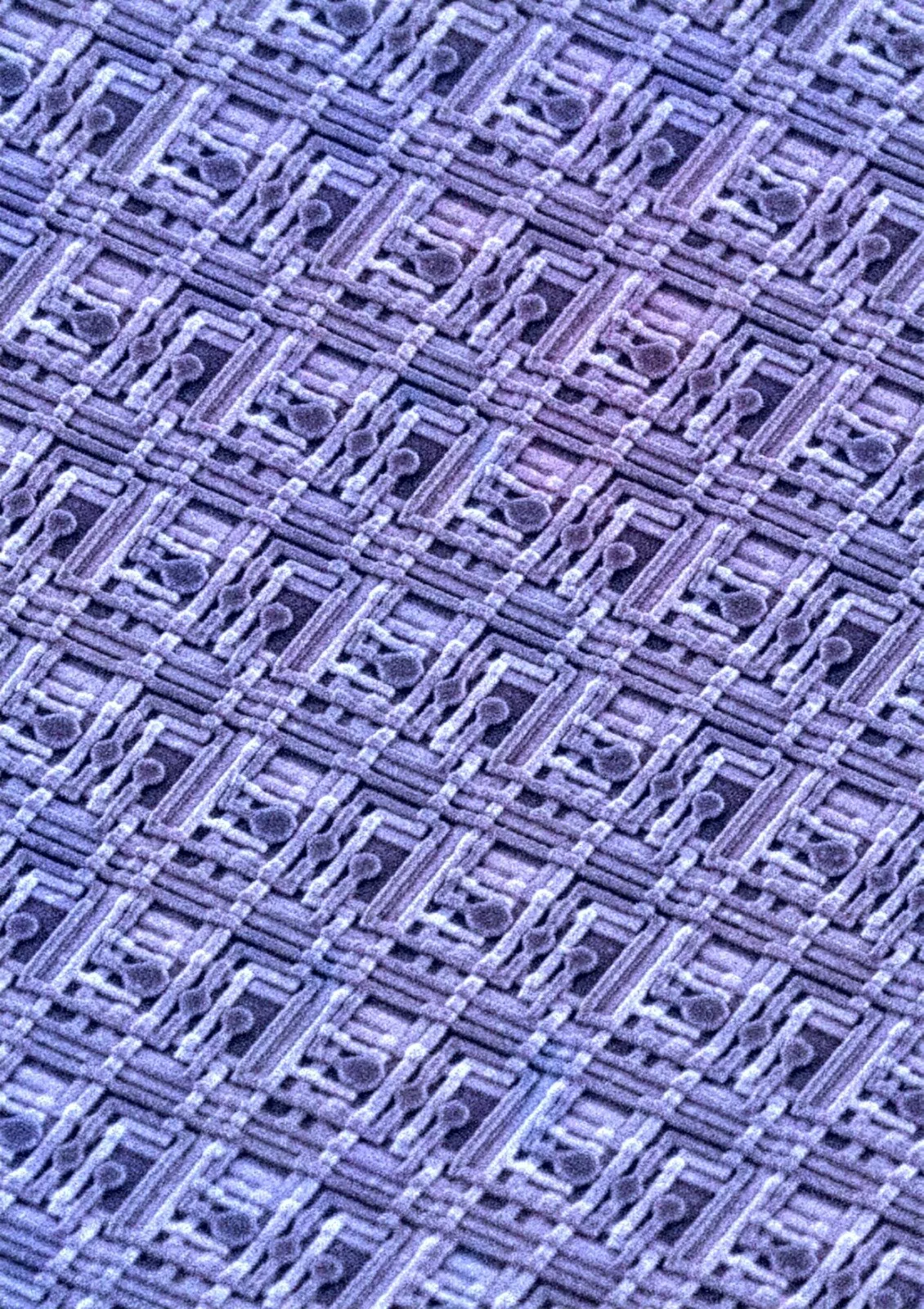
They've created a chip called QARPET—basically a testing ground for quantum processors made from semiconductor spin qubits. When you look at it under a microscope, it looks almost woven, with thousands of crossing electrodes packed so densely that it pushed the limits of what nanofabrication can do. But when the team cooled it to millikelvin temperatures (colder than outer space), it worked.
Building Quantum Processors Like Computer Memory
The key insight is deceptively simple: instead of building and testing each qubit individually, the researchers created a grid of repeating tiles. Each tile holds two spin qubits and one charge sensor—a self-contained unit that can be measured on its own. These tiles connect in a crossbar layout, the same architecture used in your computer's memory chips.
We're a new kind of news feed.
Regular news is designed to drain you. We're a non-profit built to restore you. Every story we publish is scored for impact, progress, and hope.
Start Your News DetoxWhat makes this elegant is the scaling problem it solves. In most quantum chip designs, adding more qubits means adding exponentially more wiring and control electronics. QARPET uses a shared control system—rows and columns of tiles share the same control lines, like a spreadsheet. The first demonstration chip has 529 tiles (23 by 23) and could theoretically hold up to 1,058 qubits, yet it only needs 53 control lines. That's the kind of efficiency that actually makes scaling feasible.

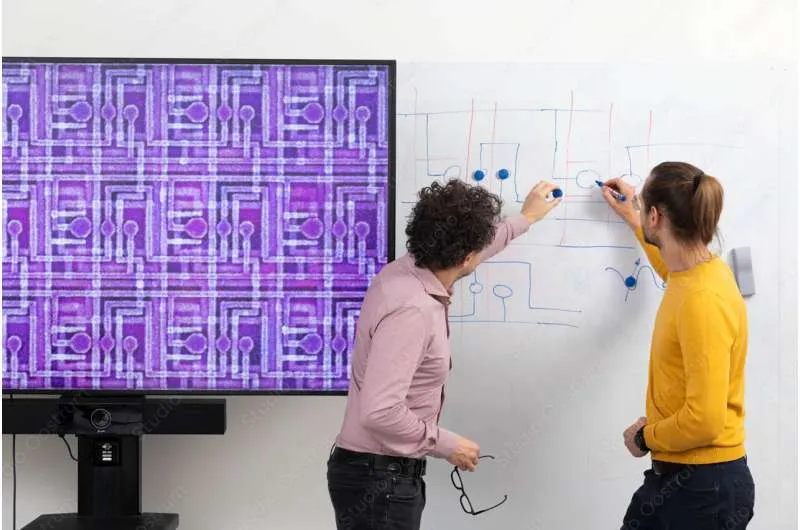
Delft scientists Tosato and Scappucci demonstrate the principles of the QARPET (Qubit-Array Research Platform for Engineering and Testing) platform using simple tape. Credit: QuTech—Delft University of Technology / Studio Oostrum
The team tested 40 tiles on the chip and found something crucial: nearly all of them could be individually addressed and tuned independently. They extracted key measurements—threshold voltages, charge noise levels, how consistently the qubits formed—and discovered a high degree of consistency across the array. Yes, there were small variations (inevitable given the complexity of the fabrication), but nothing that undermined the design. They even proved the qubits could actually function as intended within this architecture.
These statistical insights matter because they show that the problems plaguing quantum devices aren't insurmountable. They're measurable. They're improvable. When you can test hundreds of qubits in a single experiment, you start seeing patterns. You learn what material impurities cause problems. You understand which fabrication steps are most sensitive. That's how you build reliable systems.
Because QARPET works with standard semiconductor fabrication techniques, it can be adapted to different qubit types—silicon-based qubits, for instance, which many companies prefer. The design also opens the door to machine learning-assisted tuning, where algorithms automatically optimize qubit properties instead of humans manually adjusting thousands of settings.
"Given the complexity and density of this chip, demonstrating that it actually works is an important milestone," says Giordano Scappucci, the lead researcher. "It shows that we can already build and study the kind of large qubit arrays that future quantum processors will rely on."
That's the real progress here. Not a breakthrough in qubit performance itself, but proof that you can build the infrastructure to test them at scale. Quantum computing has always been a two-front problem: making qubits work, and making lots of them work together. QARPET doesn't solve either problem completely, but it gives you the testing ground to solve both.