Remember when music lived on actual tapes? Turns out, scientists are asking if our old friend, sticky tape, could actually store information.
Because apparently, the future of computing might look less like a microchip and more like something you'd wrap a present with. Nathan Keim, a physics professor at Penn State, points out that there's a growing appetite for devices that don't need electricity and aren't quite so fragile as your average computer.
The Sticky Science of Memory
Keim and his team dove into the surprisingly complex world of mechanical imprints. Their big question: Could partially peeling and reapplying everyday adhesive tape store information? Basically, could Scotch tape become a "memory material"?
We're a new kind of news feed.
Regular news is designed to drain you. We're a non-profit built to restore you. Every story we publish is scored for impact, progress, and hope.
Start Your News DetoxMemory materials aren't new. Vanadium dioxide, for example, can recall electrical currents, making it useful for data storage. Other materials shift shape or rigidity based on temperature or programming. But the team's goal was a system that could add new memories without wiping out the old ones.
Think of a combination lock. It remembers a sequence of turns using something called "return-point memory." Most of these systems, however, require alternating inputs – turn left, then right. If you reverse the steps, the memory often gets erased.
Keim's team wanted a system that could remember a series of events with just one-directional input. And lo and behold, ordinary adhesive tape delivered. It could store multiple memories, and even better, the strength of these memories could be adjusted and erased.
How Your Tape Recorder Works Now
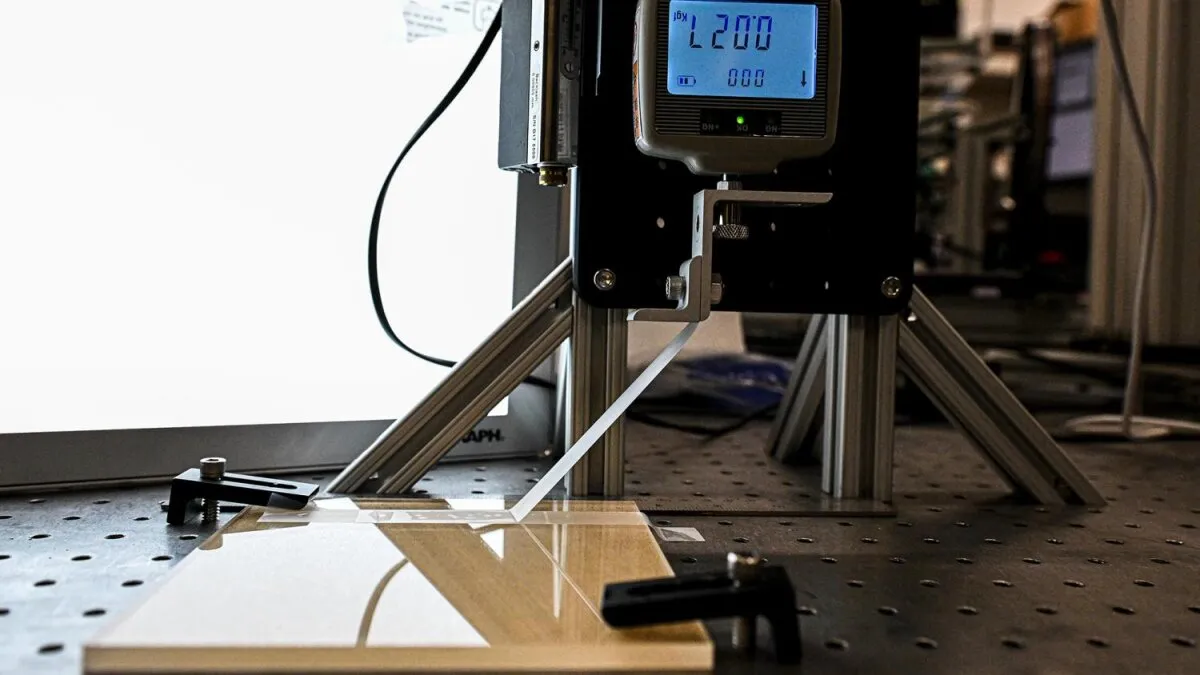
To prove it, the researchers built an automated device that peels and reapplies tape at precise distances. Lead author Sebanti Chattopadhyay explained that peeling the tape partway creates a strong adhesion line at the exact stopping point. This line, a 'memory,' stays put when the tape is laid back down. You can repeat this, creating multiple lines for multiple memories.
To retrieve these sticky secrets, the device peels the tape past the marked distances and measures the increased force needed at each line. It’s like a tiny, analog force-feedback system.
Chattopadhyay noted that peeling past the lines erases them, resetting the system. But they can also tweak the strength of these memories, meaning each line could represent different information. Some memories can even be made strong enough to survive a system reset. Because some things, you just can't unstick.
Keim highlights a crucial feature: the last information recorded is always the first retrieved. This allows for simple mechanical calculations, much like a "one-back comparison" test in neuroscience where you compare a new stimulus to the one just before it. Because the newest memory is always on top, it's immediately ready for comparison.
This Penn State research won't necessarily lead to your next hard drive being a giant roll of Scotch tape. But understanding how something so mundane can store and process information mechanically could be the sticky beginning of a whole new class of electricity-free devices. Which, if you think about it, is both impressive and slightly terrifying.