Imagine trying to photograph a ghost, but that ghost is 3 million light-years long and fuels entire galaxies. That's essentially what astronomers just pulled off. They've captured the sharpest direct image yet of a cosmic filament – one of the universe's vast, glowing, gas-filled superhighways.
This isn't just a pretty picture; it's a direct look at the cosmic web, the invisible scaffolding that holds the universe together. It's how galaxies get their gas fix, which then sparks the birth of new stars. Think of it as the universe's very own galactic plumbing system, and we just got our first good peek at a pipe.
The Universe's Invisible Infrastructure
Most of the universe is made of dark matter, the mysterious stuff that doesn't interact with light. But this dark matter isn't just floating around randomly; it forms a colossal, web-like structure with long, invisible filaments. Galaxies, those bright, shiny things, tend to cluster where these filaments intersect, like cities at major highway interchanges.
We're a new kind of news feed.
Regular news is designed to drain you. We're a non-profit built to restore you. Every story we publish is scored for impact, progress, and hope.
Start Your News DetoxScientists have long theorized these filaments act as cosmic conduits, funneling gas into galaxies. That gas is the essential ingredient for star formation. The problem? This intergalactic gas is incredibly diffuse and gives off a glow so faint it's practically a whisper in the cosmic void. Detecting it directly has been nearly impossible.
Enter the Multi-Unit Spectroscopic Explorer (MUSE), a seriously powerful instrument attached to the European Southern Observatory's Very Large Telescope in Chile. Even with MUSE, this wasn't a quick selfie. Researchers from the University of Milano-Bicocca and the Max Planck Institute for Astrophysics (MPA) spent hundreds of hours staring into the abyss, collecting enough data to finally make this elusive filament visible.
Led by PhD student Davide Tornotti, the team managed to produce an image of a filament stretching approximately 3 million light-years, linking two galaxies, each sporting an active supermassive black hole. Which, if you think about it, is both impressive and slightly terrifying.
A 12-Billion-Year-Old Road Trip
The light from this particular filament has been traveling for almost 12 billion years to reach us. Let that number sink in. By capturing its faint glow, the team could precisely map its shape and, for the very first time, directly measure the boundary between the gas inside galaxies and the gas in the cosmic web.
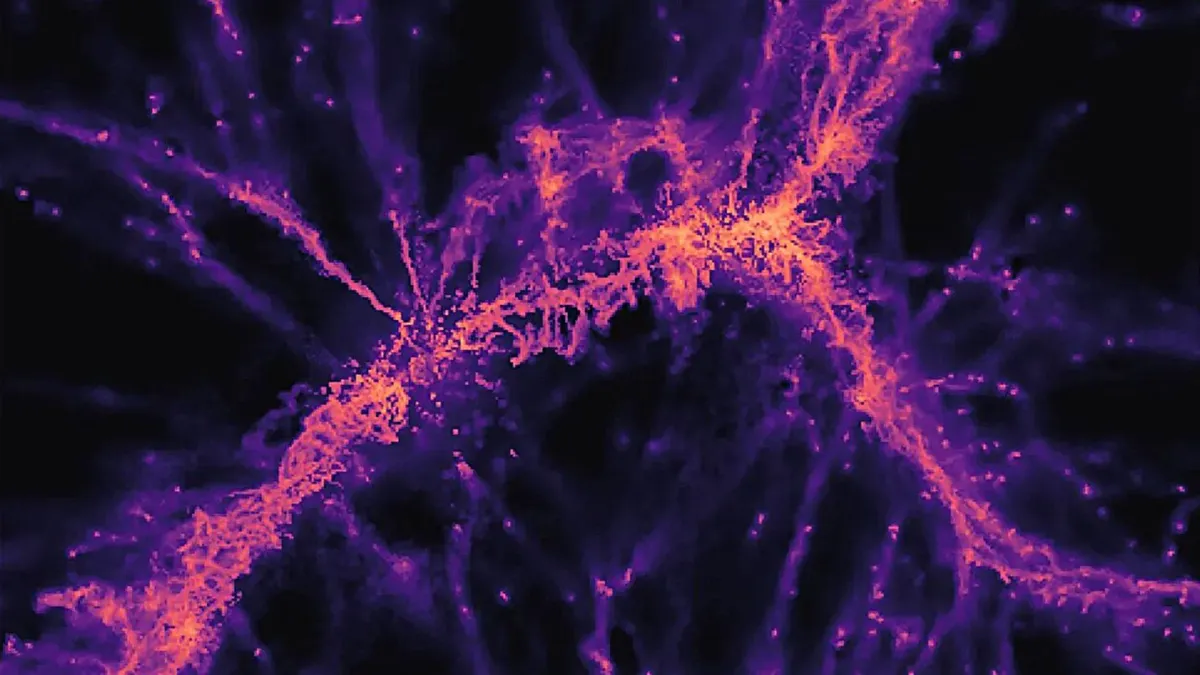
To make sure they weren't just seeing things, the researchers cross-referenced their observations with supercomputer simulations from MPA. These simulations predict what such filamentary structures should look like. The good news? The new high-definition image largely matches current theories. It's always nice when the universe cooperates with your spreadsheets.
This strong agreement isn't just a pat on the back for scientists; it builds confidence in our understanding of how gas is distributed around galaxies and how they get the raw materials to keep cranking out stars. Now, the plan is to find more of these faint structures. Because, as MPA staff scientist Fabrizio Arrigoni Battaia notes, one observation isn't enough. The universe is a big place, and they've got a lot more cosmic highways to map.