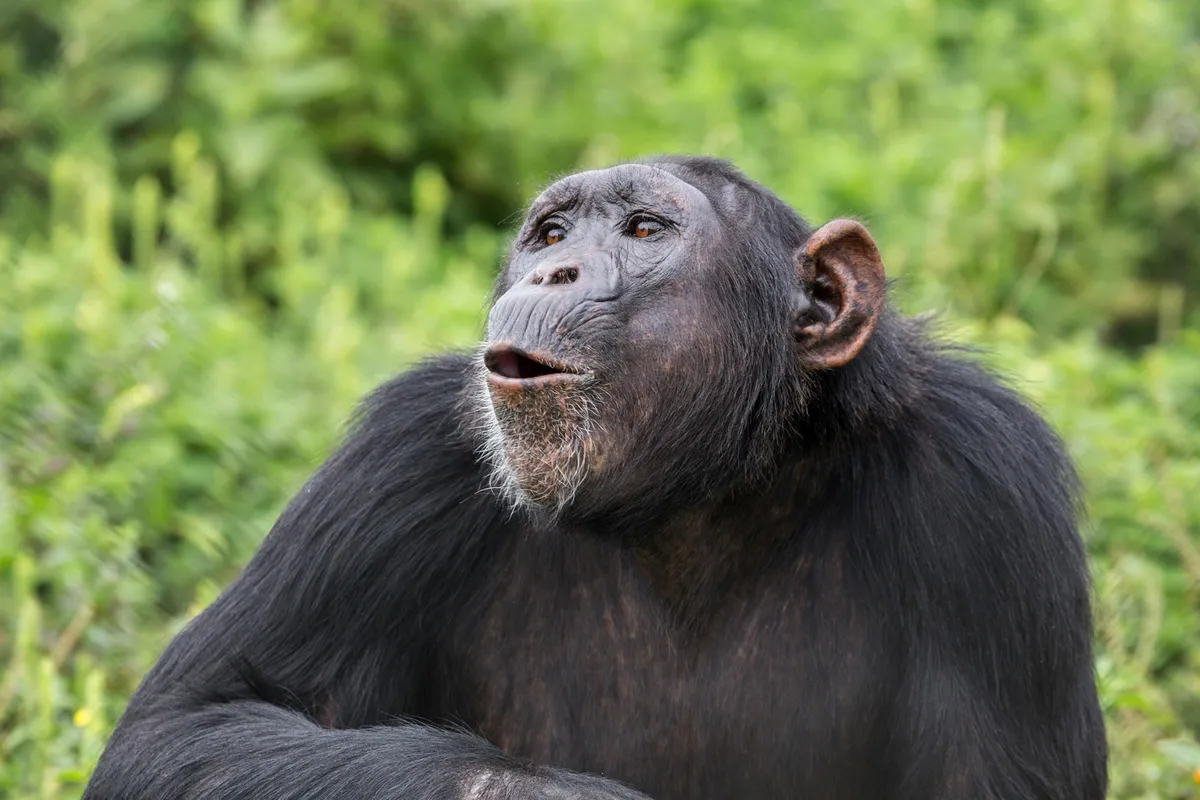
Your brain does something odd when it hears a chimpanzee vocalize. A specific region of your auditory cortex — the part that handles language, music, and emotion — lights up in response. Not to every primate sound, but distinctly to chimpanzees. Researchers at the University of Geneva discovered this by scanning the brains of 23 people listening to calls from four different species, and what they found rewrites part of our understanding of how human communication evolved.
The question driving this research is deceptively simple: Did our ability to recognize and process voices develop recently, or does it reach back millions of years into our shared primate past? To answer it, Leonardo Ceravolo and his team at UNIGE's Faculty of Psychology and Educational Sciences took an evolutionary approach. They compared how the human brain responds to vocalizations from species at different distances on our family tree — chimpanzees and bonobos (our closest relatives), macaques (more distant), and human voices (the control).
The Brain's Selective Hearing
The findings, published in eLife, revealed something precise: a region called the anterior superior temporal gyrus responded distinctly to chimpanzee calls, but not equally to all primates. This matters because bonobos are genetically just as close to us as chimpanzees are. Yet their vocalizations, which structurally resemble birdsong more than chimpanzee grunts and screams, triggered a noticeably different response. The pattern suggests that the human brain's sensitivity to primate calls isn't simply about genetic relatedness — it's about acoustic similarity too.
We're a new kind of news feed.
Regular news is designed to drain you. We're a non-profit built to restore you. Every story we publish is scored for impact, progress, and hope.
Start Your News DetoxCeravolo explains the significance: "We already knew that certain areas of the animal brain reacted specifically to the voices of their fellow creatures. But here, we show that a region of the adult human brain is also sensitive to non-human vocalizations." This implies that over millions of years, humans retained the ability to process calls from closely related species, even as our own communication system evolved into language.
What makes this discovery compelling is what it suggests about our origins. The neural architecture for recognizing and processing voices didn't appear when humans invented grammar or developed spoken language. It was already there, inherited from ancestors we shared with other great apes. The research hints that this foundational ability — recognizing a familiar voice, processing emotional tone, distinguishing one individual from another — may have existed long before words did.
There's a practical implication too. Understanding how these ancient voice-processing circuits work could illuminate how infants develop the ability to recognize familiar voices, even before birth. The same neural systems that let your brain pick out a chimpanzee's alarm call may be what lets a newborn recognize their mother's voice in a room full of sound.
The next step is mapping exactly how this sensitivity develops early in human life, and whether it shapes how we learn language.