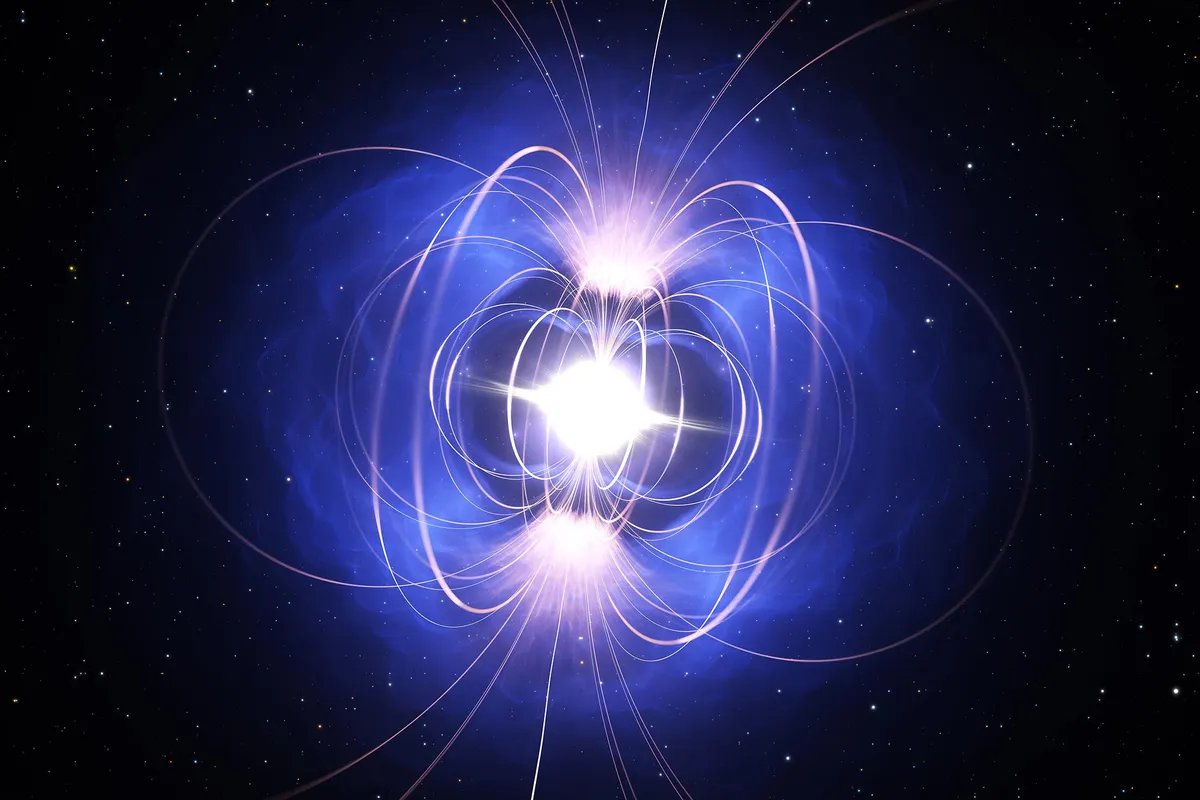
Galaxies can develop strong magnetic fields surprisingly fast. This happens because of collapsing plasma and turbulent flows.
Scientists used to think it took billions of years for galaxies to form organized magnetic fields. But observations show that real galaxies develop them much quicker.
Collapsing Plasma Speeds Up Magnetic Fields
A new study in Physical Review Letters offers an explanation. Researchers suggest that as plasma clouds collapse during galaxy formation, they quickly boost the growth of magnetic fields.
We're a new kind of news feed.
Regular news is designed to drain you. We're a non-profit built to restore you. Every story we publish is scored for impact, progress, and hope.
Start Your News DetoxMost visible matter in the universe is plasma. Plasma reacts to forces like gravity, temperature, and rotation. These forces can create turbulence. When there's turbulence, a process called dynamo theory says that existing magnetic fields get stronger. This theory helps explain how cosmic magnetic fields form.
Pallavi, an assistant professor at the International Centre for Theoretical Sciences (ICTS) and a co-author, noted that dynamo theory has limits. It struggles to explain strong magnetic fields seen in young galaxies that stretch thousands of light-years.
Gravity's Role in Early Galaxy Formation
The study looks at how dynamo processes might work differently when galaxies are first forming. It focuses on a collapsing cloud of ionized gas, which is a key step in building galaxies.
Irshad, a graduate student at ICTS and the lead author, explained that gravity itself can stir the plasma when a galaxy is forming. This stirring can make magnetic fields stronger.
Using mathematical methods, the researchers showed that this gravity-driven motion can speed up how magnetic fields develop. Their findings suggest these fields could form much earlier than thought before.
This effect is linked to changes in turbulent motion during the collapse. Turbulence creates swirling patterns, like eddies in water. The speed at which magnetic fields grow depends on how fast these eddies rotate.
As the cloud shrinks, the eddy rotation speeds up. The team found this leads to "super exponential" growth in magnetic strength. This could explain the strong magnetic fields in young galaxies. Their results also show these fields can become stronger than standard dynamo theory predicts.
Mathematical Tools and Future Work
The researchers used a mathematical method called "supercomoving coordinates" for their analysis. This method helps account for the universe's expansion.
Irshad said these coordinates make the equations for a collapsing galaxy similar to a static one, simplifying calculations. This works well for a uniformly collapsing sphere, but more realistic cases need further study.
Even with these new insights, questions remain. Pallavi noted there's still much to learn about the timescale of these processes. Scientists are creating computer models to simulate how structures form in the universe. This study's predictions could help test and improve those models.
Magnetic forces are usually weaker than gravity in shaping cosmic structures. However, these findings suggest that strong, organized magnetic fields might have appeared earlier than expected. Over time, these fields could have subtly influenced the universe's evolution.
Deep Dive & References
Turbulent Dynamos in a Collapsing Cloud - Physical Review Letters, 2026