Get this: scientists might have just figured out a seriously clever way to find pairs of giant black holes we didn't even know were there. Think of them as cosmic stealth bombers, usually invisible.
Turns out, we might spot them by looking for super subtle, repeating flashes of starlight. These flashes come from stars way behind the black holes themselves. It's like the universe is winking at us.
How the Blinking Works
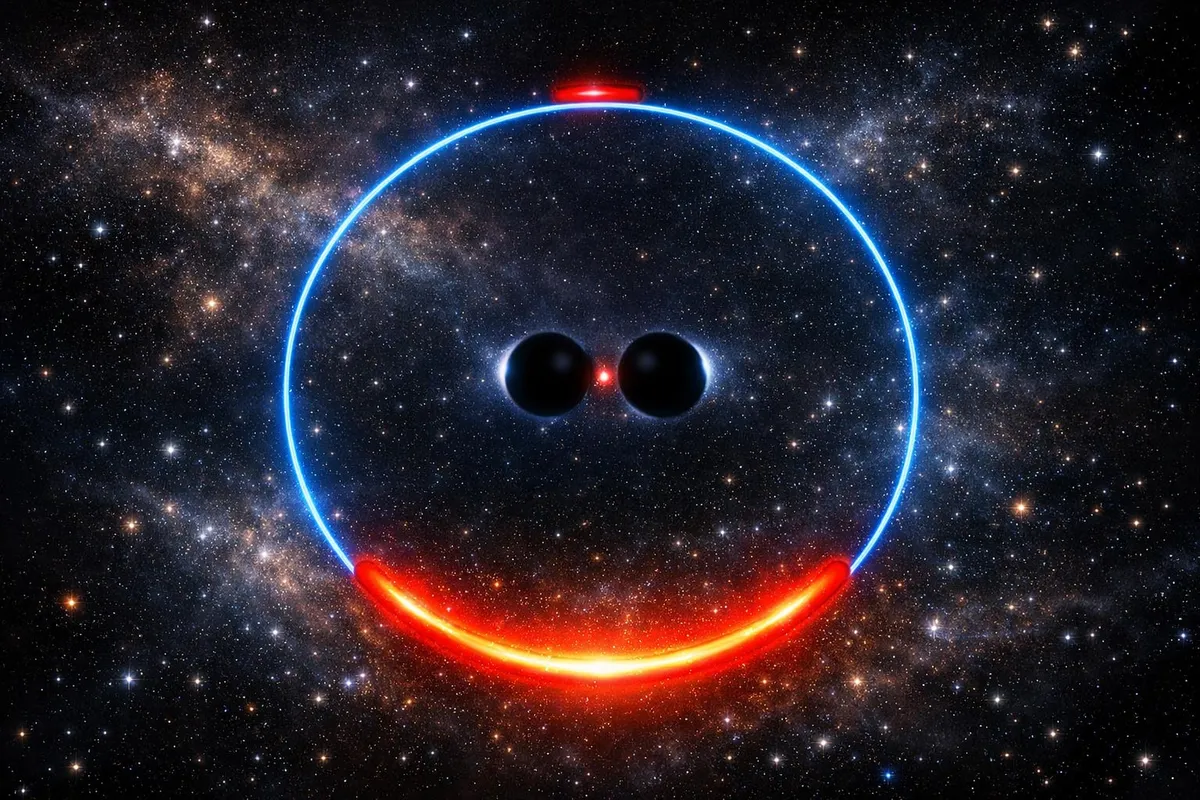
Here’s the trick: when two massive black holes orbit each other, their combined gravity acts like a giant, wobbly lens. It bends and brightens the light from any stars directly behind them. As the black holes dance around each other, this "lens" moves, making those background stars appear to flash on and off in a predictable rhythm.
We're a new kind of news feed.
Regular news is designed to drain you. We're a non-profit built to restore you. Every story we publish is scored for impact, progress, and hope.
Start Your News DetoxThese supermassive black holes are the giants at the heart of most galaxies, weighing millions or even billions of times more than our Sun. When galaxies collide, their central black holes eventually get pulled together, forming a duo. These pairs are a big deal because they sculpt galaxies and create huge ripples in space called gravitational waves.
Right now, we can only really see black holes that are pretty far apart. But this new method, dreamed up by researchers from Oxford University and the Max Planck Institute, could help us find those much closer pairs.
Normally, a single black hole only bends light dramatically if a star lines up perfectly. But two black holes working together create a special diamond-shaped zone where light gets super-magnified. As the black holes orbit, this zone sweeps across background stars. Each time it hits a bright star, blink—a flash appears.
What’s cool is that these flashes aren't random. They follow patterns. As the black holes spiral closer, the flashes change their timing and brightness. By studying these shifts, astronomers could actually figure out how big the black holes are and how fast their orbit is shrinking. Pretty nuts, right?
This is a big deal because it means we could find these black hole duos years before new detectors are even ready to pick up their gravitational waves. It’s like getting a sneak peek at the universe's most dramatic dance-off. Upcoming observatories, like the Vera C. Rubin Observatory, are expected to make spotting these cosmic blinks much easier, helping us unlock more secrets of the universe.