For decades, a bright star you can spot without a telescope has been blasting out wild amounts of X-rays, and no one knew why. Now, scientists have finally found the culprit: a tiny, hidden white dwarf star lurking nearby.
This isn't just a cool space story. It proves a whole new type of star system exists, one that scientists predicted but had never actually seen. Think of it like finding a secret room in an old mansion everyone thought they knew inside and out.
The Star That Wouldn't Quit
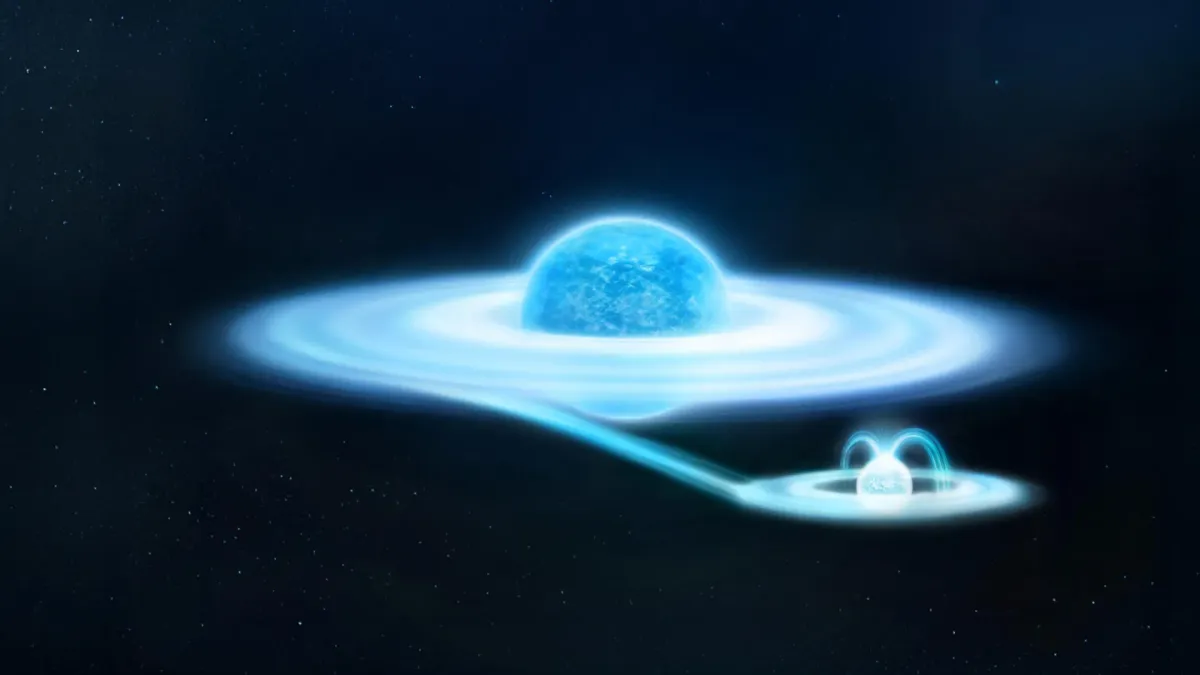
The star in question is Gamma Cassiopeiae, first noticed way back in 1866. It's a Be-type star, which means it spins super fast, flinging gas and dust into a swirling disk around itself.
We're a new kind of news feed.
Regular news is designed to drain you. We're a non-profit built to restore you. Every story we publish is scored for impact, progress, and hope.
Start Your News DetoxBut here's the kicker: in 1976, astronomers realized Gamma Cassiopeiae was spitting out X-rays about 40 times stronger than any other similar star. The gas making these X-rays was hotter than 100 million degrees! Over the next 20 years, they found about 20 more stars doing the same thing. They called them 'Gamma Cassiopeiae analogues.'
Scientists had a few guesses for the X-ray source. Maybe magnetic fields around the star? Or maybe a hidden companion star, like a white dwarf, was sucking up material and getting superheated? Earlier observations ruled out other big companion stars, leaving the white dwarf as the best bet.
Catching the Culprit
Enter Japan's XRISM space telescope. A team used its special Resolve instrument to watch the system over its entire 203-day orbit in late 2024 and early 2025. What they saw was seriously cool.
The data showed that the scorching hot gas creating the X-rays was actually changing speed. And that speed change perfectly matched the orbit of a white dwarf, not the main Be star. That's the first direct proof that the super-hot X-ray gas is coming from the white dwarf itself.
Even better, the measurements hinted that this white dwarf has its own magnetic field. If it didn't, the material falling onto it would create much wider X-ray signals. Instead, the magnetic field acts like a funnel, guiding the gas straight to its poles.
This discovery means Gamma Cassiopeiae and its X-ray-blasting friends are part of a previously unconfirmed club of binary star systems – a massive Be star paired with a magnetic white dwarf. This group accounts for about 10% of all massive Be stars out there.
It's a big deal because it means we might need to tweak our models for how binary stars evolve. And understanding these systems helps us grasp bigger cosmic events, like gravitational waves. As astronomer Yaël Nazé put it, solving this mystery just opened up a bunch of new questions for scientists to chase.