Scientists at Cambridge just watched electrons do something they shouldn't be able to do: cross from one material to another in 18 femtoseconds—that's 18 quadrillionths of a second. It's fast enough to challenge everything solar researchers thought they understood about how these systems work.
The discovery matters because solar cells, photodetectors, and devices that split water into hydrogen fuel all depend on one thing: separating electrons from the "holes" they leave behind when light hits them. The faster that separation happens, the less energy gets wasted as heat. Until now, scientists believed you had to choose: accept slow charge transfer or accept lower voltage and efficiency losses. Cambridge researchers just proved that trade-off might be unnecessary.
The Catapult Effect
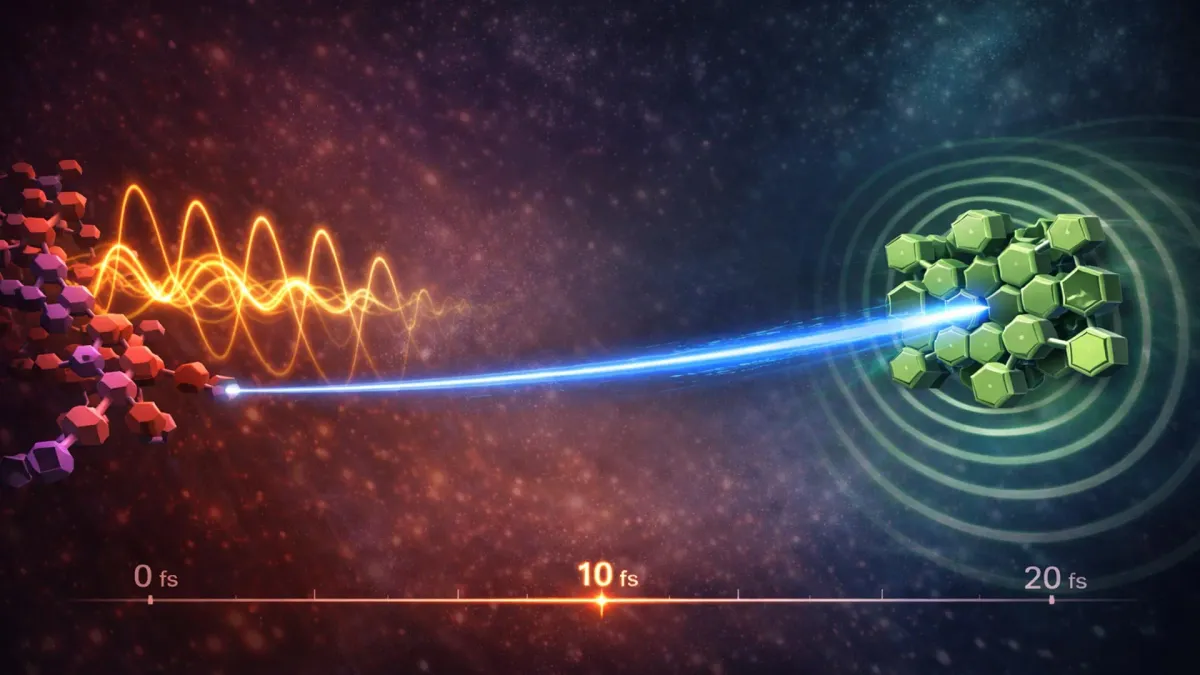
Dr. Pratyush Ghosh and his team deliberately designed what they expected to be a poorly performing system. They paired a polymer with a non-fullerene acceptor—materials with almost no energy difference between them and only weak interaction. By conventional theory, electrons should have drifted slowly and randomly across this interface. Instead, they launched in a coherent burst in 18 femtoseconds, matching the natural vibration rhythm of atoms themselves.
We're a new kind of news feed.
Regular news is designed to drain you. We're a non-profit built to restore you. Every story we publish is scored for impact, progress, and hope.
Start Your News Detox"Instead of drifting randomly, the electron is launched in one coherent burst," Ghosh explained. "The vibration acts like a molecular catapult."
The mechanism is elegant: when the polymer absorbs light, it vibrates in specific high-frequency patterns. These vibrations mix the electronic states and effectively push the electron across the boundary in a single, directed motion rather than slow diffusion. When the electron lands on the acceptor molecule, it triggers a distinctive coherent vibration—a signature so clear that it reveals exactly how fast and cleanly the transfer occurred.
This insight opens a fundamentally different design approach. For decades, materials scientists tried to suppress molecular motion, treating vibrations as noise that slowed things down. The Cambridge results suggest the opposite: you can engineer materials to use those vibrations as a feature, not a bug.
What This Means for Real Technology
Organic solar cells have always been hampered by the assumption that ultrafast charge separation required either very different energy levels between materials (which reduces voltage) or very strong electronic coupling (which has its own efficiency costs). If engineers can now design systems that exploit molecular vibrations instead, they have more freedom to optimize other properties—voltage, light absorption, stability.
The same principle applies beyond solar cells. Photodetectors, which convert light into electrical signals, could become faster and more sensitive. Photocatalytic systems that use sunlight to split water into hydrogen fuel could operate more efficiently. Even natural photosynthesis uses similar ultrafast charge separation, suggesting these vibration-driven mechanisms might be more widespread than anyone realized.
The research, published in Nature Communications in March 2026, involved collaborators across Europe and the United States. Professor Akshay Rao, co-author of the study, frames the shift clearly: "Instead of trying to suppress molecular motion, we can now design materials that use it—turning vibrations from a limitation into a tool."
The next phase will be translating this lab discovery into actual materials and devices. But the conceptual breakthrough is already significant: the speed of charge separation isn't determined only by static properties of materials. It depends on how those materials move.