Most solar panels waste more than half the sun's energy. Infrared light—the heat part of the spectrum—just passes through, unused. For scientists trying to split water into hydrogen fuel using only sunlight, that's a frustrating bottleneck. But a new class of materials called upconverters could change that by capturing the light we've been throwing away.
Upconversion materials work like a second chance for wasted photons. They absorb two or more low-energy infrared photons and combine them into a single higher-energy photon that hydrogen-producing catalysts can actually use. It's a bit like collecting loose change from the couch and turning it into a usable bill. A review in RSC Advances maps out how this emerging strategy could unlock 10–20% more efficiency in solar hydrogen systems—a gain that matters when you're trying to scale green fuel production.
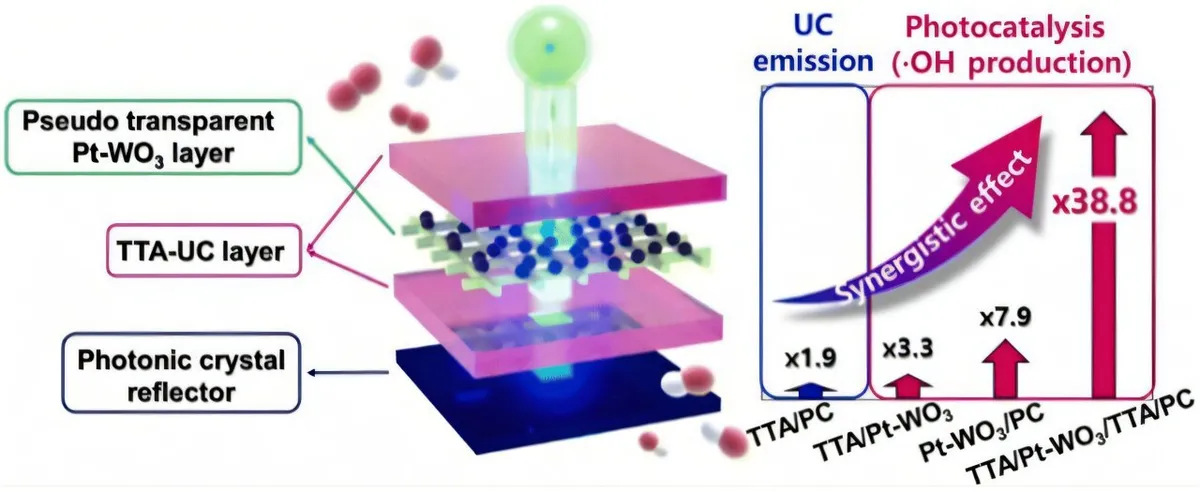
There are two main approaches, and interestingly, they work best together rather than in competition. The first uses lanthanide-doped materials—rare-earth compounds that excel at harvesting deep infrared wavelengths. They're chemically stable, which matters if your reactor needs to survive years of exposure to water and oxygen. The second approach, called triplet-triplet annihilation, uses molecular pairs that are more flexible and work efficiently even in weak sunlight. These could be tuned to target different parts of the spectrum depending on your location or season.
We're a new kind of news feed.
Regular news is designed to drain you. We're a non-profit built to restore you. Every story we publish is scored for impact, progress, and hope.
Start Your News DetoxWhat makes this genuinely promising is the practical angle. Engineers aren't theorizing about laboratory conditions—they're testing thin films, composite materials, and optical coupling setups that could actually fit into real photoelectrochemical reactors. The bottleneck isn't the concept anymore. It's engineering these materials to be cheap enough and durable enough to compete with conventional hydrogen production.
The broader context matters here: hydrogen is essential for decarbonizing steel, cement, and long-distance transport. But today, 95% of hydrogen comes from fossil fuels. Solar-to-hydrogen conversion has been stuck at relatively low efficiencies for years, partly because of that spectral mismatch problem. If upconverters can push efficiency gains into the 20–25% range, suddenly solar hydrogen becomes economically competitive with current methods in sunny regions. That's not incremental progress—that's the difference between a niche technology and something grid operators might actually deploy.
The next phase is clear: scale these materials from lab benches to pilot reactors, test them in real climates, and solve the durability question under continuous operation. If that works, we could see prototype hydrogen farms using upconversion technology within five years.