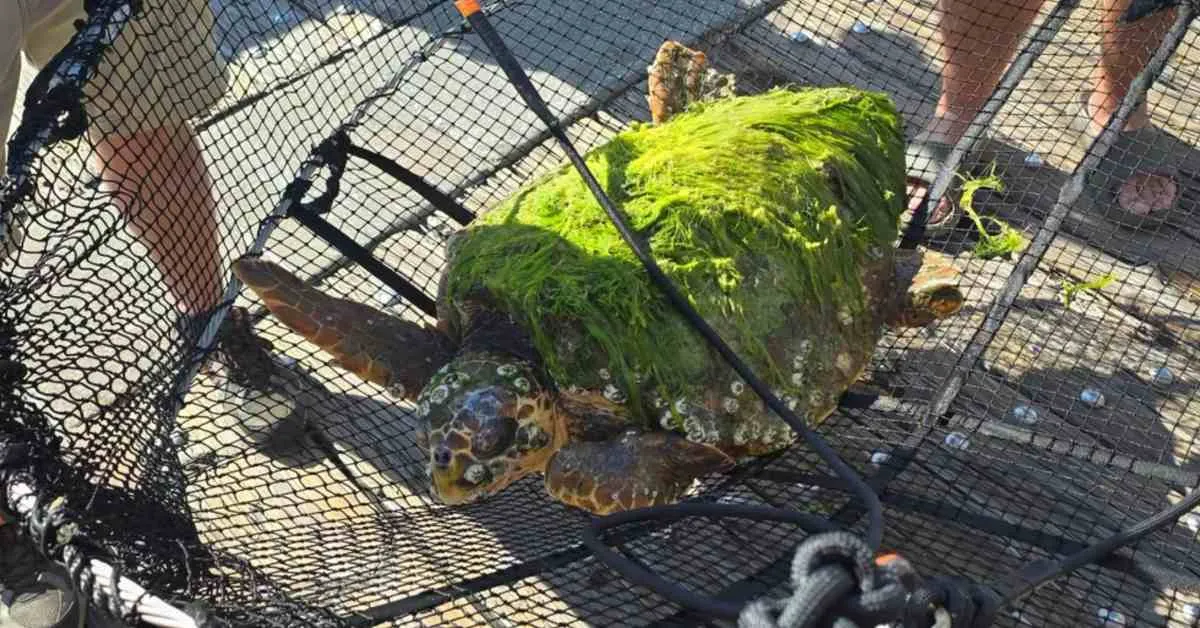
When Chlorophyllis, a loggerhead sea turtle, washed up in late March, she wasn't exactly ready for her close-up. Picture this: a fishing hook snagged in her mouth, another one lurking internally, and a shell so thoroughly encrusted with algae and barnacles that it looked less like a turtle and more like a particularly slow-moving, green rock.
Sarah Kamen, a stranding coordinator at Florida’s Gulfarium C.A.R.E. Center, noted that this kind of biological overgrowth is a tell-tale sign of a turtle that's been in a bad way — too sick and sluggish to fend off the hitchhikers. Basically, she was the aquatic equivalent of a neglected garden gnome.
The C.A.R.E. team's first move wasn't a power wash, surprisingly. Removing those barnacles too soon can actually do more harm than good, which makes sense when you think about it. So, they focused on the basics: food, medicine, and a whole lot of rest. Chlorophyllis needed to get her strength back before anyone started scraping.
We're a new kind of news feed.
Regular news is designed to drain you. We're a non-profit built to restore you. Every story we publish is scored for impact, progress, and hope.
Start Your News DetoxThe Ultimate Spa Day
About a month in, once she was strong enough, Chlorophyllis finally got her much-deserved "spa day." We’re talking professional barnacle removal, which, if you’ve ever tried to scrape anything off anything, is no small feat. Kamen shared a video of the transformation, and let’s just say it involved a lot of careful work to reveal the sleek, beautiful turtle underneath the crusty exterior.
For the team, even tiny steps are huge victories. And Chlorophyllis was making progress, slowly but surely shedding her green, barnacled past.
Another month of attentive care, and Chlorophyllis was a new turtle. Energetic, strong, and eating like she was making up for lost time. She was finally ready to go home.
On May 22, the moment arrived. Chlorophyllis was released back into the ocean, her flippers waving a triumphant farewell as she swam off. Her shell, once a biological apartment complex, was now clean and shiny. Kamen put it best: after two months of rehab, Chlorophyllis was "unrecognizable now — in the best way." Which, honestly, is the kind of glow-up we all aspire to.