Turns out, even a critically important ecosystem like a saltmarsh needs a little help from its friends. Specifically, some brushwood fences. New research suggests these unassuming barriers can bring back our rapidly disappearing saltmarshes, but there’s a catch: someone actually has to keep them in working order. Because apparently, even mud needs a bouncer.
Globally, a staggering 46% of saltmarsh has either vanished or is on life support. Reversing that trend is notoriously difficult. Enter the humble brushwood fence, a surprisingly effective tool in what scientists call “sedimentation fields.” Basically, you build fences, they trap mud, and marsh plants decide it’s a lovely place to set up shop. It’s like a slow-motion, nature-assisted land reclamation project.
The Case of the Vanishing Mud
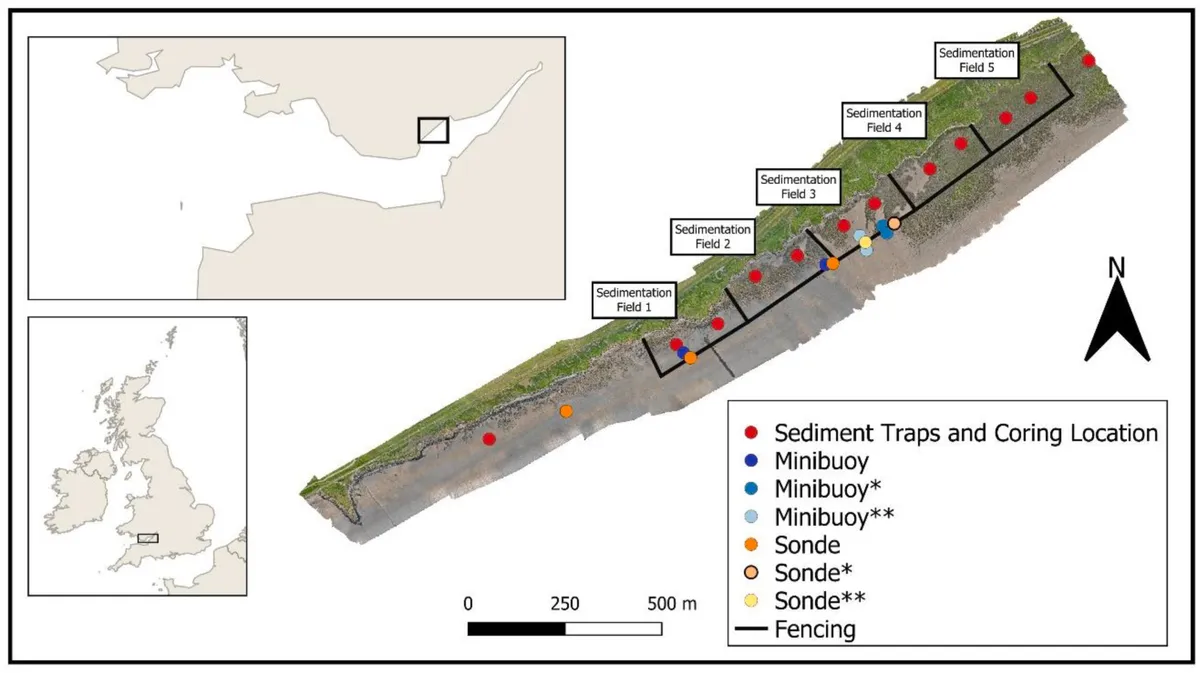
Researchers from the University of Reading honed in on a spot in Wales called Rumney Great Wharf. Five sedimentation fields were lovingly constructed there between 1989 and 2005. The fences did their job for a while. Then, after 2010, the maintenance budget apparently got reallocated to, well, anything else. The willow bundles that made up the barriers simply washed away, leaving behind a sad collection of wooden stakes.
We're a new kind of news feed.
Regular news is designed to drain you. We're a non-profit built to restore you. Every story we publish is scored for impact, progress, and hope.
Start Your News DetoxFast forward to drone surveys in May 2023 and May 2024. The results were less than encouraging. In just one year, 87% of the fenced-off area lost sediment. We’re talking 9,531 cubic meters of mud, which, for context, is enough to fill four Olympic swimming pools. With mud. Despite the fact that some areas could build up over 10 centimeters of mud per year, the strong waves and tidal currents, unchecked by fences, simply carried it all away. It was an exercise in futility.
Natural Resources Wales (NRW), clearly having learned a lesson, stepped in. In August 2024, they re-installed and extended the fencing at Rumney Great Wharf. The goal: boost biodiversity, strengthen protected areas, and reduce flood risk. Because a healthy saltmarsh isn’t just pretty; it’s a natural flood defense and a carbon sink, which, if you think about it, are two things we really need right now.
Dr. Jonathan Dale, the lead author from the University of Reading, put it plainly: saltmarshes are disappearing fast, and sedimentation fields are one of the few ways to bring them back in certain areas. But, he stressed, "the work isn't finished once fences are built." They need ongoing repair until the marsh can stand on its own two muddy feet. Exactly when that magical moment arrives is the next big question for researchers.
So, the fences are back up, and a maintenance program is in place. Because sometimes, saving the planet is less about futuristic tech and more about making sure someone's actually doing the odd fence repair. Who knew mud could be so high-maintenance?