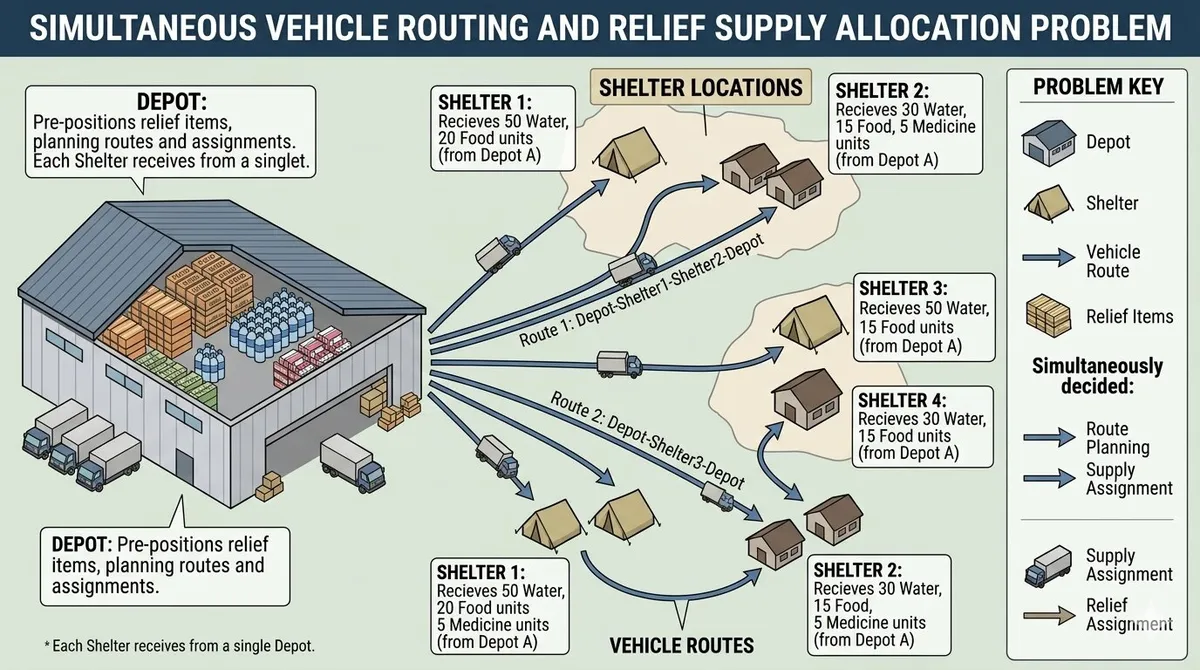
When disaster strikes, the clock starts ticking. And while speed is obviously crucial, a new study reveals that fairness can be baked into aid delivery without sacrificing precious time. Because apparently, we can now have our humanitarian cake and eat it too. Researchers from Koç University and their international partners have cooked up an algorithm that slashes unequal unmet needs by a staggering 34%.
The Not-So-Fair Reality of Disaster Relief
Think back to the devastating 2023 Maraş earthquakes in Türkiye. Millions were displaced, and emergency supplies were a lifeline for hundreds of makeshift tent cities. But even with Herculean efforts, the reality was stark: not enough supplies for everyone, and brutal road conditions causing delays. Some areas got aid relatively quickly; others, like Hatay and Adıyaman, waited much longer, their needs piling up.
This isn't just an anecdotal problem. It's a logistical nightmare that a study in the European Journal of Operational Research decided to tackle head-on. The question: How do you get limited aid to people both quickly and equitably?
We're a new kind of news feed.
Regular news is designed to drain you. We're a non-profit built to restore you. Every story we publish is scored for impact, progress, and hope.
Start Your News DetoxProfessor Dr. Sibel Salman's team at Koç University came up with a mathematical model that plans delivery truck routes and decides aid amounts simultaneously. This isn't just about finding the fastest path; it's about finding the fastest and most balanced path, ensuring no district is left staring at empty shelves while another is fully stocked.
The Secret Sauce: The Gini Coefficient
Instead of just measuring fairness after the fact, the researchers embedded the Gini coefficient — yes, the same one economists use to measure income inequality — directly into their decision-making process. So, fairness wasn't just a hopeful outcome; it was a core objective from the get-go. Which, if you think about it, is both impressive and slightly terrifying in its elegance.
To solve such a beast of a problem in real-time, the team developed a special "branch-and-price" algorithm. It's like breaking a giant, complicated puzzle into a bunch of smaller, solvable ones, then snapping them back together for a near-perfect solution. This makes calculations fast enough for actual emergencies, not just theoretical ones.
Tested against real data from the 2011 Van earthquake and even predicted scenarios for Istanbul, the algorithm outperformed commercial tools, delivering almost perfect solutions within practical time limits. The takeaway? This smart routing doesn't just promise fairness; it delivers it, reducing inequality in aid distribution by roughly a third without slowing down the trucks.
This means humanitarian groups now have a powerful new tool in their arsenal. Because when disaster strikes, the last thing anyone needs is a system that accidentally picks winners and losers. And now, thanks to some clever algorithms, they might not have to. Now, if only it could also clear the roads.