A puzzle has nagged at nutrition scientists for years: flavanols—the compounds in dark chocolate, red wine, and berries linked to sharper memory and stronger thinking—barely make it into the bloodstream. So how do they actually change your brain.
Japanese researchers may have just solved it. They found that flavanols don't need to be absorbed to work. Instead, their characteristic astringent taste—that mouth-drying sensation—acts as a direct signal to your brain, triggering a cascade of neural activity that mimics what happens during exercise.
The taste that wakes up your brain
Dr. Yasuyuki Fujii and his team at Shibaura Institute of Technology tested whether the astringent flavor of flavanols could bypass the absorption problem entirely. Rather than waiting to be digested, the taste itself might travel via sensory nerves straight to the central nervous system, activating stress and attention pathways.
We're a new kind of news feed.
Regular news is designed to drain you. We're a non-profit built to restore you. Every story we publish is scored for impact, progress, and hope.
Start Your News DetoxThey gave mice flavanol doses and watched what happened. The animals became more active, explored their environment more readily, and performed better on learning tasks. But the real action was happening inside: levels of dopamine and norepinephrine—neurotransmitters tied to motivation, focus, and alertness—surged in the brain regions that control attention and stress response.
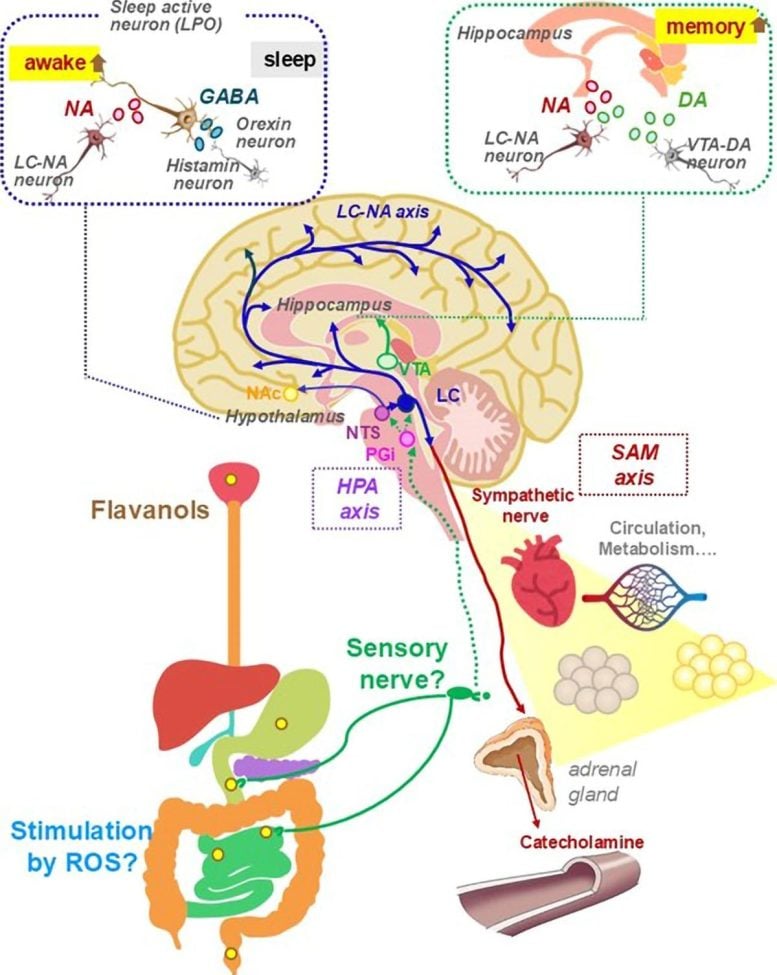
The researchers also found that the stress-regulating part of the brain lit up, releasing hormones associated with the body's arousal response. The effect was measurable in the mice's urine within hours.
Exercise in flavor form
What's striking is that these responses resemble what happens when you exercise—your body enters a controlled state of alertness that sharpens focus and strengthens memory formation. Except this time, the trigger wasn't physical exertion. It was flavor.
"Stress responses elicited by flavanols in this study are similar to those elicited by physical exercise," Dr. Fujii explains. "Thus, moderate intake of flavanols, despite their poor bioavailability, can improve the health and quality of life."
This reframes how we think about nutrition. For decades, the focus has been on what your body absorbs—the bioavailability problem. But flavanols appear to work through a different door: your sensory system. The taste itself is the medicine.
The implications ripple outward. Food manufacturers could now design products not just for nutritional content, but for sensory properties that trigger beneficial physiological responses. A piece of dark chocolate wouldn't just contain flavanols; its astringency would become part of the mechanism that makes it work.
This opens a new frontier in what researchers call sensory nutrition—the idea that how food tastes and feels in your mouth is as relevant to health as what's actually in it. The next generation of functional foods might be designed around this principle: harnessing the brain's response to flavor itself.