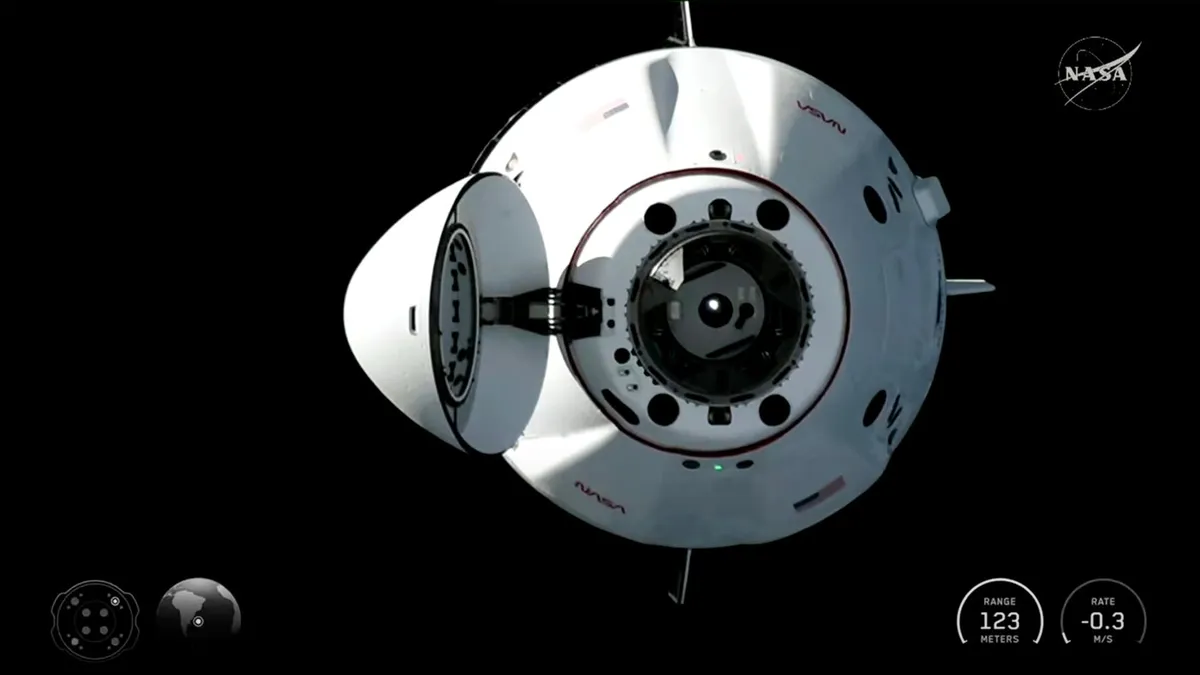
Four astronauts — two Americans, one French, one Russian — arrived at the International Space Station on Saturday afternoon, ending a day-long journey that began before dawn on Friday from Cape Canaveral.
The Crew-12 mission marks a return to full capacity for the orbiting lab. Jessica Meir and Jack Hathaway (NASA), Sophie Adenot (France), and Andrey Fedyaev (Russia) will spend eight months conducting research that feeds directly into two ambitious goals: preparing humans to venture beyond Earth's orbit, and learning how to grow food reliably in space.
The timing matters. The space station has been running lean since January, when the previous crew departed a month early due to a medical evacuation. With only three people aboard, the station operated well below its typical seven-person complement — which meant less science getting done and more time spent on maintenance. "With Crew-12 safely on orbit, America and our international partners once again demonstrated the professionalism, preparation, and teamwork required for human spaceflight," NASA Administrator Jared Isaacman said in a statement.
We're a new kind of news feed.
Regular news is designed to drain you. We're a non-profit built to restore you. Every story we publish is scored for impact, progress, and hope.
Start Your News DetoxWhat's striking about this mission is how routine it's become to dock four people at a space station 250 miles above Earth. The launch window, the rendezvous, the docking — these operations now happen with the kind of practiced precision that once seemed impossible. SpaceX has flown 12 crew rotations now. The infrastructure that once required the space shuttle program's entire budget is now part of the regular rhythm of orbital operations.
Meanwhile, NASA is already looking further out. The agency is preparing for Artemis II, a 10-day mission that will send four astronauts around the moon — the first crewed lunar mission since Apollo 17 in 1972. That launch is targeted for as soon as March. So while Crew-12 settles into eight months of experiments in low Earth orbit, the machinery for returning humans to the moon is already in motion.