For decades, astronomers have known the Milky Way has a magnetic field. What they didn't know was how wildly chaotic it actually is.
A team led by Dr. Alex Hill at the University of British Columbia Okanagan has just released the sharpest picture yet of this invisible cosmic architecture — and it's far messier than anyone expected. Using a technique that's been theoretically possible since 1966 but only now practical, they've created the first broadband map of how the galaxy's magnetic field twists and turns across the northern sky.
How they did it
The method works like this: polarized radio waves traveling through space get twisted by magnetic fields, the way light bends through a prism. By measuring how these waves change at many different frequencies — something only modern broadband radio telescopes can do — researchers can reconstruct the magnetic field in 3D rather than averaging it into a flat, simplified picture. Hill's team used the DRAO 15-metre telescope near Penticton, British Columbia, to observe the entire northern sky this way.
We're a new kind of news feed.
Regular news is designed to drain you. We're a non-profit built to restore you. Every story we publish is scored for impact, progress, and hope.
Start Your News DetoxThe result is revelatory. More than half the sky contains complex, tangled magnetic structures rather than the smooth, orderly fields scientists had imagined. "For decades, we could only measure the Milky Way's magnetic field in a very averaged, simplified way," Hill explains. "But its magnetic field is an important piece of the puzzle when it comes to understanding how the universe and everything in it operates."
Why this matters
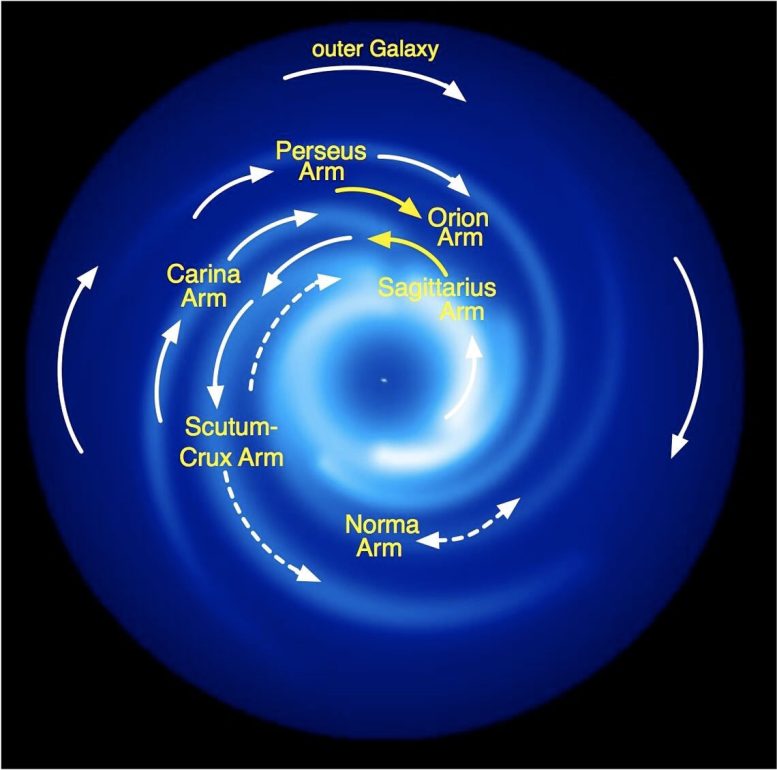
Magnetic fields aren't just abstract physics — they shape how stars form, how galaxies evolve, and how matter organizes itself across cosmic scales. The new data reveal something striking: the field interacts with supernova explosions, spiral arms, and other galactic structures in ways that were invisible before. One accompanying study, led by University of Calgary doctoral student Rebecca Booth, has already used the DRAGONS data to investigate a mysterious large-scale reversal in the galactic magnetic field — a phenomenon that was difficult to study with older methods.
This is part of a larger shift in astronomy. A new generation of radio surveys is finally making it possible to map the three-dimensional magnetic field structure in the space between stars — work that's being led, in part, by Canadian institutions and researchers. It's the kind of foundational knowledge that doesn't grab headlines but quietly reshapes how we understand the cosmos.
The data are now available to the global astronomical community. What comes next is up to the researchers who'll use this map to answer questions about magnetism, star formation, and galactic evolution that we're only just beginning to ask.