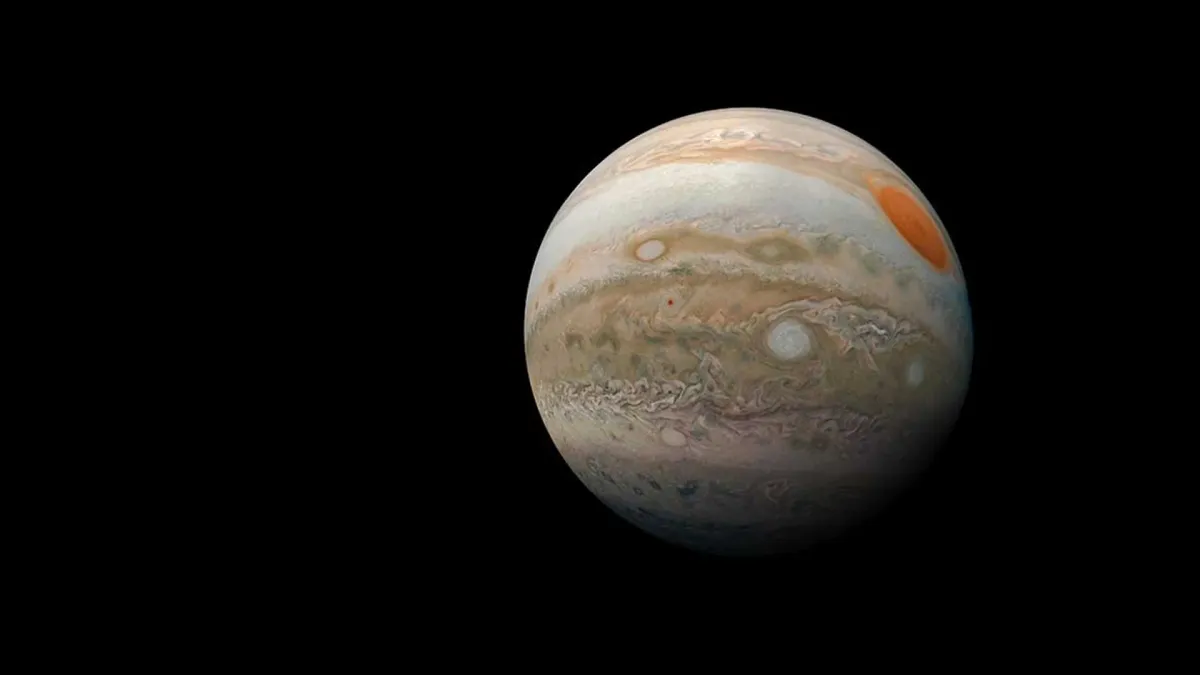
For nearly 50 years, we've been measuring Jupiter with data from spacecraft that flew past it in the 1970s. Now NASA's Juno spacecraft has done what those early missions couldn't: it's passed directly behind the planet from Earth's perspective, allowing scientists to measure Jupiter's actual shape with precision that's changed what we thought we knew.
The findings are modest in scale but significant in implication. Jupiter is about 8 kilometers narrower at the equator and roughly 24 kilometers flatter at the poles than textbooks have claimed. That might sound like rounding error on a planet 142,000 kilometers across, but for planetary scientists, these few kilometers matter enormously.
How Radio Signals Revealed Jupiter's True Shape
Juno, which has been orbiting Jupiter since 2016, was given an extended mission in 2021 that repositioned it for a rare vantage point. When the spacecraft passes behind Jupiter relative to Earth, its radio signals bend and distort as they travel through the planet's atmosphere. By analyzing exactly how those signals warp, researchers at the Weizmann Institute of Science could calculate Jupiter's dimensions with unprecedented accuracy—the first major refinement since the Voyager and Pioneer missions of the 1970s.
We're a new kind of news feed.
Regular news is designed to drain you. We're a non-profit built to restore you. Every story we publish is scored for impact, progress, and hope.
Start Your News Detox"When the spacecraft passes behind the planet, its radio communication signal is blocked and bent by Jupiter's atmosphere," explained Dr. Scott J. Bolton, Juno's principal investigator. "This enables an accurate measurement of Jupiter's size."
What made this possible wasn't just a better vantage point. It was accounting for something earlier measurements missed entirely: Jupiter's extreme winds. The planet hosts some of the solar system's most powerful atmospheric currents, and these winds distort the planet's shape in ways that previous models hadn't fully captured. By incorporating wind dynamics into their calculations, the team resolved long-standing gaps between theoretical models and actual gravity data.
Why This Matters Beyond Jupiter
Jupiter serves as a reference point for understanding gas giants everywhere—both in our solar system and in the thousands discovered around distant stars. When you refine your measurements of the solar system's largest planet, you sharpen the lens through which you understand planetary structure itself. The new data allows interior models of Jupiter to better align with both gravity measurements and atmospheric observations, which means scientists can now build more accurate models of how gas giants work.
Prof. Yohai Kaspi of the Weizmann Institute noted the practical reality: "Textbooks will need to be updated." The size of Jupiter hasn't changed, of course. But how we measure it has, and that distinction matters for everything from understanding how planets form to predicting what we'll find when we study similar worlds elsewhere.
The research team plans to apply the same techniques to data from the European Space Agency's JUICE mission, launched in 2023, which carries instruments designed specifically to probe Jupiter's atmosphere in even greater detail. The cycle of refinement continues.