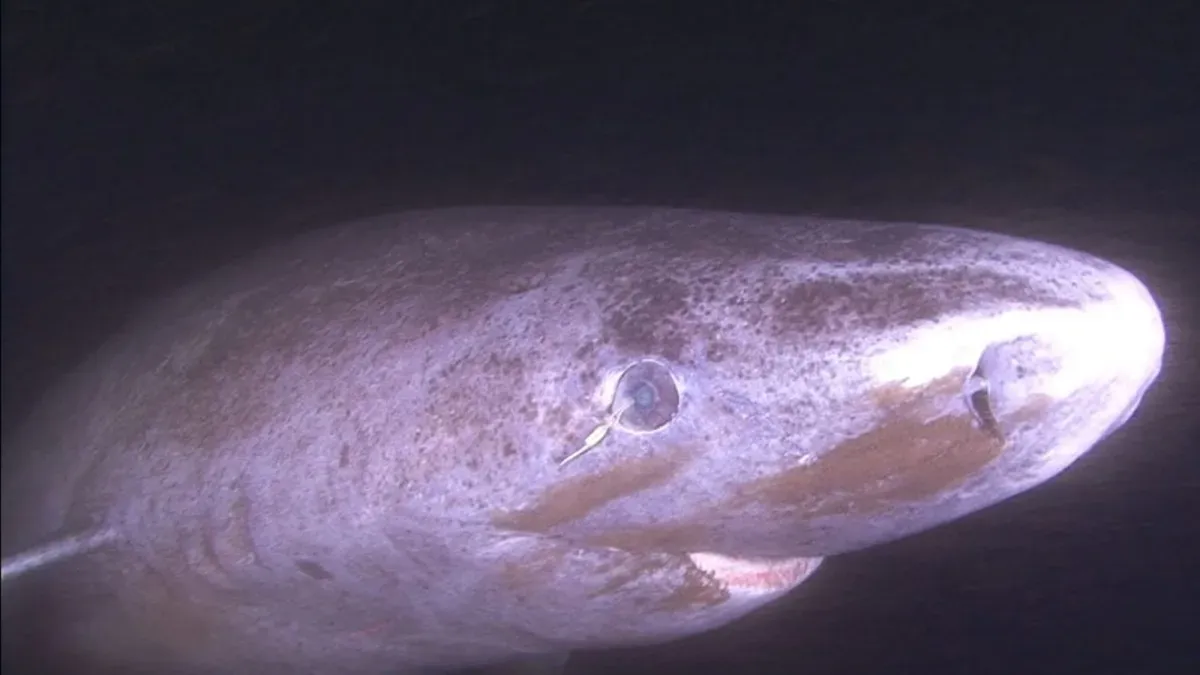
A creature that can live 400 years and doesn't reach adulthood until 150 might seem like the last place to look for answers about human eyesight. But researchers studying the Greenland shark's eyes have found something unexpected: a biological mechanism for maintaining vision across centuries, with potential applications for diseases that steal sight from millions.
Greenland sharks are extreme outliers even among deep-sea creatures. They grow slowly—sometimes just a centimeter per year—and spend their entire lives in the frigid waters of the North Atlantic and Arctic, hunting in near-total darkness at depths where sunlight never reaches. For decades, scientists assumed their eyes were essentially vestigial, evolutionary leftovers from a time when their ancestors lived in shallower, brighter waters.
Then researchers actually watched them move. "You see it move its eye. The shark is tracking the light," says Dorota Skowronska-Krawczyk, a physiologist at UCLA who led the international team studying these animals. That simple observation—a 400-year-old shark responding to light—prompted a closer look.
We're a new kind of news feed.
Regular news is designed to drain you. We're a non-profit built to restore you. Every story we publish is scored for impact, progress, and hope.
Start Your News DetoxWhat a century-old eye reveals
Expeditions to Greenland's Disko Island brought up specimens that allowed the team to examine shark eyes in detail. What they found challenged assumptions: the eyes contained all the essential cell types needed for vision, and crucially, the oldest specimens examined—over a century old—showed no signs of retinal degeneration. No wear. No breakdown of the light-sensing cells that typically deteriorate with age in humans.
This points to something the sharks have evolved that humans haven't: an exceptionally effective DNA repair system that keeps ocular cells healthy for centuries. If researchers can understand how that mechanism works, it could inform treatments for glaucoma, macular degeneration, and other age-related vision diseases that affect millions globally.
"We can learn so much about vision and longevity from long-lived species like the Greenland shark," says Emily Tom, the study's co-author. The research, published in Nature Communications in 2023, is still in its early stages—the team is working to secure ongoing federal funding to continue the work. But the direction is clear: sometimes the answers to human aging hide in the most unexpected places, in creatures that have had centuries to perfect survival.
What comes next is the harder part: translating what a deep-sea predator's eyes can teach us into therapies that preserve sight in human patients. That's where the real work begins.