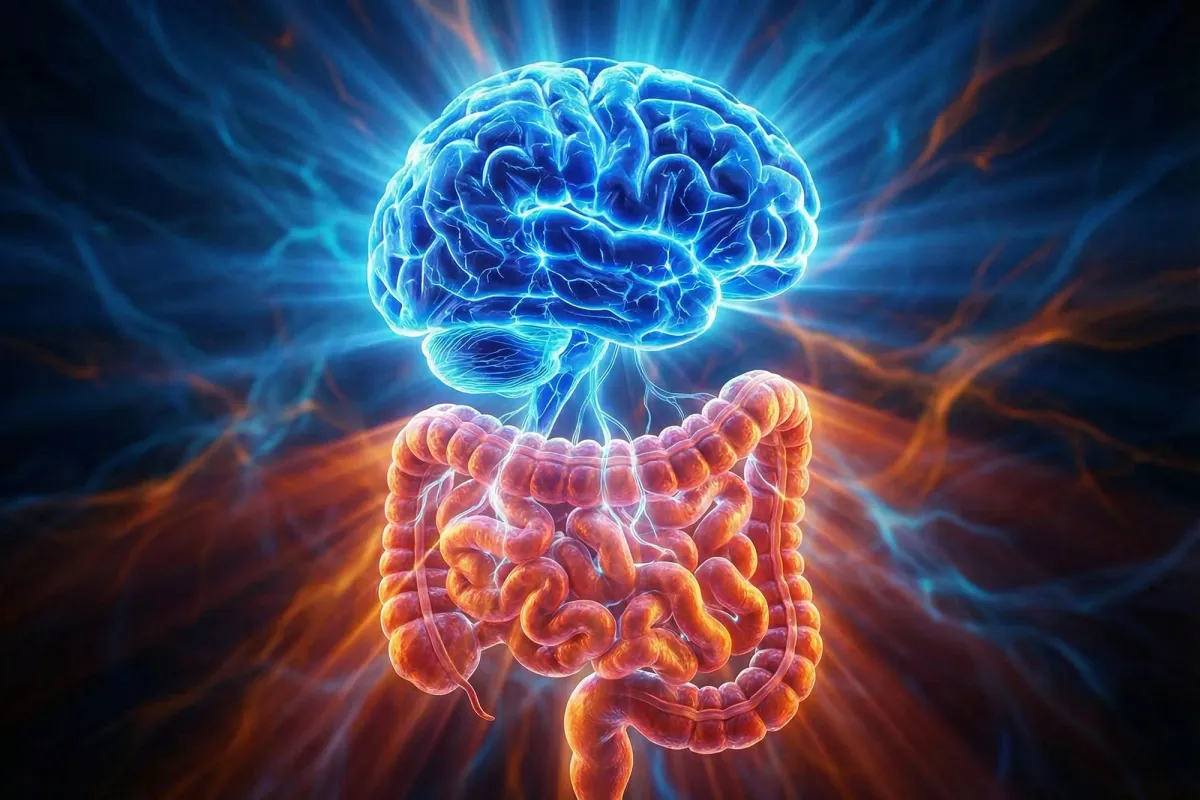
Your gut bacteria might be doing more than you thought. A new study from Northwestern University suggests they could actually shape how your brain develops and functions — and may have played a crucial role in human evolution itself.
For years, scientists have puzzled over how our ancestors managed to grow such large, energy-hungry brains. Building a human brain is metabolically expensive; it demands constant fuel. Yet we still don't fully understand the mechanism that allowed our species to meet those demands while other primates didn't. The answer, it seems, might live in your microbiome.
Researchers took gut bacteria from three primate species — humans and squirrel monkeys (large-brained) and macaques (smaller-brained) — and introduced them into mice with no microbes of their own. After eight weeks, the results were striking. Mice colonized with bacteria from large-brained primates showed dramatically higher activity in genes linked to energy production and synaptic plasticity — the physical process underlying learning. Mice that received bacteria from smaller-brained primates showed the opposite pattern. Even more remarkably, when researchers compared the gene expression patterns in the mice to actual primate brains, many of the patterns matched.
We're a new kind of news feed.
Regular news is designed to drain you. We're a non-profit built to restore you. Every story we publish is scored for impact, progress, and hope.
Start Your News Detox"What was super interesting is we were able to compare data we had from the brains of the host mice with data from actual macaque and human brains, and to our surprise, many of the patterns we saw in brain gene expression of the mice were the same patterns seen in the actual primates themselves," said Katie Amato, the study's principal investigator.
The implications ripple outward in unexpected directions. The mice colonized with small-brained primate microbes showed gene expression patterns associated with ADHD, schizophrenia, bipolar disorder, and autism — suggesting the gut microbiome may influence not just brain size, but susceptibility to certain neurological conditions. This doesn't mean gut bacteria cause these conditions, but it hints that the microbial community plays a causal role in brain development.
What makes this work genuinely novel is the direction of causation. Previous research hinted at connections between the microbiome and brain function. This study demonstrates it directly: change the microbes, and you change how the brain operates. That's a meaningful shift in how we understand evolution. It suggests that natural selection didn't just work on genes — it worked on the entire ecosystem living inside us.
The researchers are already planning the next phase of investigation, looking for broader rules about how microbes interact with brain development across species. If those patterns hold, they could reshape how we think about everything from psychiatric conditions to human cognitive evolution.