Inside data centers, lasers have a problem: they get hot, they need constant replacement, and they're expensive to cool. Researchers at UC Santa Barbara have just shown a way around it — using light sources so small you couldn't see them without a microscope.
"We're talking about devices that are literally the size of a hair follicle," says Roark Chao, a doctoral student in electrical engineering at UCSB. "If you can engineer how the light comes out, those microLEDs can start to replace lasers in short-distance data communication."
The breakthrough, published in Optics Express, redesigns how these microscopic light-emitting diodes work. By wrapping the light-emitting region with special reflectors, the team achieved something significant: they got 35% more electrical efficiency and 46% more wall-plug efficiency — meaning these tiny devices convert far more of the power they draw into actual usable light. They also reduced how much the light spreads out as it travels, making the beam sharper and more controllable.
We're a new kind of news feed.
Regular news is designed to drain you. We're a non-profit built to restore you. Every story we publish is scored for impact, progress, and hope.
Start Your News DetoxWhy this matters for the cloud
Data centers are where the internet lives. Every video you stream, every email you send, every AI model that learns — it all moves through these massive buildings filled with servers. Those servers need to talk to each other constantly, and right now lasers handle a lot of that conversation. But lasers have a weakness: they get unreliable when they heat up, which they do constantly in the warm, dense environment of a data center.
MicroLEDs — devices smaller than 100 microns wide — don't have this problem. They can run hot without degrading. They need less cooling infrastructure. They fail less often. "The big thing with lasers is that they start having thermal issues at relatively low temperatures," Chao explains. "MicroLEDs can be driven much hotter without needing complex cooling. That means less replacement, less cost and more flexibility in data centers."
As AI training demands more computing power and cloud services expand globally, data centers are becoming bottlenecks. Even small improvements in how efficiently light moves information can ripple through the entire system. But the real power of this research is that it's not just about data centers. The same microLED technology could make displays brighter and thinner, power augmented and virtual reality headsets, and do it all with the same underlying device.
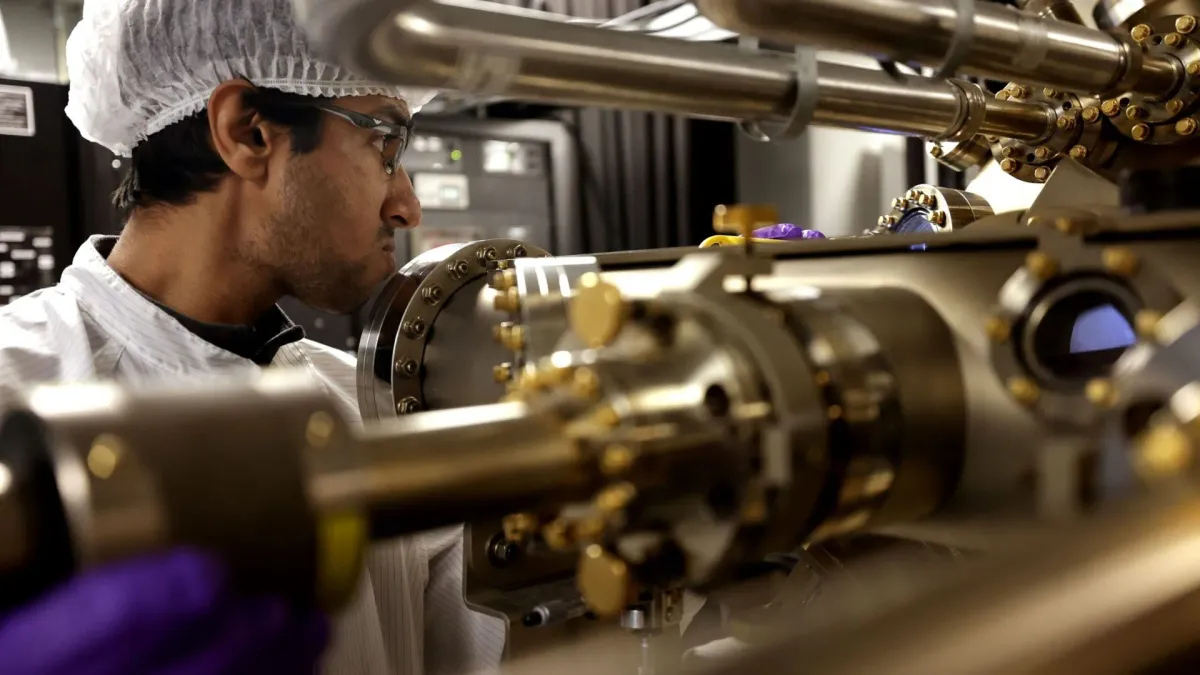
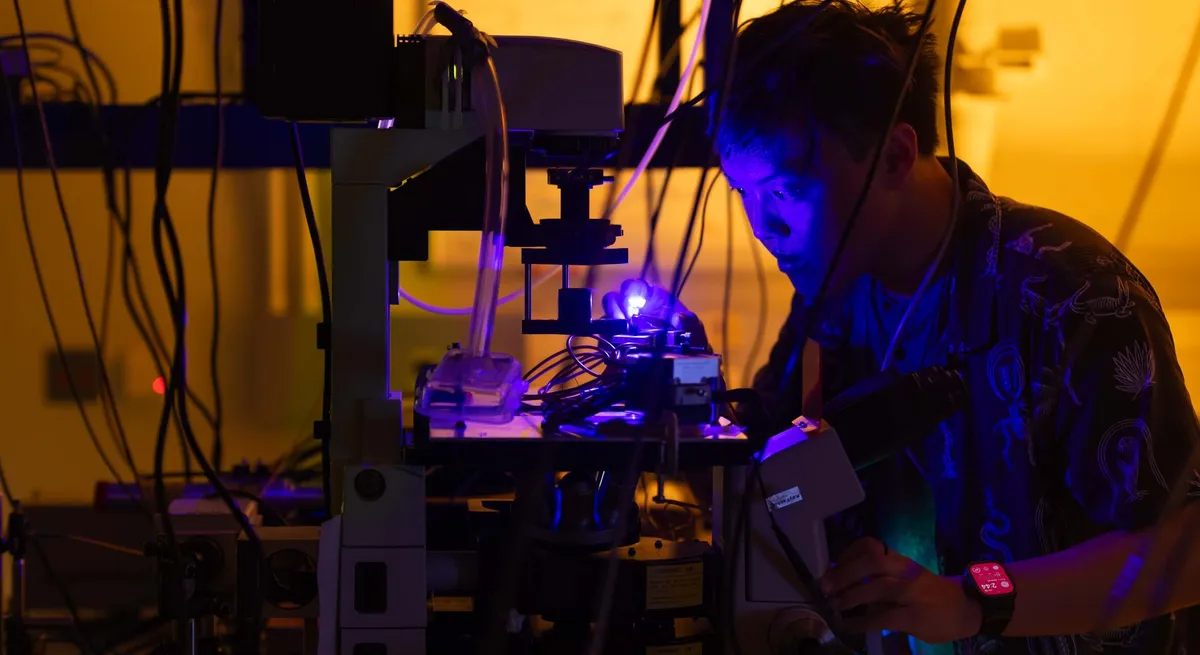
The work builds on decades of research at UCSB in gallium nitride semiconductors — the same material that won Shuji Nakamura a Nobel Prize for creating the first practical blue LED, which transformed global lighting. That institutional depth matters: Chao can simulate a design, grow the crystal, fabricate the device, and test it all on campus. "That speed from idea to experiment is what makes this place powerful," he says.
The next phase is scaling this up — moving from the lab to something that could actually run inside a data center. That's typically where promising research either accelerates or stalls. But with efficiency gains this large and the thermal advantages so clear, the path forward looks less like theory and more like engineering.