For nearly a decade, astronomers watched Betelgeuse flicker and shift in ways that didn't quite add up. The red supergiant—one of the brightest stars visible from Earth—dimmed dramatically in 2020, then showed odd patterns of brightness that cycles through roughly every 2,100 days. Something was clearly pushing the star around, but what.
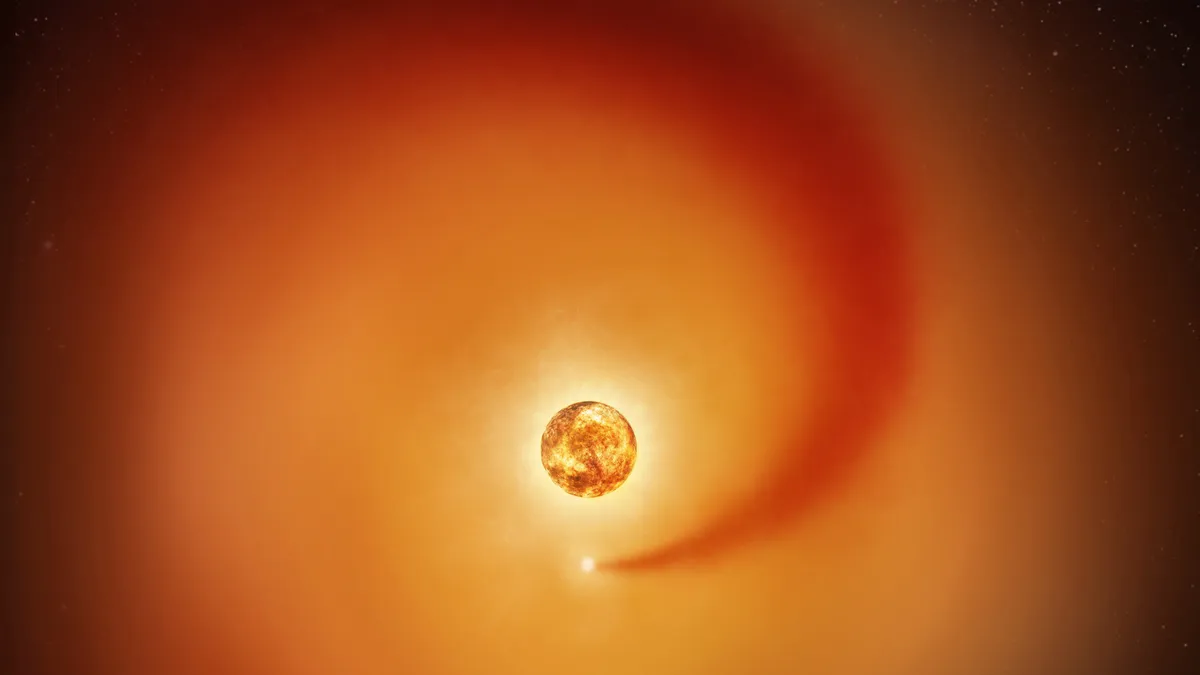
Now, using data from NASA's Hubble Space Telescope and ground observatories, researchers at Harvard & Smithsonian's Center for Astrophysics have caught the culprit: a companion star they've named Siwarha, orbiting so close to Betelgeuse that it carves a visible wake through the giant star's atmosphere.
The discovery sounds abstract until you consider the scale. Betelgeuse is so enormous that if you placed it where our sun is, its surface would extend beyond Mars's orbit. Siwarha is tiny by comparison—a pinprick next to it. Yet this small star is so close that it plows directly through Betelgeuse's outer layers, leaving behind a trail of dense gas that astronomers could finally detect by tracking eight years of light variations.
We're a new kind of news feed.
Regular news is designed to drain you. We're a non-profit built to restore you. Every story we publish is scored for impact, progress, and hope.
Start Your News DetoxThe Mystery That Wouldn't Quit
Astronomers have puzzled over Betelgeuse's behavior for decades. The star showed two distinct rhythms: a shorter 400-day cycle (now understood as pulsations within the star itself) and a mysterious 2,100-day cycle that resisted explanation. Scientists considered everything—massive convection cells, dust clouds, magnetic storms. Some had theorized a hidden companion, but without proof, it remained speculation.
"The idea that Betelgeuse had an undetected companion has been gaining in popularity for the past several years, but without direct evidence, it was an unproven theory," said researcher Andrea Dupree. "Now, for the first time, they have firm evidence that a companion is disrupting the atmosphere of this supergiant star."
What makes this matter beyond the triumph of solving a puzzle: massive stars like Betelgeuse are rare and poorly understood. They live fast and die young, eventually exploding as supernovae. Watching how Siwarha's presence shapes Betelgeuse's evolution—how it strips material away, how it stirs the atmosphere—gives astronomers a front-row seat to understanding what happens when giant stars age and eventually collapse.
The companion is currently hidden behind Betelgeuse from our vantage point, but astronomers are already planning new observations for 2027, when Siwarha emerges from behind its massive partner again. This discovery may also explain similar mysteries in other supergiant stars across the galaxy.
The research appears in the Astrophysical Journal.