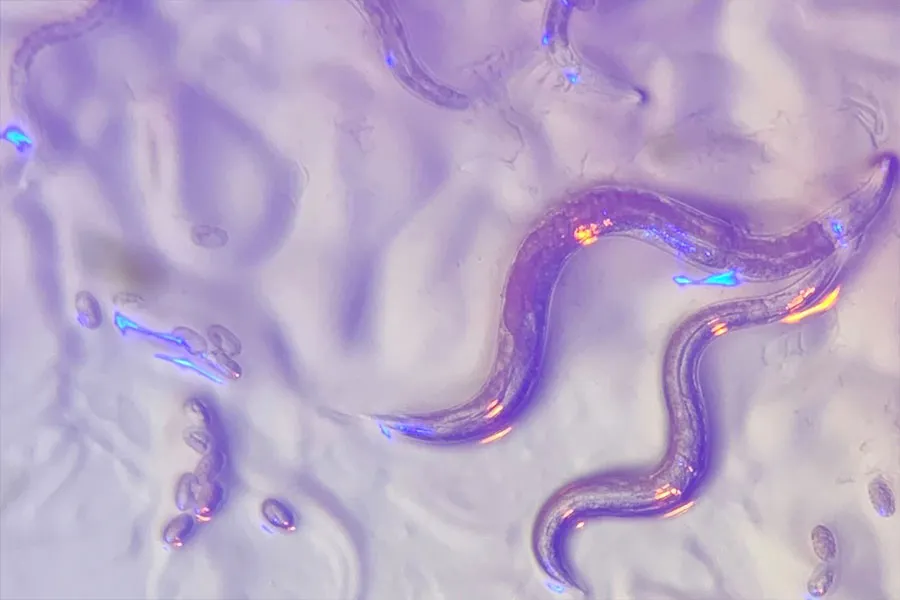
For decades, a creature you could barely see without a microscope has been quietly reshaping medicine. Caenorhabditis elegans—a worm so small it fits on the period at the end of this sentence—has led to four Nobel Prizes and treatments for diseases that affect millions of people. The discoveries keep coming.
It started in the 1960s when molecular biologist Sydney Brenner realized this worm was almost perfect for studying how life works. Its nervous system has exactly 302 neurons (humans have roughly 86 billion, but the principle translates). It develops from a single cell to a complete organism in three days. And crucially, scientists could watch every step.
The discoveries that changed medicine
In the 1970s, researcher John Sulston traced the journey of a fertilized egg becoming an adult worm, mapping the origin of all 959 cells in its body. But here's what mattered most: some cells that formed during development simply vanished. They were deliberately eliminated by a process called programmed cell death—a kind of cellular self-destruct that seemed counterintuitive until you realized it was essential for building organs, building immune systems, and preventing cancer.
We're a new kind of news feed.
Regular news is designed to drain you. We're a non-profit built to restore you. Every story we publish is scored for impact, progress, and hope.
Start Your News DetoxRobert Horvitz and colleagues hunted for mutations that disrupted this process, eventually identifying the genes controlling it. One of those genes had a human equivalent called BCL-2. Today, drugs targeting BCL-2 are used to treat blood cancers in patients worldwide.
That was just the beginning. Andrew Fire and Craig Mello discovered RNA interference—a natural mechanism that silences genes—using C. elegans. Six FDA-approved drugs now use this principle. Martin Chalfie borrowed a fluorescent protein from jellyfish to light up individual cells in the worm, transforming how scientists observe living systems. Victor Ambros and Gary Ruvkun discovered microRNAs, tiny molecules that regulate genes across every multicellular organism on Earth.
Four Nobel Prizes. One worm.
What made this possible wasn't just the worm's biology. It was the culture around it. Worm researchers built an unusually open community, sharing data and tools freely through shared databases like WormBase and WormAtlas. Discoveries weren't hoarded—they were passed along. When one lab found something useful, others could build on it immediately. This collaborative spirit accelerated everything.
Still yielding answers
C. elegans hasn't retired. At MIT and labs worldwide, researchers are using it to understand neural circuits, how the brain changes with age, and how animals perceive time. Steven Flavell's team is investigating how internal states—hunger, fatigue, mood—combine with sensory information to shape behavior. As technologies like artificial intelligence and high-speed imaging become more powerful, the worm's simplicity becomes even more valuable. You can map everything. You can test everything.
The story of C. elegans is partly about luck—finding the right model organism for the right moment. But it's also about recognizing that profound answers often hide in unexpected places, and that the willingness to share discoveries matters as much as making them.