Imagine having to sniff out your friends from your enemies every single day. Now imagine that your friends' scent keeps subtly changing, and you have to keep up. Welcome to the life of an ant.
A new study reveals that ants, those tiny architects of underground empires, are surprisingly flexible in how they tell who's in the club and who's getting the boot. Scientists previously thought their recognition system was pretty rigid. Turns out, it's more like a constantly updated social media feed, but with antennae.
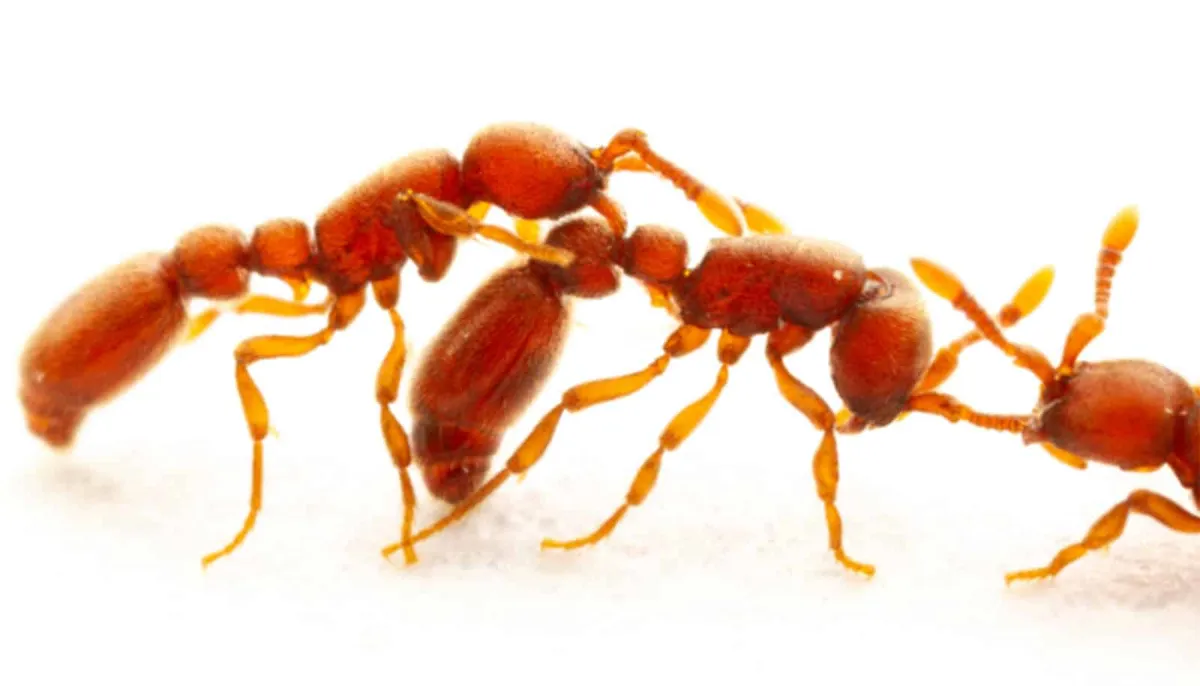
Ants need to be lightning-fast at recognizing nestmates. It's how they keep their colony safe from freeloaders, invaders, or just a really lost tourist ant. Researchers focused on clonal raider ants (Ooceraea biroi), a species that reproduces asexually, making them perfect for genetic experiments. And what they found was fascinating: ants update their 'friend' list throughout their lives, learning new scents through repeated interactions. Yet, they still retain an innate, unshakeable sense of who their biological relatives are.
We're a new kind of news feed.
Regular news is designed to drain you. We're a non-profit built to restore you. Every story we publish is scored for impact, progress, and hope.
Start Your News DetoxDaniel Kronauer, who helms Rockefeller University's Laboratory of Social Evolution and Behavior, noted that while ants are ace at IDing their own, the flexibility of this behavior was a mystery. This research is the first step in unraveling how these tiny brains process social smells and integrate new information.
Ant colonies are, in evolutionary terms, a pretty big deal. They're thousands of individuals working as one, like cells in a body or your immune system. And just like those systems, they need to distinguish 'self' from 'other' to survive. Their secret weapon? Waxy chemicals on their bodies. Every colony uses the same basic chemicals, but in different ratios, creating a unique scent signature. It's like a secret handshake, but for your entire exoskeletal surface.
The Scent of Acceptance
But here’s the rub: scents aren't static. A colony's genetics might shift, or the environment could subtly alter its smell. Ants might also encounter new neighbors and need to adjust their social parameters. Clearly, they need a system that can adapt.
Tiphaine Bailly, a researcher in Kronauer's lab, suspected there was more learning involved than previously thought. After all, cooperation is the bedrock of ant society, and knowing who belongs is paramount. To test this, Bailly's team used their clonal raider ants, mixing genetically distinct lines to create new social scenarios. They confirmed that ants aggressively attacked foreign genetic types in initial tests, which, fair enough.
Then came the interesting part. They placed young ants, whose chemical profiles were still developing, into foreign colonies. After a month, these adopted ants not only chemically resembled their foster families but also behaved like them — no aggression, just good vibes. It seems long-term exposure can change both their scent and their social behavior.
But there was a limit. Even ants separated from their biological relatives since they were eggs still accepted ants of their own genetic type. Your experience can broaden your horizons, it seems, but it doesn't erase your DNA-level family ties.
This learned tolerance was also a bit fragile. Stop the contact, and aggression crept back in about a week. Their chemical profiles slowly reverted, and eventually, their foster nestmates would turn on them. Harsh, but practical. However, even short, occasional meetings were enough to maintain the peace. This suggests ants might have a longer-lasting scent memory than a simple, temporary desensitization.
Kronauer drew a fascinating parallel to the human immune system: repeated, small exposures to a foreign signal can gradually reduce defensive responses. Think allergy shots for pollen. Ants seem to do something similar, slowly learning to tolerate 'foreign' odors rather than seeing them as a threat. It’s a conceptual comparison, he notes, but one that makes you wonder if the evolutionary parallels between an ant colony and a multicellular organism run deeper than we’d imagined.
So, ants are not just tiny, hard-working robots. They're nuanced social learners, capable of adapting their friendships while still holding onto their deepest family connections. Now, if only we could figure out where in their tiny brains all this sophisticated social learning happens. That, Kronauer says, is the next big question.