Researchers have described the properties of one-dimensional anyons. They also outlined how these particles can be observed using current experimental setups.
A New Kind of Particle
Physicists usually sort all elementary particles in our three-dimensional universe into two groups: bosons and fermions. Bosons are often force-carrying particles, like photons. Fermions make up matter, including electrons, protons, and neutrons.
But in lower-dimensional systems, this clear difference starts to disappear. Since the 1970s, scientists have thought there might be a third type of particle called anyons. These particles fall between bosons and fermions. They were first seen in experiments in 2020 in very thin, strongly magnetized semiconductor systems.
We're a new kind of news feed.
Regular news is designed to drain you. We're a non-profit built to restore you. Every story we publish is scored for impact, progress, and hope.
Start Your News DetoxScientists from the Okinawa Institute of Science and Technology (OIST) and the University of Oklahoma have now found a one-dimensional system where anyons can exist. They also looked at their theoretical properties.
Professor Thomas Busch from OIST's Quantum Systems Unit noted that every particle in our universe seems to fit strictly into two categories. He wonders why there are no others. He said this work helps us better understand the quantum world.
Beyond Bosons and Fermions
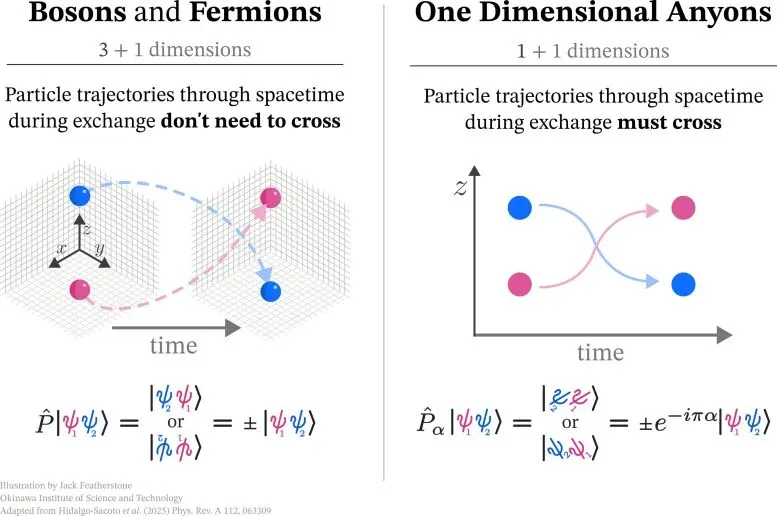
The usual way to classify particles depends on how identical particles act when they swap places. In three-dimensional space, experiments show only two possible results. Either the system stays the same, like with bosons, or it changes sign, like with fermions.
This behavior comes from the quantum rule that identical particles cannot be told apart. When two such particles swap positions, the system must remain physically the same. Raúl Hidalgo-Sacoto, a PhD student at OIST, explained that this exchange is like doing nothing. So, the math that governs it, called the exchange factor, must follow a simple rule: its square must be one.
The only two numbers that fit this rule are +1 and -1. This is why all particles must be either bosons (factor is +1) or fermions (factor is -1).
This difference leads to very different physical behaviors. Bosons tend to work together, like in lasers. Fermions, however, cannot be in the same state. This property helps form atoms and the periodic table.
In lower dimensions, things change. Particles have fewer ways to move around each other. Swapping places becomes linked to their paths through space and time. This means the system might not return to the exact same state after particles swap. Hidalgo-Sacoto explained that in lower dimensions, this exchange is no longer the same as doing nothing.
To follow the rule of indistinguishability, exchange factors can be a continuous range of numbers. These factors depend on the exact twists and turns of the paths. This allows for a new type of particle with exchange factors not limited to +1 or -1. These are called anyons.
Creating Adjustable Anyons
Hidalgo-Sacoto and his team showed that in one-dimensional systems, this wider range of behavior continues. It can even be adjusted. In one dimension, particles cannot move around each other. They must pass through one another. This changes how their exchange is defined.
The researchers found that the exchange factor is directly connected to how strongly particles interact at short distances. This link lets scientists change the exchange behavior in a controlled way. This opens up new possibilities for experiments.
Professor Busch noted that they not only found that one-dimensional anyons can exist, but also how their exchange can be mapped. He added that their nature can be seen through their momentum distribution. The experimental setups needed for these observations already exist.