For decades, dark matter has been the universe's most elusive rock star: everyone knows it's out there, its gravitational pull is undeniable, but nobody's actually seen it. Now, a new hypothesis suggests it's not just shy, but also a bit of a chameleon, possibly existing in two different forms. This could finally explain why we see hints of it in our own galaxy, but not in others.
The idea, published in the Journal of Cosmology and Astroparticle Physics, suggests that the absence of a signal can be just as telling as its presence. Basically, the universe isn't always going to give us the same clues, and that's okay.
The Milky Way's Peculiar Glow
Here's the rub: scientists have spotted an excess of gamma radiation right in the heart of the Milky Way. One leading theory is that this glow comes from dark matter particles annihilating each other in a spectacular, high-energy light show. The problem? We haven't seen a clear encore in other galactic neighborhoods, especially in smaller, dimmer dwarf galaxies. This new research says, "Hold on, that doesn't mean dark matter isn't the culprit."
We're a new kind of news feed.
Regular news is designed to drain you. We're a non-profit built to restore you. Every story we publish is scored for impact, progress, and hope.
Start Your News DetoxInstead, what if dark matter isn't a single, uniform entity? What if it's got different components that behave differently depending on their surroundings? Gordan Krnjaic, a physicist at Fermilab and one of the study's authors, points to the Fermi Gamma-ray Space Telescope, which has consistently shown this photon excess around our galactic disk. While pulsars could be throwing off some of these emissions, the dark matter theory is compelling.
To really test this, you have to look beyond our own cosmic backyard. If certain dark matter theories hold true, Krnjaic notes, those signals should be popping up in every galaxy, including the little guys.
Why Dwarf Galaxies Are the Universe's Best Dark Matter Labs
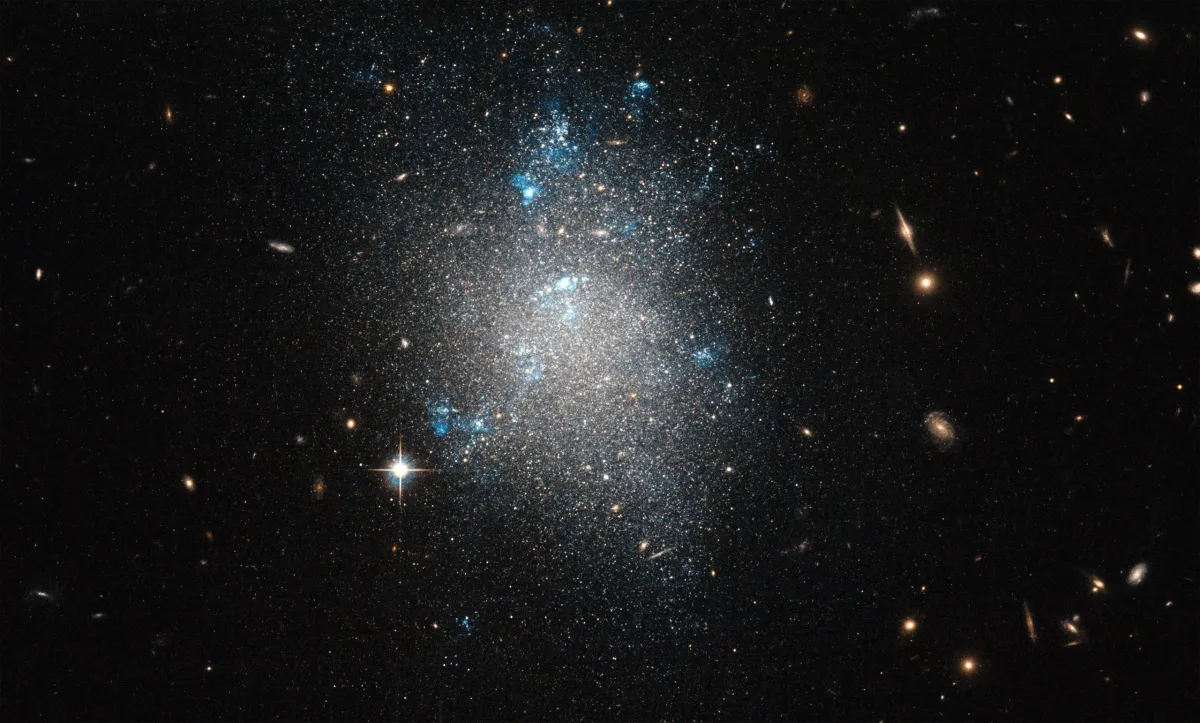
Dwarf galaxies are small, unassuming, and surprisingly packed with dark matter. Crucially, they have very little "background noise" from stars, making them ideal for spotting faint signals. Think of them as the quietest room in the universe for a very specific type of eavesdropping.
Typically, dark matter models propose two scenarios for particle annihilation: either the interaction rate is constant, regardless of particle speed (meaning signals should be everywhere), or it depends on speed, making interactions incredibly rare (and signals almost impossible to find anywhere).
Neither of these standard scenarios quite explains the Milky Way's unique gamma-ray signature if dwarf galaxies remain silent. Which is where Krnjaic and his team step in with their clever two-particle solution.
What if dark matter is actually made of two distinct particles that need to find each other to go poof? In this model, the annihilation rate isn't just about how much dark matter is around, but specifically about the ratio of these two different types. Our Milky Way might have a Goldilocks zone — just the right mix for frequent interactions. Dwarf galaxies, on the other hand, might have an abundance of one type and hardly any of the other, making those crucial particle meet-ups much less likely.
This approach, Krnjaic explains, drastically changes the predictions for emissions. It offers a much-needed flexibility, allowing dark matter to be the source of our galaxy's mysterious glow without forcing us to see it everywhere else. Because apparently, even dark matter can have a preferred hangout spot.
Future observations from the Fermi Gamma-ray Telescope will be key. If dwarf galaxies eventually start showing gamma-ray signals, it might suggest a more even distribution of these two dark matter components. If they remain stubbornly quiet, well, it could mean one type is just playing hard to get. Either way, the universe just got a little more interesting.