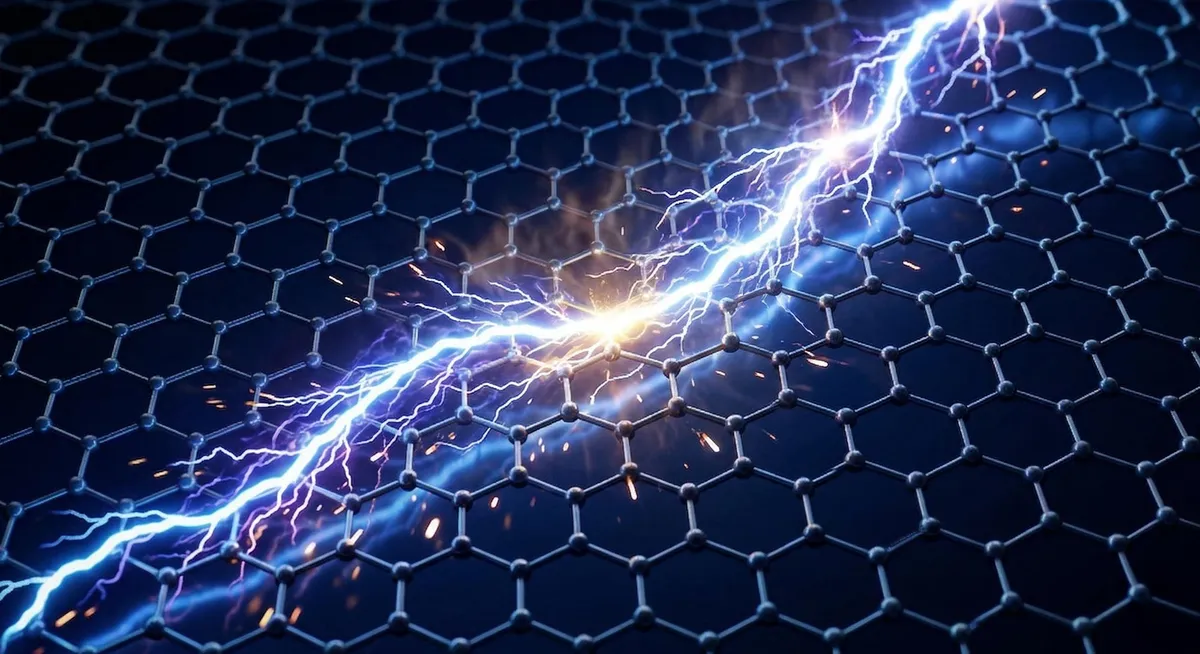
Imagine a world where your phone never got hot, and power lines didn't lose a single electron to the ether. That's the dream of superconductivity: electricity flowing with zero resistance, zero energy lost. For decades, scientists have been trying to make this dream a reality, usually by chilling materials to absurdly cold temperatures.
Now, a team led by physicist Chun Ning (Jeanie) Lau at The Ohio State University has found a new trick. Instead of radically altering the material itself, they discovered they could simply change its surroundings to switch superconductivity on and off. Because apparently that's where we are now: flipping a switch on the fabric of reality.
The Graphene Twist
The star of this show is something called twisted bilayer graphene. Take two sheets of carbon, stack them, and then twist one ever so slightly. That subtle rotation creates a whole new world of quantum weirdness.
We're a new kind of news feed.
Regular news is designed to drain you. We're a non-profit built to restore you. Every story we publish is scored for impact, progress, and hope.
Start Your News DetoxLau's team placed this twisted graphene on a synthetic base called strontium titanate. This allowed them to meticulously tweak the environment and watch how electrons, those tiny rebels of the atomic world, started behaving. Normally, electrons are like cranky toddlers, pushing each other away. But in superconductors, they pair up, forming an orderly queue that glides through the material without a fuss.
By subtly adjusting these paired interactions, the scientists could essentially tell the electrons, "Okay, you can be super-conductive now," and then, "Alright, break it up, regular electricity time." It's like having a dimmer switch for a quantum phenomenon.
What's wild is that more adjustments didn't always mean more superconductivity. Sometimes, it actually dialed it back. This is counter-intuitive to how most superconductors work, proving that twisted bilayer graphene is playing by its own rules.
Powering the Future (Without the Heat)
This isn't just a cool party trick for physicists. The ability to control superconductivity at potentially higher temperatures—maybe even room temperature someday—would be, to put it mildly, a very big deal. Think hyper-efficient electronics, power grids that don't hemorrhage energy, and communications that are faster and cooler.
As Xueshi Gao, a PhD student and lead author, puts it, the exact mechanism for superconductivity in twisted bilayer graphene is still a bit of a mystery. But these results offer a tantalizing new pathway for understanding it. The paper, published in Nature Physics, is just an early step into a complex electronic dance.
For now, the field is buzzing. Because showing you can flip a quantum switch with a little environmental nudge? That's the kind of discovery that makes you want to tell someone about it.