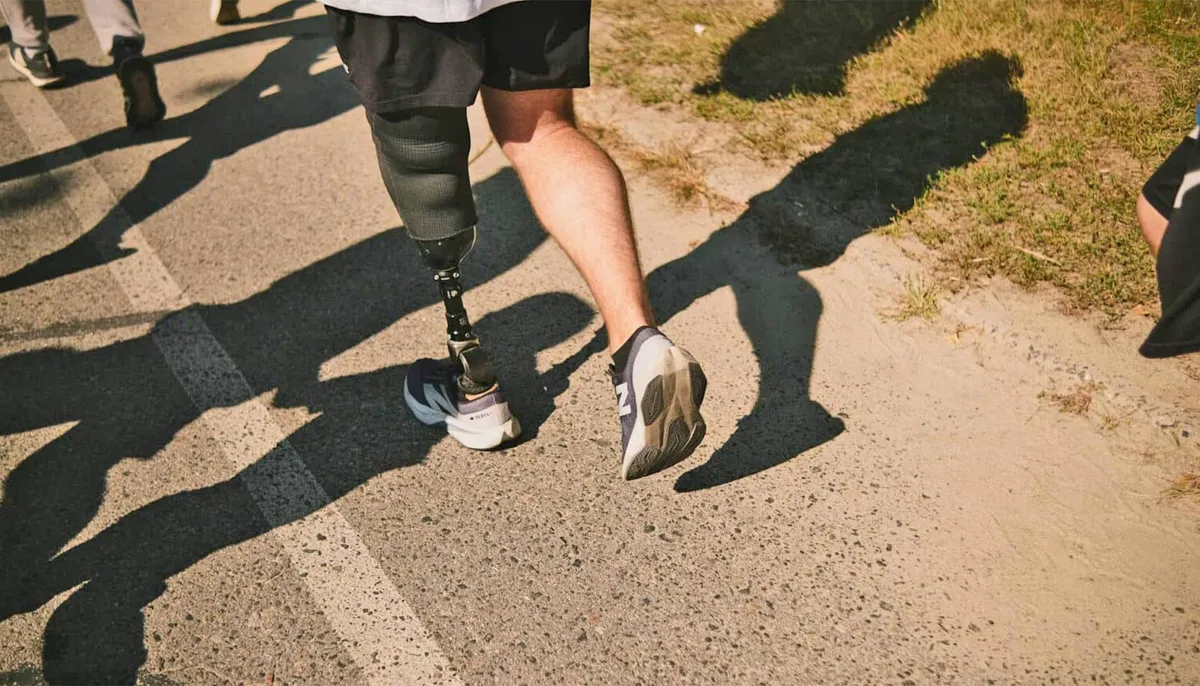
When you learn to walk with a robotic prosthetic leg, your brain plays a trick on you. At first, you think you're stumbling more than you actually are. Then, after a few days of practice, you swing to the opposite extreme—you think you're moving smoothly when you're really not. Both times, you're wrong. But the second kind of wrong might be the bigger problem.
Researchers at North Carolina State University wanted to understand how people mentally map their own movement when wearing a lower-limb robotic prosthetic. The question matters because that mental image—your sense of how your body is moving through space—directly shapes how well you can improve. If your brain is telling you something false, you stop trying to get better.
The Gap Between Feeling and Reality
Nine able-bodied participants walked on a treadmill wearing a robotic prosthetic with their knee bent at a right angle. Over four days, they practiced walking as fast as possible. After each session, they watched computer animations of different walking patterns and picked which one matched what they'd just done.
We're a new kind of news feed.
Regular news is designed to drain you. We're a non-profit built to restore you. Every story we publish is scored for impact, progress, and hope.
Start Your News DetoxThe results were consistent but strange. On day one, participants felt their gait was jerky and off-balance—worse than it objectively was. By day four, their actual walking had improved significantly. But their perception had flipped: now they thought they were moving more smoothly than they really were. The performance gap had closed, but the confidence gap had widened.
Helen Huang, the biomedical engineering professor leading the work, describes this as a fundamental mismatch between body image and reality. It's not unique to prosthetics—dancers and athletes experience similar distortions when learning new skills. But with a prosthetic, the stakes feel different. You're not just learning a movement; you're learning to live in an altered body.
Why This Matters
The researchers discovered something revealing about where people's attention went. When assessing their own walking, participants focused almost entirely on their torso position. They barely registered what the prosthetic itself was doing. This makes intuitive sense—you can feel your core moving, but you can't see the prosthetic working. You're flying partially blind.
That overconfidence that builds over time might actually slow improvement. If you already believe you're walking well, you're less motivated to refine your technique, even when room for improvement clearly exists. It's the opposite of what you need during the critical early learning phase.
The path forward is practical: give people better feedback about what's actually happening. Visual displays, perhaps, or other sensory cues that help recalibrate their mental model of their own movement. "We think it would be valuable to find a way to give people a more accurate assessment of how their body is really moving," Huang said.
The research, published in PNAS Nexus, hints at a broader principle: learning to use assistive technology isn't just physical. It's cognitive. Your brain has to catch up to your body's new reality before either one can truly adapt.