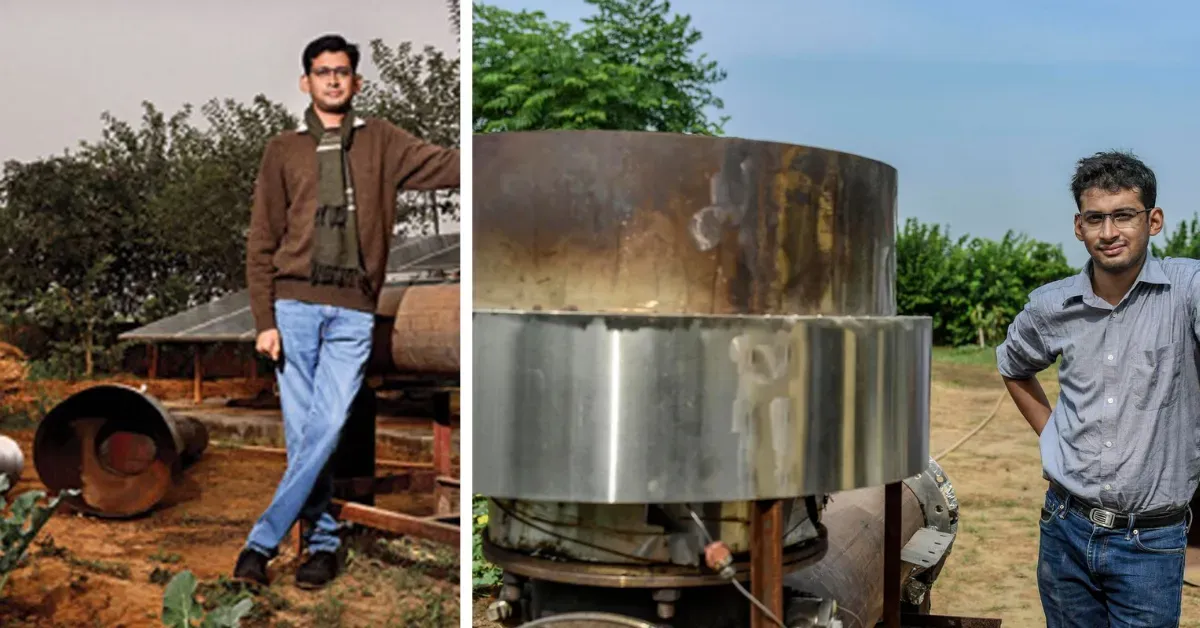
Every winter, northern India disappears under smoke. Farmers burn leftover paddy stubble after harvest—a practice so routine it's become seasonal, so toxic it turns Delhi's air into something you can see. Vidyut Mohan grew up breathing it. He knew bans wouldn't work. Farmers needed a reason not to burn, not just a rule against it.
That realization led him to co-found Takachar with Kevin Kung. Instead of treating crop residue as waste to dispose of, they built a machine that turns it into something farmers actually want: biochar, which locals call 'black gold'.
From Smoke to Soil
The machine attaches to a tractor. It heats stubble to between 400 and 700 degrees Celsius in a low-oxygen environment—a thermochemical process that converts waste into carbon-rich biochar. The output works two ways: farmers can plow it back into soil to improve health and water retention, or sell it as biofuel. Either way, it's money or fertility that burning would never have provided.
We're a new kind of news feed.
Regular news is designed to drain you. We're a non-profit built to restore you. Every story we publish is scored for impact, progress, and hope.
Start Your News DetoxOne unit processes a tonne of stubble per hour, which means it works at village scale, not just industrial scale. That matters. It means a cooperative can afford one, or a cluster of farms can share it. In Punjab and Haryana alone, farmers now use around 3,000 tonnes of biochar annually. The result: stubble burning in Punjab dropped nearly 90% in a single season.
That's not a projection or a pilot. That's what happened when the alternative became practical.
The Economics of Staying Put
Takachar's real innovation isn't just the machine—it's keeping the operation local. The company trains villagers to run the equipment themselves. Skills stay in the community. Profits stay in the community. For Vidyut, the calculus is straightforward: cleaner air, additional income for farmers, stronger rural economies. No need to choose between them.
The work has drawn international attention. Takachar won Prince William's Earthshot Prize—sometimes called the Eco Oscars—for tackling air pollution and climate change. But the real validation comes from Punjab itself, where millions of tonnes of stubble still burn across the region each year. This solution proves the problem was never awareness. It was never even technology, really. It was viable alternatives. Give farmers a better option, and they'll take it.
As the practice spreads to other crop residues and regions, the question shifts from whether this works to how fast it can scale.