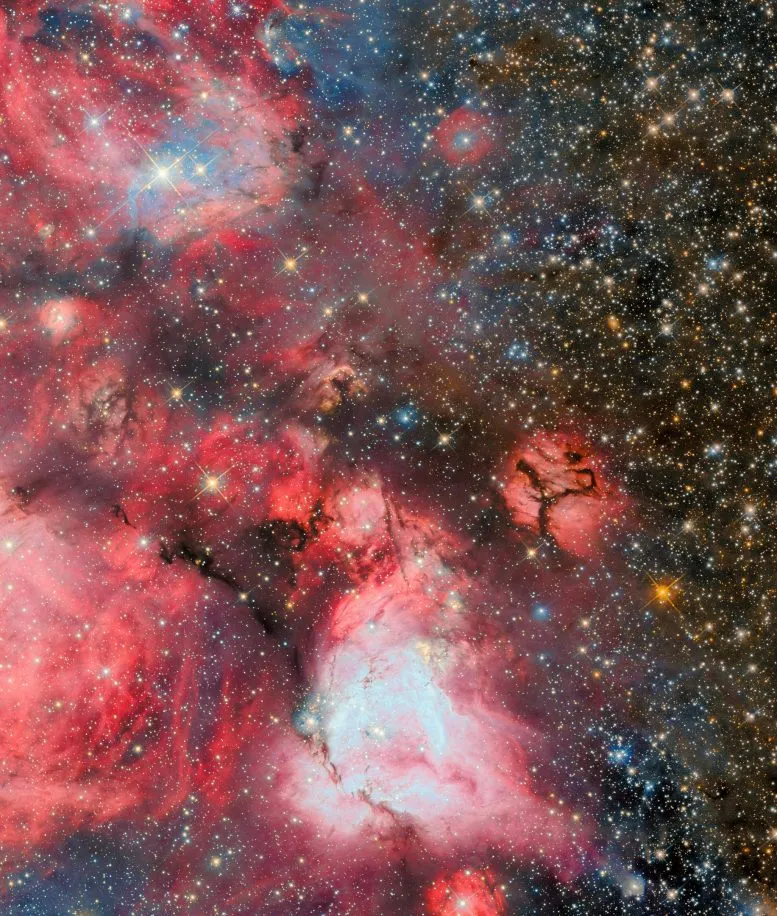
160,000 light-years away, inside a cloud called N159, stars are being born right now—and they're reshaping their entire neighborhood in the process.
The Hubble Space Telescope just captured fresh images of this stellar nursery, a region so massive it stretches across 150 light-years of space. To put that in perspective: if you traveled at light speed, it would take 150 years to cross it. This cloud sits in the Large Magellanic Cloud, a smaller galaxy orbiting our own Milky Way, close enough (in cosmic terms) for astronomers to watch star formation unfold in remarkable detail.
What makes N159 so visually striking isn't just the stars themselves—it's what they're doing to the gas around them. When newborn stars ignite, they don't quietly settle into their surroundings. Instead, they blast out intense radiation and fast-moving streams of charged particles, heating and shoving the surrounding hydrogen gas outward. Over time, this creates hollow cavities that look like enormous bubbles carved into the cloud. Some young stars sit at the center of these voids, still glowing red from the hydrogen gas they've energized but visibly pushing it away.
We're a new kind of news feed.
Regular news is designed to drain you. We're a non-profit built to restore you. Every story we publish is scored for impact, progress, and hope.
Start Your News DetoxThis process, called stellar feedback, is fundamental to how galaxies evolve. The same forces that clear these bubbles can slow star formation in some areas while triggering it in others—essentially sculpting where the next generation of stars will be born. Astronomers have long suspected this happens, but seeing it in action, in such vivid detail, confirms how actively young stars reshape their cosmic birthplace.
The Hubble image released this week improves on a 2016 version by adding observations at a new wavelength of light, which highlights the hot gas surrounding newborn stars more clearly. This gives researchers a sharper view of exactly how these stellar winds and radiation interact with their environment.
What happens next in N159 will unfold over millions of years—but astronomers will be watching.