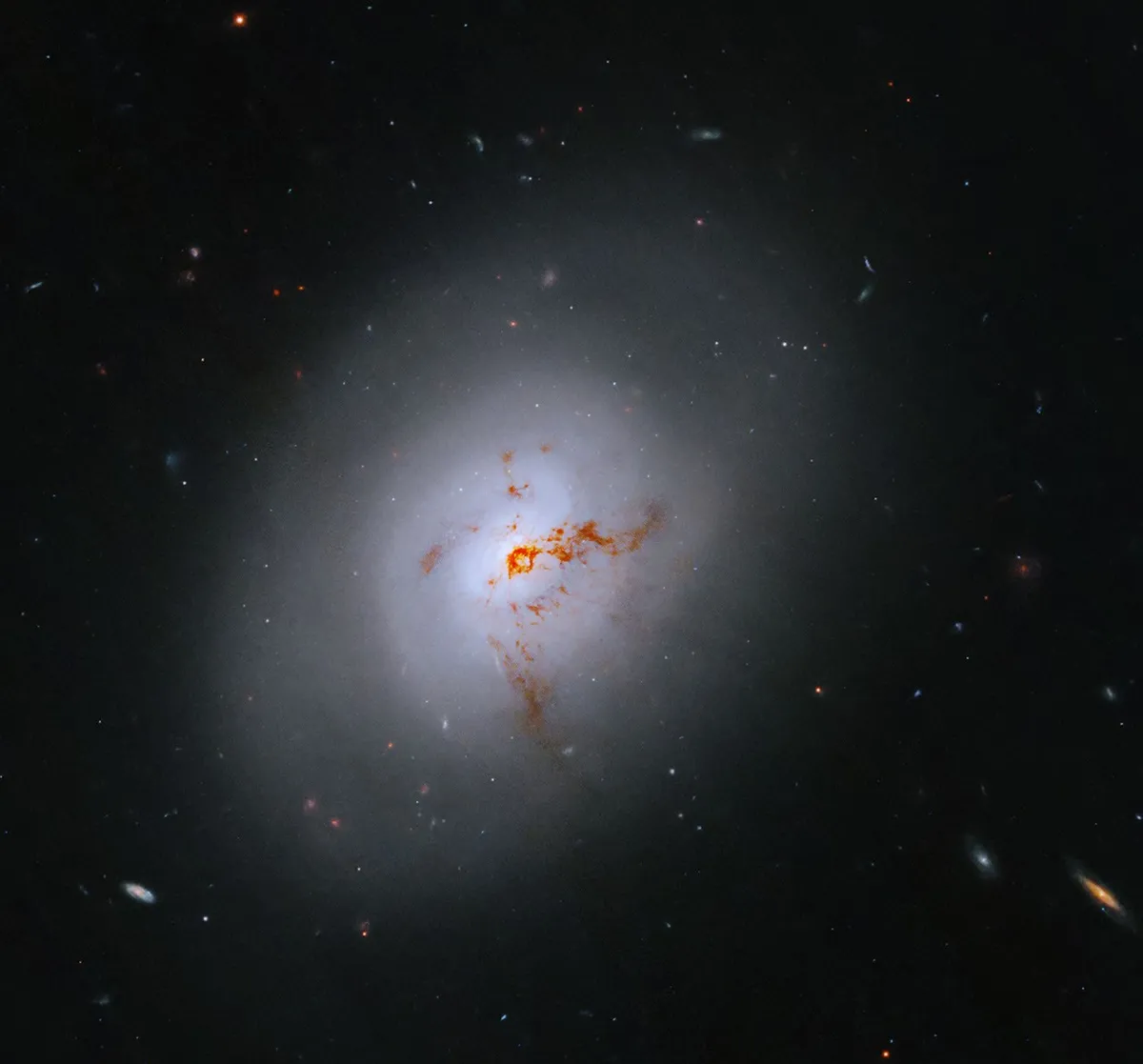
This NASA Hubble Space Telescope image shows NGC 1266, a galaxy with a bright center. It looks like it might have spiral arms, but it doesn't. Reddish-brown dust clouds hide parts of the galaxy. Light from distant galaxies shines through its outer edges.
NGC 1266 is a lenticular galaxy about 100 million light-years away in the constellation Eridanus. Lenticular galaxies are a bridge between spiral and elliptical galaxies. They are lens-shaped with a bright center and flat disk, like spirals. But they lack spiral arms and form few new stars, like ellipticals.
A Galaxy in Transition
NGC 1266 is special because it's a rare "post-starburst" galaxy. This means it's changing from a galaxy that made many stars quickly to a quieter elliptical galaxy. Post-starburst galaxies have young stars but few areas where new stars are forming. Only about one percent of local galaxies are like this.
We're a new kind of news feed.
Regular news is designed to drain you. We're a non-profit built to restore you. Every story we publish is scored for impact, progress, and hope.
Start Your News DetoxAstronomers believe NGC 1266 merged with another galaxy about 500 million years ago. This merger caused new stars to form and increased the size of its central bulge. It also fed gas into the galaxy's supermassive black hole, making it very active. This active black hole created strong winds and jets of gas.
Over time, these new stars and the black hole's jets used up the gas needed to form stars. The turbulence from these processes also stopped new stars from forming in the remaining gas.
Black Holes and Star Formation
Hubble and other telescopes show a strong outflow of gas from NGC 1266. The space between its stars is also highly disturbed. Researchers found that any remaining star-forming regions are only in the galaxy's core. Very few, if any, new stars form outside this core.
These findings suggest the supermassive black hole at the galaxy's heart might be stopping star birth. It could be stripping or ejecting gas needed for stars. The shockwaves from this process would create turbulence. This turbulence would disturb the gas and dust, preventing it from clumping together to form new stars.
Studying post-starburst galaxies like NGC 1266 helps astronomers. They can learn about the complex ways star formation is stopped. This also helps us understand how galaxies evolve and how supermassive black holes affect their host galaxies.
Deep Dive & References
Hubble Space Telescope - NASA