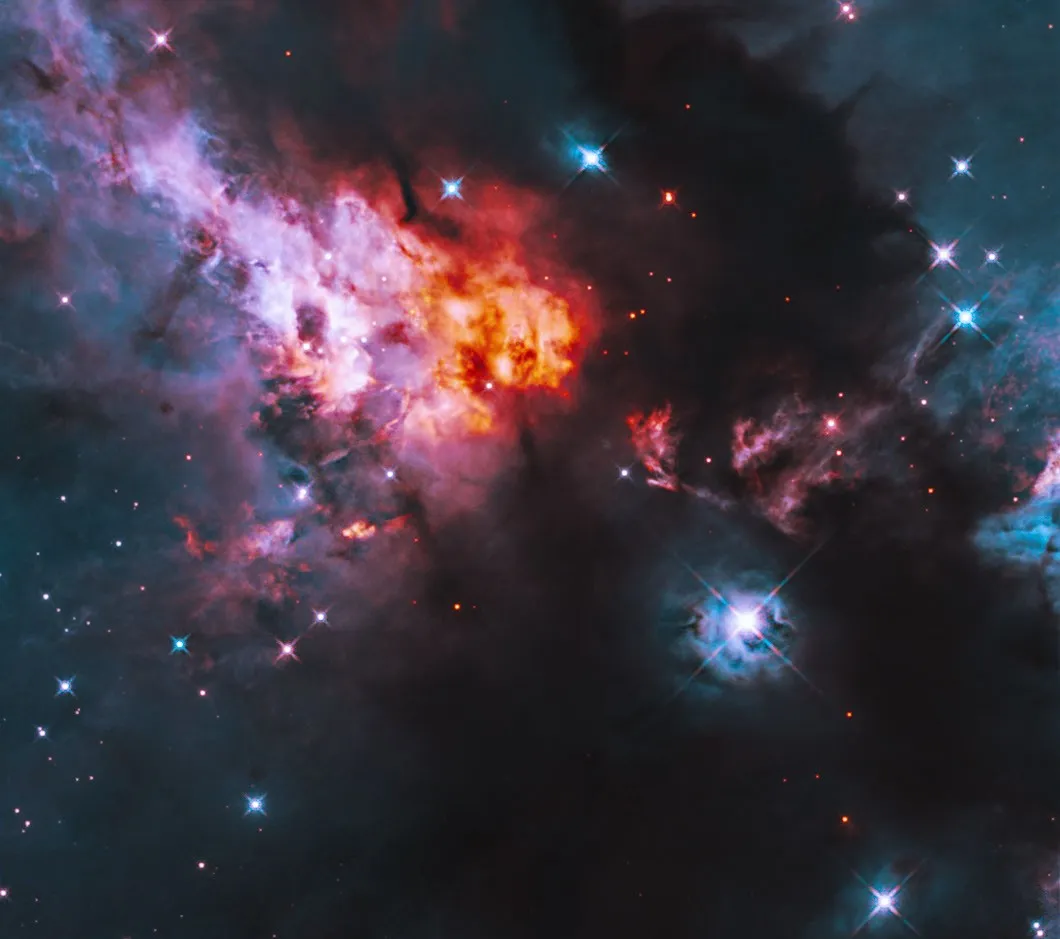
Somewhere 2,400 light-years away, inside clouds of dust so thick that visible light can't penetrate them, stars are being born right now. NASA's Hubble Space Telescope just caught them in the act.
The trick is that newborn stars — called protostars — are hidden behind walls of dust and gas. But Hubble can see through that darkness using infrared light, the same way thermal cameras can see heat signatures through fog. When a protostar jets out streams of hot gas, those jets punch holes in the surrounding dust, and infrared light escapes through the gaps. That's what Hubble photographed: not the stars themselves, but the light leaking out from their nurseries.

Why does this matter? Astronomers still don't fully understand how massive stars form — the ones with more than eight times the mass of our Sun. These new images are part of a systematic survey called SOMA (Massive Star Formation Survey) designed to solve that puzzle. By studying what happens around protostars at different ages — their outflows, brightness, mass, and environment — researchers can test their theories about stellar birth.
We're a new kind of news feed.
Regular news is designed to drain you. We're a non-profit built to restore you. Every story we publish is scored for impact, progress, and hope.
Start Your News DetoxThe images reveal something visually striking too. In the Cepheus A region, hidden protostars illuminate surrounding gas clouds from within, creating glowing pink and white nebulae. That pink glow is ionized hydrogen, excited by the intense ultraviolet radiation from nearby young stars. It's what stellar nurseries look like when you know how to look.

One particularly active protostar, IRAS 20126+4104, sits 5,300 light-years away in the constellation Cygnus. It's a B-type protostar — the kind destined to become a massive, hot, bluish-white star. The jets shooting from its poles are so energetic they're creating a bright region of glowing hydrogen visible even through all that dust. Ground-based observatories spotted those jets years ago; Hubble's new images show the full context of what's happening around them.

This is just the beginning of the data release. NASA is publishing new images daily through mid-January 2026, adding to the archive of stellar construction zones. Each image is another piece of the puzzle about how the universe builds its most massive stars.