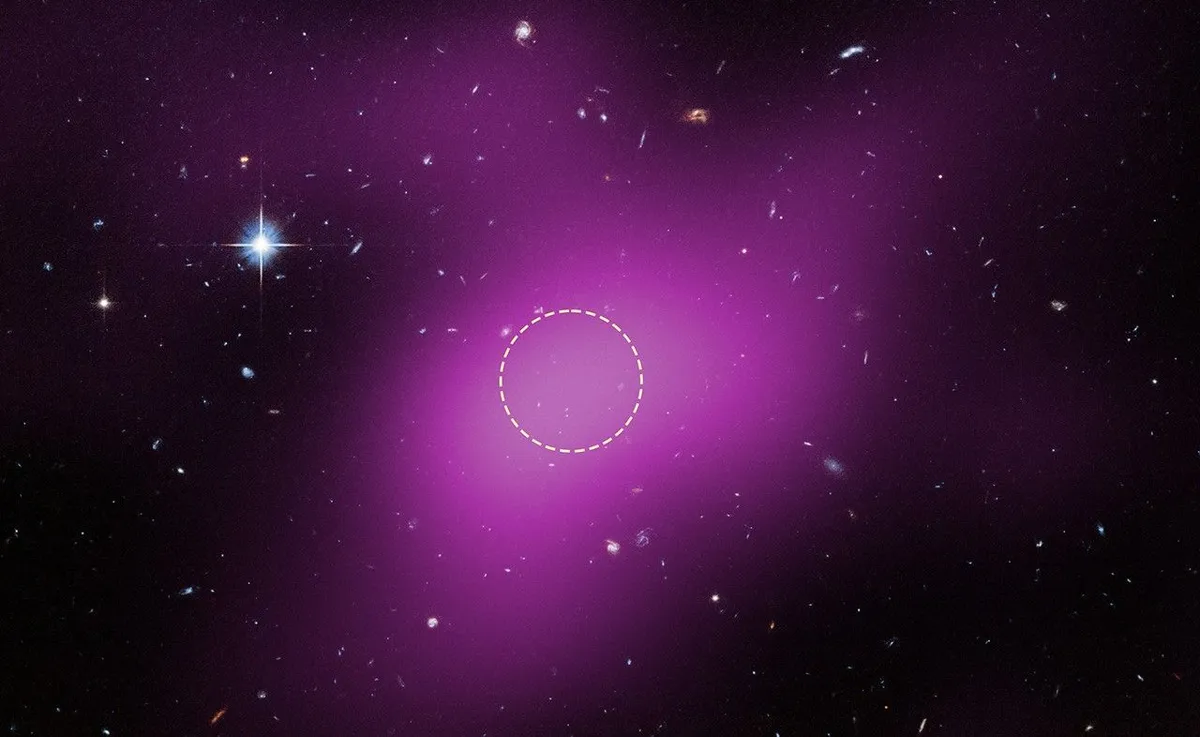
Astronomers have found something that shouldn't exist — a cloud of gas and dark matter that looks like it should have become a galaxy, but never did.
Nicknamed Cloud-9, it's the first confirmed detection of what scientists call a RELHIC (Reionization-Limited H I Cloud) — essentially a failed galaxy, a relic from the early universe that got stuck in an in-between state. The discovery, made using NASA's Hubble Space Telescope and confirmed by ground-based radio observatories, is forcing astronomers to rethink how galaxies form and what role dark matter plays in that process.
"This is a tale of a failed galaxy," said Alejandro Benitez-Llambay of Milano-Bicocca University, the study's principal investigator. "In science, we usually learn more from the failures than from the successes. In this case, seeing no stars is what proves the theory right."
We're a new kind of news feed.
Regular news is designed to drain you. We're a non-profit built to restore you. Every story we publish is scored for impact, progress, and hope.
Start Your News DetoxThe discovery of an invisible world
Cloud-9 was first spotted three years ago by the Five-hundred-meter Aperture Spherical Telescope (FAST) in China as part of a radio survey. But here's where it gets interesting: radio data alone can't prove a cloud is starless. You need to actually look. So astronomers pointed Hubble at it — and found nothing. No stars. Just gas and dark matter, hanging in space near the spiral galaxy Messier 94.
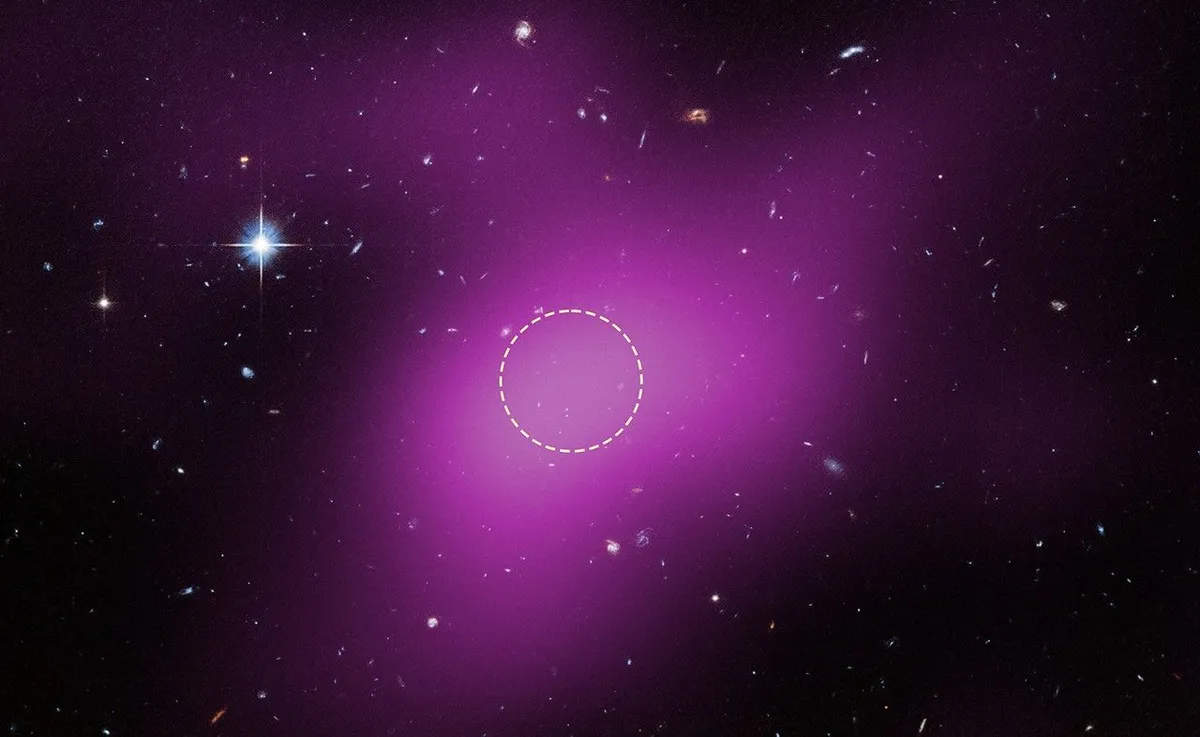
Magenta is radio data from the ground-based Very Large Array (VLA) showing the presence of Cloud-9. The dashed circle marks the area where researchers focused their search for stars. Hubble found no stars within Cloud-9. The few objects within its boundaries are background galaxies.
The cloud itself is about 4,900 light-years across — smaller and more compact than other hydrogen clouds astronomers have studied. It contains roughly one million times the mass of our Sun in gas, but the real story is what's holding it together: about five billion solar masses of dark matter. That's the invisible stuff that makes up most of the universe's mass, and it's almost impossible to detect directly.
"This cloud is a window into the dark universe," said Andrew Fox of the Space Telescope Science Institute. "We know from theory that most of the mass in the universe is expected to be dark matter, but it's difficult to detect this dark material because it doesn't emit light. Cloud-9 gives us a rare look at a dark-matter-dominated cloud."
Why a failed galaxy matters
Theory predicted these objects should exist. Early in the universe's history, gravity pulled gas and dark matter together into clouds. Most of these clouds accumulated enough mass to collapse, heat up, and ignite nuclear fusion — becoming the first stars and galaxies. But some clouds, it was thought, would get stuck in between. Too small to collapse into stars, but too massive to disperse. Cloud-9 appears to be exactly that: a primordial building block that time forgot.
Finding it matters because it proves the theory works. And if one exists in our cosmic neighborhood, there are likely others. Each one is a window into the early universe and the physics of dark matter — the dominant force shaping how galaxies form and evolve. These aren't just curiosities. They're keys to understanding the universe's architecture.
Cloud-9 exists in what researchers call a "sweet spot." If it were much larger, it would have already collapsed into a normal galaxy. If it were much smaller, its gas would have been stripped away long ago. For now, it remains frozen in time — a relic of how the universe used to work, still visible in our own galactic backyard.