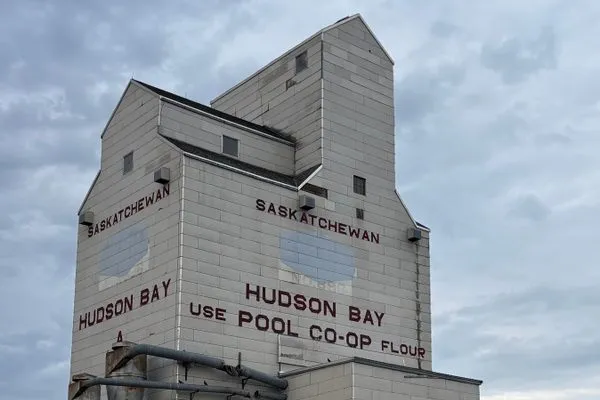
In Hudson Bay, Saskatchewan, a wooden grain elevator still stands against the flat prairie horizon—one of the last of its kind. For most of the 20th century, these structures were as common as telephone poles across the Canadian prairies. Farmers would drive their harvest to the local elevator, sell their wheat, and catch up with neighbors in the process. The building was the economic anchor of every railway town.
Today, most of those elevators are gone, replaced by industrial concrete facilities or simply demolished as they aged. The Hudson Bay elevator survives as a working reminder of how rural economies actually functioned—not as a museum piece, but as a structure that still matters to the people who live there.
What makes grain elevators worth preserving isn't nostalgia. These buildings are architectural records of a specific moment in North American history: when farming communities were dense enough to support local infrastructure, when the wheat trade moved through small towns rather than around them. The elevator's wooden frame, its mechanical systems, its very presence on the landscape tells you something true about how people lived and worked.
We're a new kind of news feed.
Regular news is designed to drain you. We're a non-profit built to restore you. Every story we publish is scored for impact, progress, and hope.
Start Your News DetoxThe structure also represents something less tangible but equally real—the accumulated knowledge of farmers who understood their land, their crop cycles, and their neighbors' needs well enough to build institutions around them. That kind of localized agricultural knowledge has largely disappeared, replaced by global supply chains and industrial-scale farming. Whether that's progress or loss depends partly on what you value, but it's undeniably a shift.
Preserving the Hudson Bay elevator means more than keeping one building from rotting. It's a way of saying that this particular way of organizing economic life—rooted in place, built on relationships, scaled to what a community could actually manage—deserves to be remembered and studied. New generations can walk past it and understand, in concrete terms, how their grandparents' world worked.
The elevator stands as part of a larger pattern across the prairies, where heritage grain elevators are slowly being recognized as cultural landmarks worth protecting. Some have been converted to museums or community spaces. Others, like Hudson Bay's, remain in use. Either way, they're becoming less invisible.