An international team of archaeogeneticists has settled a long-running scientific debate: humans first arrived in Australia and New Guinea around 60,000 years ago, not 45,000 as some researchers had argued. The evidence comes from analyzing nearly 2,500 mitochondrial DNA genomes from Aboriginal Australians, New Guineans, and people across Southeast Asia and the western Pacific.
The finding matters because it aligns with what Indigenous communities have always known—that their presence in this region stretches back tens of thousands of years into deep time. For Western science, it's a moment of convergence: genetic data, archaeological evidence, and paleoenvironmental records now tell the same story.
Two competing timelines
For decades, researchers have debated exactly when Homo sapiens first crossed the sea to settle Sahul (the ancient landmass that connected Australia and New Guinea before rising sea levels separated them). The "long chronology" proposed 60,000 years ago. The "short chronology" suggested a much later arrival—between 45,000 and 50,000 years ago. Both camps had evidence, and the disagreement persisted even as genetic studies multiplied.
We're a new kind of news feed.
Regular news is designed to drain you. We're a non-profit built to restore you. Every story we publish is scored for impact, progress, and hope.
Start Your News DetoxThen something shifted. In recent years, many geneticists began favoring the shorter timeline. This new research, led by teams at the University of Huddersfield, the University of Southampton, and collaborators in Portugal, Australia, and Oxford, pushes back against that trend with a larger dataset and a clearer methodology.
Reading the molecular clock
The researchers focused on mitochondrial DNA—genetic material inherited only from mothers, which allowed them to trace maternal lineages with precision. By analyzing how DNA sequences vary between individuals, they reconstructed a genealogical tree spanning populations across the region. Then they used a technique called the "molecular clock," which measures how much DNA has changed over time, to date when lineages diverged.
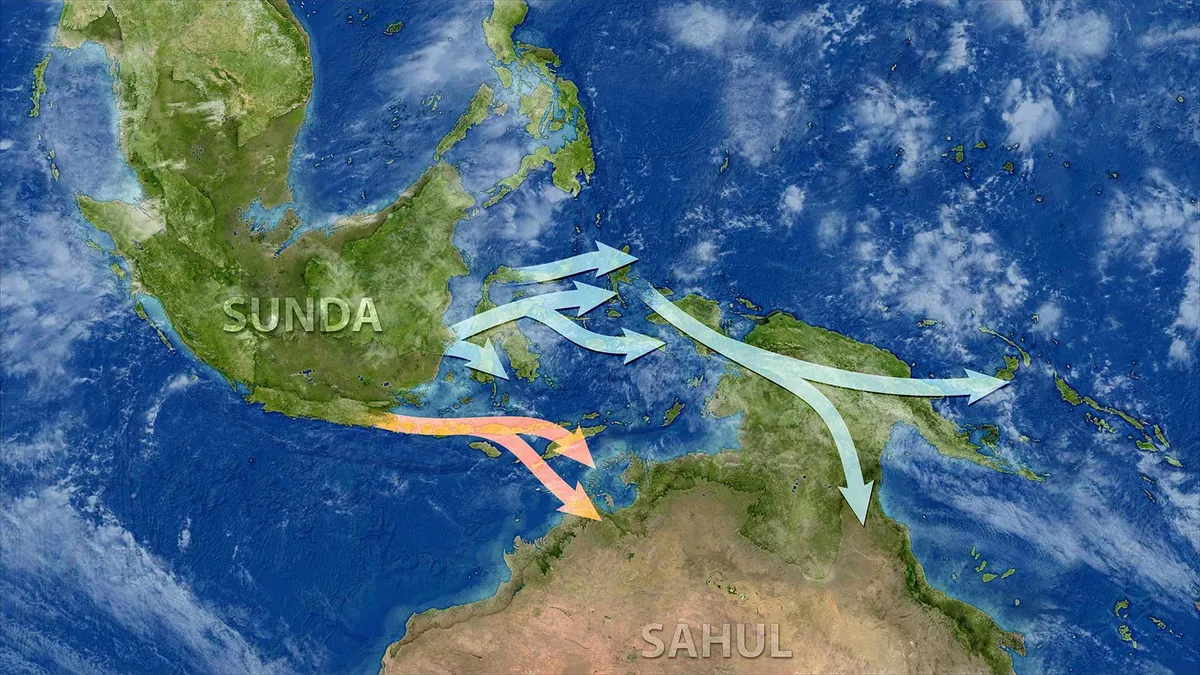
The most ancient lineages found in Aboriginal Australians and New Guineans—but nowhere else—dated to around 60,000 years ago. That's the key finding. But there's more texture to it: those ancestral lineages traced back to Southeast Asia, but not from a single source. Some came from northern Indonesia and the Philippines; others from southern Indonesia, Malaysia, and Indochina. This suggests at least two distinct seafaring routes into Sahul, both active around the same time.
For a moment, consider what that means. These weren't accidental drifts. These were navigational journeys across open ocean, made by people with maritime knowledge and technology sophisticated enough to establish multiple settlement routes to a distant landmass. The scale of human capability—and ambition—was already vast 60,000 years ago.
What comes next
The researchers acknowledge that molecular clock estimates can always be challenged, and mitochondrial DNA represents only one line of descent. They're now analyzing hundreds of complete human genomes—each containing 3 billion bases compared to mitochondrial DNA's 16,000—to test their findings across thousands of other ancestral lines. That work will either strengthen the 60,000-year timeline or reveal new complexity. Either way, the conversation between genetic data and Indigenous knowledge is deepening, and that's where the real progress lies.