Engineers have a frustrating problem: aluminum is perfect for cars—it's light, recyclable, and cheap—but it rusts in ways they don't fully understand. Now researchers at Tohoku University have figured out how to watch corrosion happen in real time, which could mean better engines, suspensions, and transmissions that last longer.
The challenge has always been that aluminum alloys are structurally complex. When salt water (or road salt spray) hits them, tiny pits form and spread, eating away at the metal from the inside. But pinpointing where these pits start has been nearly impossible. You'd need to see the corrosion as it happens, at the microscopic level, without the surrounding mess of chemical reactions clouding your view.
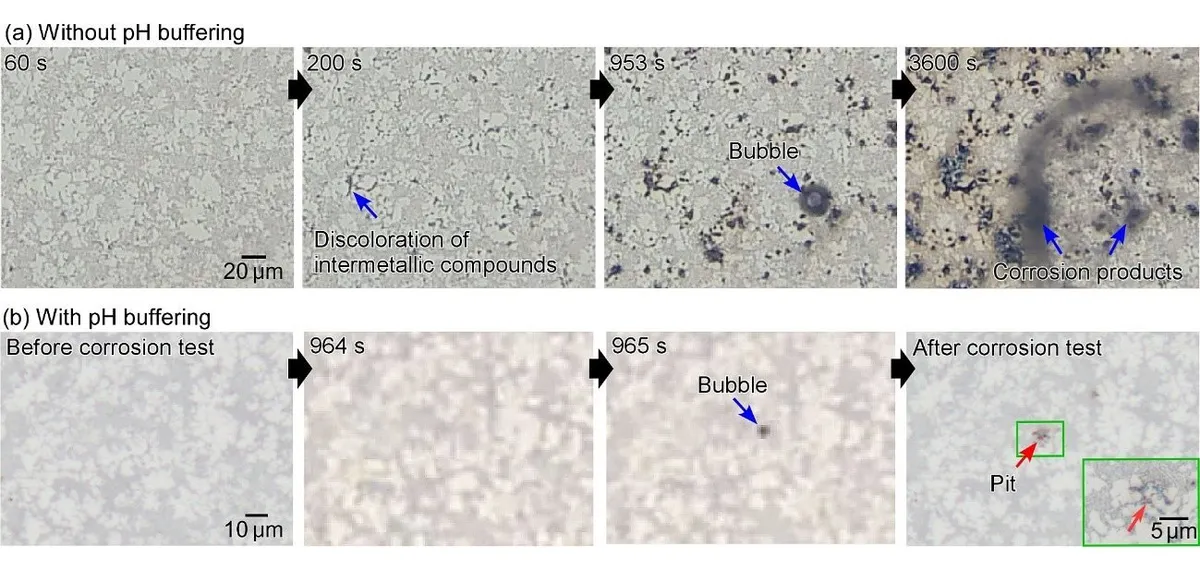
The team developed a clever workaround. They combined real-time optical microscopy with a special buffer solution that prevents discoloration and chemical buildup around the metal's internal structures. Essentially, they cleaned up the view so they could actually see where the damage begins.
We're a new kind of news feed.
Regular news is designed to drain you. We're a non-profit built to restore you. Every story we publish is scored for impact, progress, and hope.
Start Your News DetoxWhat they found was striking: in the aluminum-silicon-copper alloy they tested (ADC12), pits consistently started in the final regions where the molten metal solidified during casting. But here's the catch—not every final solidification region corroded. This means the metal's exact chemical makeup and microscopic structure at that spot matters as much as the location itself.
"Being able to observe where and how these pits form is an exciting advancement," says Masashi Nishimoto from Tohoku University, "since it may help us find ways to prevent or slow down their formation for more long-lasting vehicle components."
The research, published in the Journal of The Electrochemical Society in January 2025, opens a door that's been stuck for years. Engineers can now start designing alloys that avoid these vulnerable spots, or strengthen them before they become problems. The technique works beyond just die-cast alloys, so it could reshape how we think about corrosion across the whole field.
For car manufacturers, this is tangible progress. Lighter, more durable vehicles aren't just better for fuel efficiency—they're better for the planet. And it all started with someone asking a simple question: what if we could just watch it happen?