Comets are known for being unpredictable. Scientists often struggle to guess their paths and how bright they will be. Now, an astronomer might have seen something truly unusual: a comet possibly reversing its spin.
This observation was shared on March 26 in the Astronomical Journal.
Comet 41P's Strange Spin
Nine years ago, comet 41P/Tuttle-Giacobini-Kresák, or 41P, slowed its spin dramatically. In early 2017, it took the comet about 46 to 60 hours to complete one rotation. This was more than twice its usual 20-hour spin.
Comets do change their rotation, but usually only by a few minutes. Dennis Bodewits, an astronomer at Auburn University, noted that such a drastic change by many hours has never been seen before.
We're a new kind of news feed.
Regular news is designed to drain you. We're a non-profit built to restore you. Every story we publish is scored for impact, progress, and hope.
Start Your News DetoxThe comet's rotation became even stranger. David Jewitt, an astronomer at UCLA, looked at old images from the Hubble Space Telescope taken in December 2017. He found that the comet's spin had sped up again to about 14 hours per rotation.
The simplest explanation for these events is that comet 41P slowed down, stopped, and then started spinning in the opposite direction.
How a Comet Reverses Direction
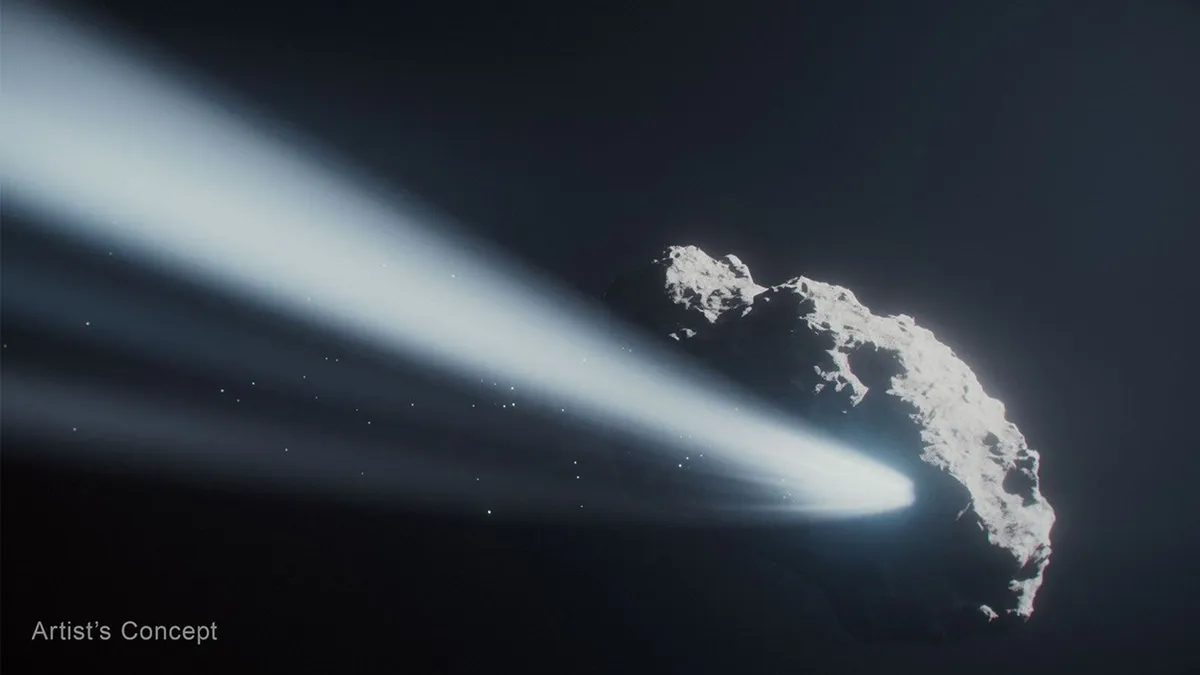
This reversal likely happened because the sun heated some of the comet's ice. This turned the ice into gas jets, which acted like small rocket thrusters. Jewitt explained that most of these powerful jets were probably on one side of the comet. This pushed the object to spin in a new direction.
Jewitt compared it to pushing a merry-go-round. If it's spinning one way, and you push against that motion, you can slow it down and then reverse it.
The comet is considered small, with a rocky center about 0.6 miles wide. Its small size likely makes it easier to twist. It's thought to have entered its current orbit about 1,500 years ago, after Jupiter's gravity moved it. Now, it passes through the inner solar system about every 5.4 years.
What This Means for Comets
Comets are icy leftovers from when the solar system formed about 4.6 billion years ago. They contain frozen gases, rock, and dust because they formed far from the sun's heat.
Qicheng Zhang, an astronomer at the Lowell Observatory, noted that most comets of this size probably change their rotation often. However, they usually don't come close enough to Earth for us to see these changes. Many are destroyed before we can observe their rotation a second time.
Jane Luu, an astronomer at the University of Oslo, agreed that scientists suspected comets could reverse their spin. She noted that this is the first time an observation has caught a comet doing it.
Most changes to a comet's structure take centuries. However, this new work suggests that comet 41P's surface is changing quickly. This offers a rare chance to watch a space rock transform in a human lifetime.
Jewitt's computer models suggest the comet's spin will keep speeding up. Eventually, the force from this motion will become stronger than the gravity holding it together. This will cause it to break into several pieces. While it's hard to say exactly when comet 41P will break apart, Jewitt believes it could happen in just a few decades.