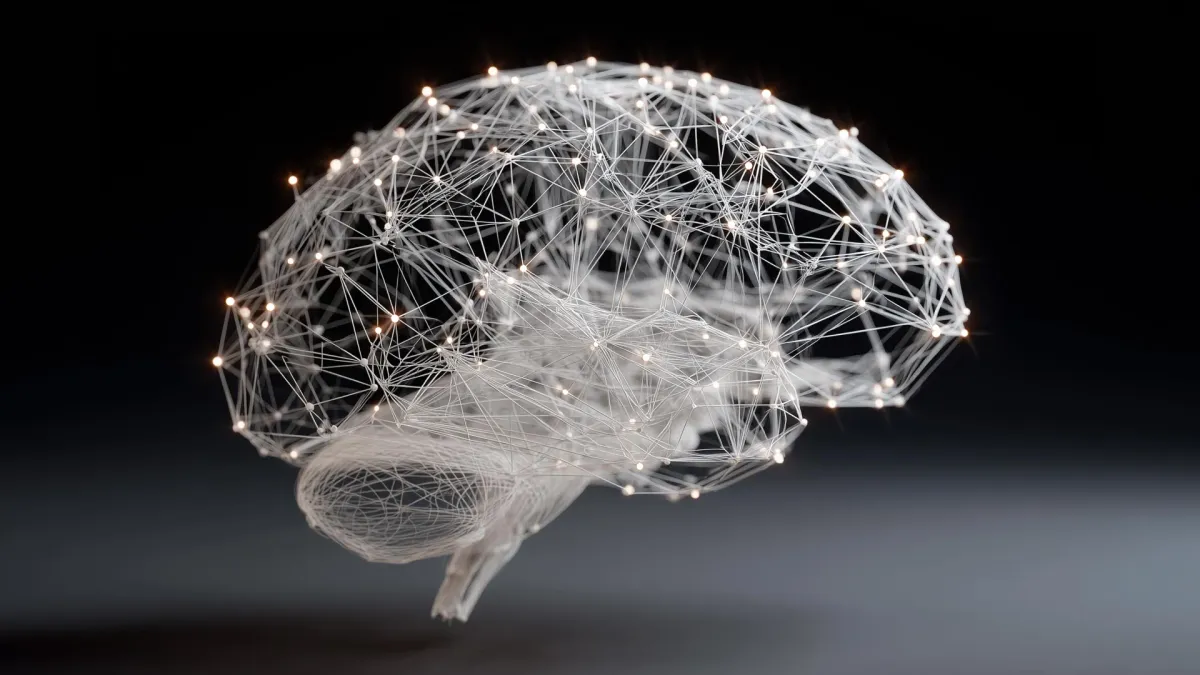
For over a century, psychologists noticed something odd: people who are good at one thing tend to be good at many things. Strong memory predicts better reasoning. Quick attention correlates with language skill. But neuroscience couldn't explain why. The brain's different networks—attention, memory, language, reasoning—seemed to work in separate regions. So where did this unified "general intelligence" actually live?
Researchers at the University of Notre Dame just answered that question, and it changes how we think about what makes someone smart.
The answer isn't a special "genius region." Intelligence emerges from how well your brain's networks coordinate with each other—how efficiently they communicate, reorganize, and work as one system.
We're a new kind of news feed.
Regular news is designed to drain you. We're a non-profit built to restore you. Every story we publish is scored for impact, progress, and hope.
Start Your News DetoxHow the Brain Orchestrates Itself
Aron Barbey's team analyzed brain imaging and cognitive test results from 976 adults across two studies. They weren't looking for a single smart spot. Instead, they mapped how different brain networks connected and communicated, then compared those maps to how well people performed on reasoning, memory, and attention tasks.
What they found was elegant: intelligence correlated not with the size or activity of any one region, but with large-scale organizational properties of the entire brain. Specifically, four things mattered.
First, the brain divides complex tasks across many specialized networks rather than relying on one command center. When you solve a problem, your attention network, memory system, and reasoning circuits all activate—and the quality of the answer depends on how smoothly they hand off information to each other.
Second, these networks need fast highways between them. The brain contains long-distance connections—"shortcuts" linking distant regions—that let far-apart areas exchange information without delay. A brain with more of these efficient pathways shows higher general intelligence.
Third, some regions act as traffic controllers. These regulatory hubs don't do the actual thinking; they orchestrate which networks activate for which tasks. They decide when you need careful analysis versus quick intuition, when to focus narrowly versus think broadly.
Finally, the best-organized brains balance two things: tight, efficient clusters of closely connected neurons and short communication paths to distant regions. Local specialization plus global integration. That balance is what flexibility looks like in neural hardware.
Across both study groups, differences in general intelligence consistently matched these system-level features. No traditional "intelligence network" explained it. "General intelligence becomes visible when cognition is coordinated," Barbey said, "when many processes must work together under system-level constraints."
Why This Matters Beyond the Lab
This research reframes what intelligence actually is. It's not about having a bigger prefrontal cortex or faster neurons. It's about orchestration—how well your brain's different parts synchronize.
That explains patterns neuroscience had struggled with. Intelligence typically grows through childhood (as neural networks become more integrated), declines with age (as coordination weakens), and suffers most from widespread brain injury rather than damage to one region (because system-level organization breaks down). These weren't mysteries before; they were just unexplained. Now they make sense.
The finding also has unexpected implications for artificial intelligence. Most AI systems excel at narrow tasks—image recognition, language translation, chess—but struggle to apply knowledge flexibly across domains. Human intelligence is defined by exactly that flexibility. If that flexibility comes from how our brain's systems coordinate rather than from raw computational power, then building truly general AI might require something more than just bigger neural networks. It might require understanding how to build systems that coordinate like brains do—not just systems that compute like brains do.
Barbey put it plainly: "Many AI systems can perform specific tasks very well, but they still struggle to apply what they know across different situations. Human intelligence is defined by this flexibility—and it reflects the unique organization of the human brain."
The next frontier isn't just mapping what each brain region does. It's understanding how the whole thing talks to itself.