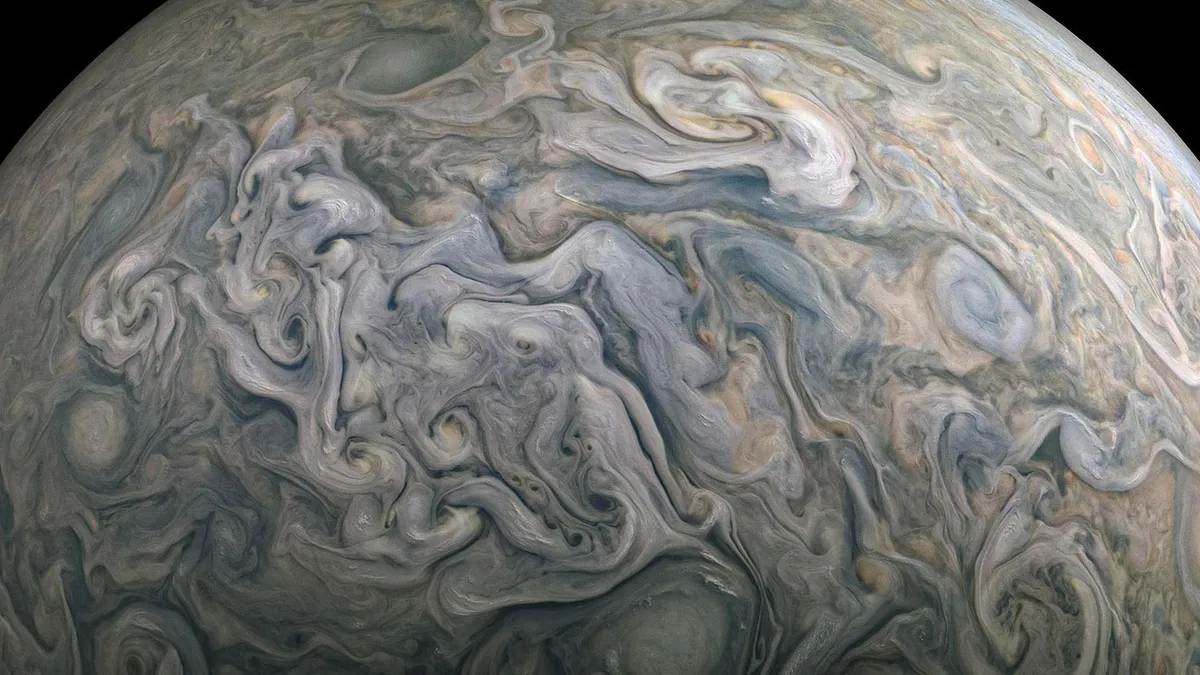
Jupiter's clouds have kept their secrets for 360 years. Galileo saw them through his telescope. NASA's probes have studied them from orbit. But no one has ever directly measured what lies beneath those towering, impossibly dense layers—until now.
A team at the University of Chicago and NASA's Jet Propulsion Laboratory just built the most detailed atmospheric model of Jupiter ever created. And it's already settling a long-running argument about what the planet is actually made of.
The finding: Jupiter contains about one and a half times more oxygen than the Sun itself. That might sound abstract, but it's the kind of number that rewrites how we understand where planets come from.
We're a new kind of news feed.
Regular news is designed to drain you. We're a non-profit built to restore you. Every story we publish is scored for impact, progress, and hope.
Start Your News DetoxReading the Planet's History
For decades, scientists have disagreed on Jupiter's oxygen content. A major recent study put it much lower—just a third of the Sun's. The difference matters because it's a clue to Jupiter's origin story. All planets and stars are made from the same raw materials, but in different amounts. Those proportions tell us where and when Jupiter formed.
Consider water. If Jupiter accumulated as ice early on, that tells us it formed far from the Sun, where water freezes. If it picked up water vapor, it was warmer and closer in. By reading Jupiter's oxygen signature—most of it locked in water molecules—scientists can work backward to reconstruct the solar system's formation.
Jeehyun Yang, the postdoctoral researcher who led the study, saw a way forward using a new approach. Previous models treated Jupiter's chemistry and physics separately. Chemistry experts built one model; fluid dynamics experts built another. Neither captured the full picture.
"You need both," Yang explained. "Chemistry is important, but doesn't include water droplets or cloud behavior. Hydrodynamics alone simplifies the chemistry too much."
So the team did something that hadn't been done before: they merged both into a single model. They had to account for thousands of different chemical reactions happening simultaneously—molecules transforming as they move between the scorching depths of the planet and the cooler upper regions, changing phases, rearranging. All while clouds formed and fell and rose again.
What Else the Model Revealed
The new model also suggests that Jupiter's atmosphere circulates far more slowly than scientists assumed. A single molecule would take several weeks to move through one atmospheric layer, not hours. That's 35 to 40 times slower than the standard assumption.
It's a humbling finding. Jupiter is our solar system's largest planet, visible to the naked eye, studied for centuries. Yet we're still fundamentally wrong about how it works.
"It really shows how much we still have to learn about planets, even in our own solar system," Yang said.
That knowledge feeds directly into the search for habitable worlds beyond Earth. Understanding how planets form—which conditions create which types of atmospheres—helps astronomers recognize which distant exoplanets might harbor life. It all traces back to understanding Jupiter, the giant next door.