Jupiter's four largest moons—Europa, Ganymede, Callisto, and Io—may have arrived in the solar system already stocked with the chemical building blocks of life. An international team of researchers has shown how complex organic molecules, the carbon-based compounds thought essential for biology, could have been woven into these moons as they formed billions of years ago.
The discovery matters because it reframes a crucial question: if life ever emerged on these distant ocean worlds, it wouldn't have started from scratch. It would have inherited not just water and internal heat, but a chemical library.
How Life's Ingredients Get Built
Complex organic molecules (COMs) are carbon compounds laced with oxygen and nitrogen—the same elements that make up amino acids and the building blocks of DNA. Scientists have known for years that these molecules can form in laboratories when icy dust is exposed to ultraviolet light or moderate heat. The question was whether the same chemistry could happen in space, and if so, whether it could reach the places where life might eventually exist.
We're a new kind of news feed.
Regular news is designed to drain you. We're a non-profit built to restore you. Every story we publish is scored for impact, progress, and hope.
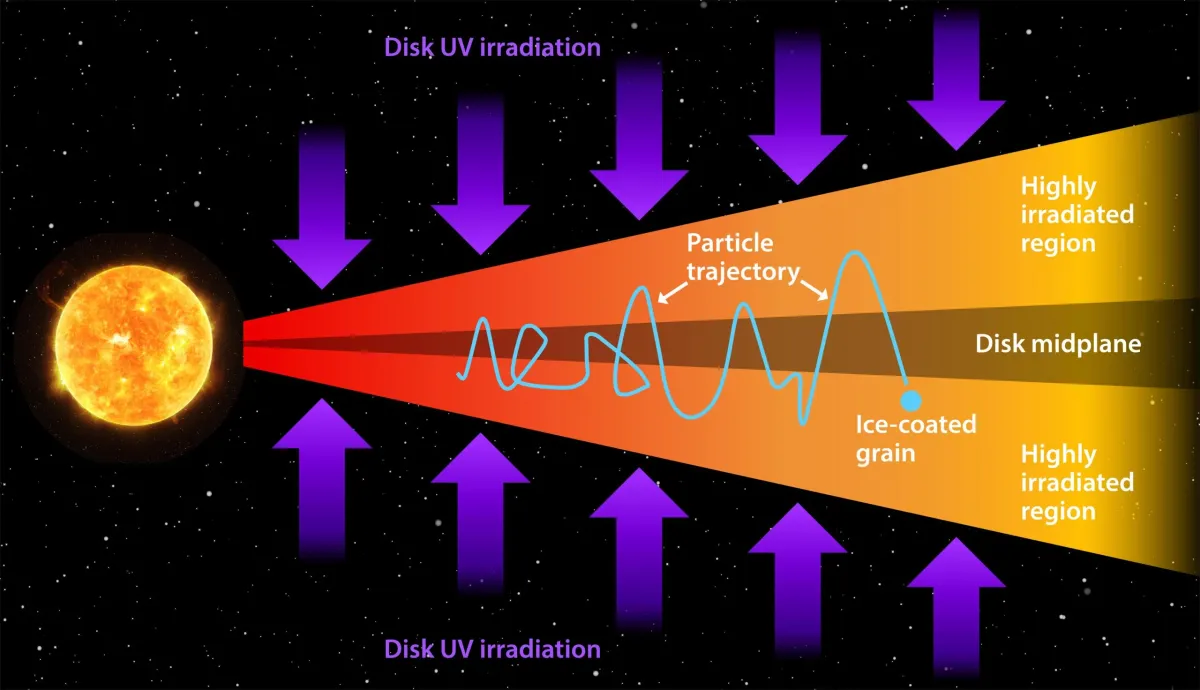
Start Your News DetoxResearchers from Southwest Research Institute, Aix-Marseille University, and the Institute for Advanced Studies combined computer models of the early solar system with laboratory experiments. They simulated how icy particles moved through the protosolar nebula—the vast cloud of gas and dust surrounding the young Sun—and traced where those particles ended up. The modeling was precise enough to calculate the exact temperatures and radiation levels each grain experienced as it drifted through space.
The results revealed two pathways. Some icy grains formed COMs in the protosolar nebula itself, then carried those molecules inward toward Jupiter. In the simulations, nearly half of the particles transported freshly made organic molecules into the region where Jupiter's moons were assembling. A second source emerged from within Jupiter's own circumplanetary disk—the ring of material that orbited the young gas giant before collapsing into moons. Certain zones there were warm enough to trigger the chemical reactions that build COMs from simpler compounds.
What This Means for Ocean Worlds
Europa, Ganymede, and Callisto are believed to harbor subsurface oceans beneath their icy shells, hidden from the vacuum above. If these moons incorporated COMs at birth, those oceans didn't simply contain water and the heat from radioactive decay. They had access to a richer chemical toolkit—one that could, in principle, support the kind of prebiotic chemistry that might lead to life.
Here's what makes this research significant beyond the obvious: it suggests that habitable conditions aren't accidents of later chemistry. They're baked in from the moment a moon forms. The implication ripples outward. If Jupiter's moons inherited organic molecules at birth, other planetary systems likely did too. The ingredients for life may not be rare or fragile. They may be standard equipment.
Two spacecraft are currently en route to test these predictions. NASA's Europa Clipper and the European Space Agency's Juice mission will examine Jupiter's moons in unprecedented detail, measuring their surface and subsurface composition. The new models give scientists a framework for interpreting what they'll find—a way to connect what's detected in the data back to the chemistry of the solar system's infancy.
The research doesn't prove life exists on these moons. But it does show that billions of years ago, when Europa, Ganymede, and Callisto were still forming, the universe was already preparing the stage.