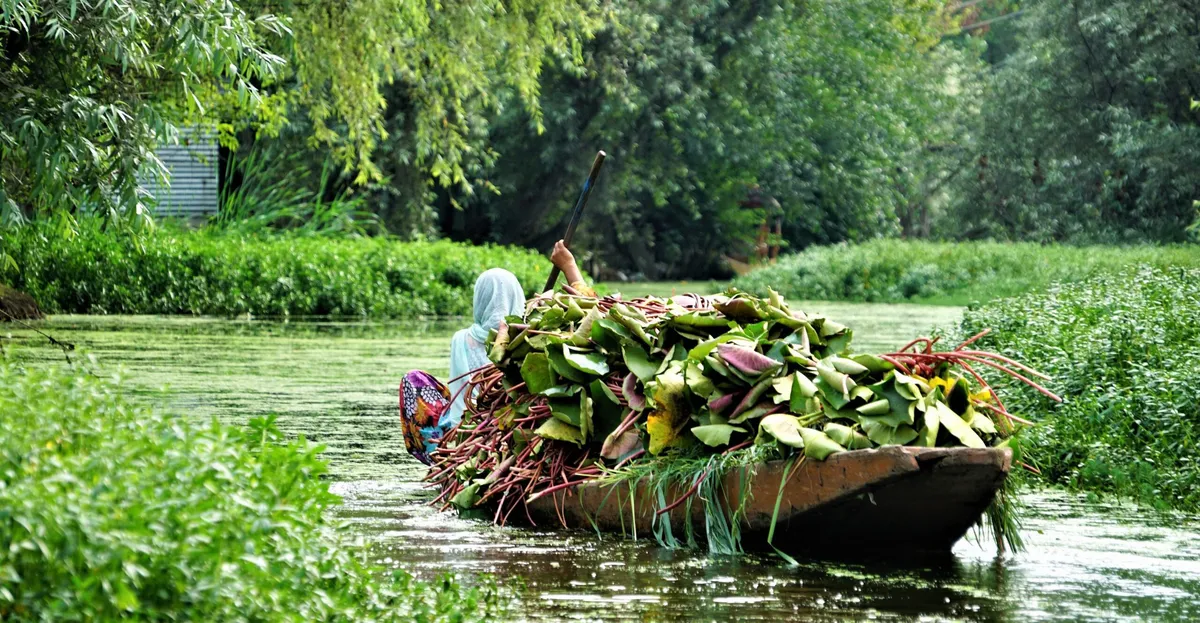
In Kashmir's wetlands, a crop thought lost to pollution and floods is coming back—not through government programs or new technology, but because farmers decided to work with water instead of against it.
Lotus stem, or nadur, once anchored winter livelihoods across the region. Families harvested it from shallow marshes on Dal and Wular lakes, cooked it as a vegetable, fried it into street snacks, pickled it for storage. Women processed and sold it, providing steady income when little else was available. The crop was woven into daily life and cultural memory.
Then it nearly vanished. Over the past decade, urban sprawl, sewage runoff, rising temperatures, and the devastating 2014 floods choked the wetlands with debris and silt. Water levels became unpredictable. Aquatic life declined. By the late 2010s, most families had abandoned lotus cultivation entirely.
We're a new kind of news feed.
Regular news is designed to drain you. We're a non-profit built to restore you. Every story we publish is scored for impact, progress, and hope.
Start Your News DetoxWorking with water
Ghulam Nabi Dar, 68, watched his two-hectare plot along Wular Lake's northern edge become unproductive. Repeated crop failures had left him with nothing. "The water changed," he says. "It became thick, dark. Lotus wouldn't grow."
Instead of waiting for large-scale restoration, Dar turned to knowledge his grandfather had passed down. In early 2021, he began cleaning his section of the lake himself. Using handmade reed nets, shovels, and family labor, he spent months removing silt and waste from shallow waters. He revived an old technique of stirring the lakebed with long poles to oxygenate the soil and help roots take hold. No chemicals. No machines. Just patience and repetition.
"It was slow work," Dar says. "But the water started responding."
Aquatic plants returned first. Small fish followed. By winter, lotus roots had re-established themselves. That season, Dar harvested 12 quintals (roughly 1,200 kilograms) and earned about 1.5 lakh rupees—approximately $1,600. Enough to sustain his family through the year.
Dar's approach points to something larger. Shakil Ahmad Romshoo, a professor of Earth Sciences at the University of Kashmir, sees the revival as evidence that community-driven solutions can address environmental challenges faster than top-down programs. "If we can empower more farmers to do this kind of work," Romshoo says, "it could make a real difference."
For Dar and other growers returning to lotus cultivation, the work is about more than income. It's a reconnection to cultural heritage and the natural rhythms that sustained their communities for generations. "Lotus is part of who we are," Dar says. "When it disappeared, we lost something important. Now that it's coming back, I feel hopeful again."
As water quality improves and more farmers adopt similar restoration techniques, the wetlands are beginning to recover—and with them, a livelihood that nearly disappeared.