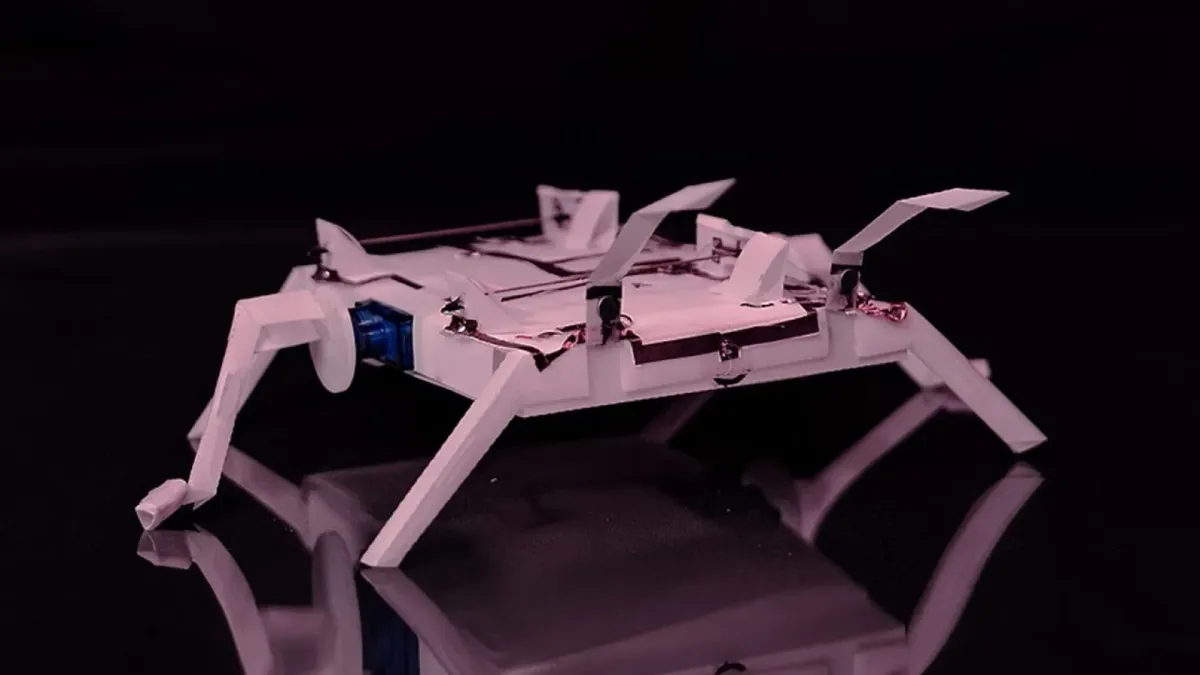
A robot the size of an insect has done something that shouldn't work: jumped 188 times in a row without a battery, motor, or computer chip inside it. Just light, rubber, and physics.
The machine is built from liquid crystal elastomers—a material that bends when exposed to light. Shine light on it, and it contracts, storing energy like a coiled spring. At a critical point, that energy releases in a snap, launching the robot into the air. As it jumps, it casts a shadow that blocks the light, allowing the material to cool and reset. Then the cycle repeats, automatically, endlessly, with no intervention needed.
When researchers first tested it, they expected maybe a few jumps before the material fatigued. Instead, it kept going. They added weight—up to 1,700 times the robot's own body weight—and it still performed without degradation. The entire system had become self-regulating through its geometry and material properties alone.
We're a new kind of news feed.
Regular news is designed to drain you. We're a non-profit built to restore you. Every story we publish is scored for impact, progress, and hope.
Start Your News DetoxThe Intelligence Is in the Shape
What makes this work is a shift in how we think about robotics. Instead of building a machine and then programming it to move, the team engineered the structure itself to perform sensing, actuation, and reset. The curved beam doesn't need a sensor to know when to jump—it jumps when the physics demands it. It doesn't need a processor to control timing—the shadow it casts controls the timing. The material doesn't need instructions—it responds to light and temperature like any physical object does.
Wenzhong Yan, now an assistant professor at UC Davis, has spent his career exploring this idea: what if we stopped trying to make machines think, and instead made them behave through design. During his Ph.D., he developed robots that folded themselves into different shapes without any electronic brain. This light-powered jumper is the same philosophy taken further—a machine that performs a complex, repetitive task through pure material intelligence.
This approach opens possibilities that conventional robotics struggles with. A robot with no electronics can operate in places where circuits would fail: wildfire zones where sensors need to move continuously across terrain and report what they detect, collapsed buildings where conventional machines get stuck, radioactive environments where electronics would degrade. The jumping mechanism becomes a way to cover ground and gather data simultaneously.
Yan is also exploring adaptive clothing—imagine a T-shirt that stiffens when you need support and softens when you don't, responding to light or temperature rather than a button you press. The principle is the same: intelligence embedded in material, not bolted on top of it.
The research was published in Advanced Materials, and it hints at a future where the boundary between a machine and a material starts to blur. We've spent a century making robots smarter by adding more electronics. This work suggests the next leap might come from making materials clever enough to need fewer electronics at all.