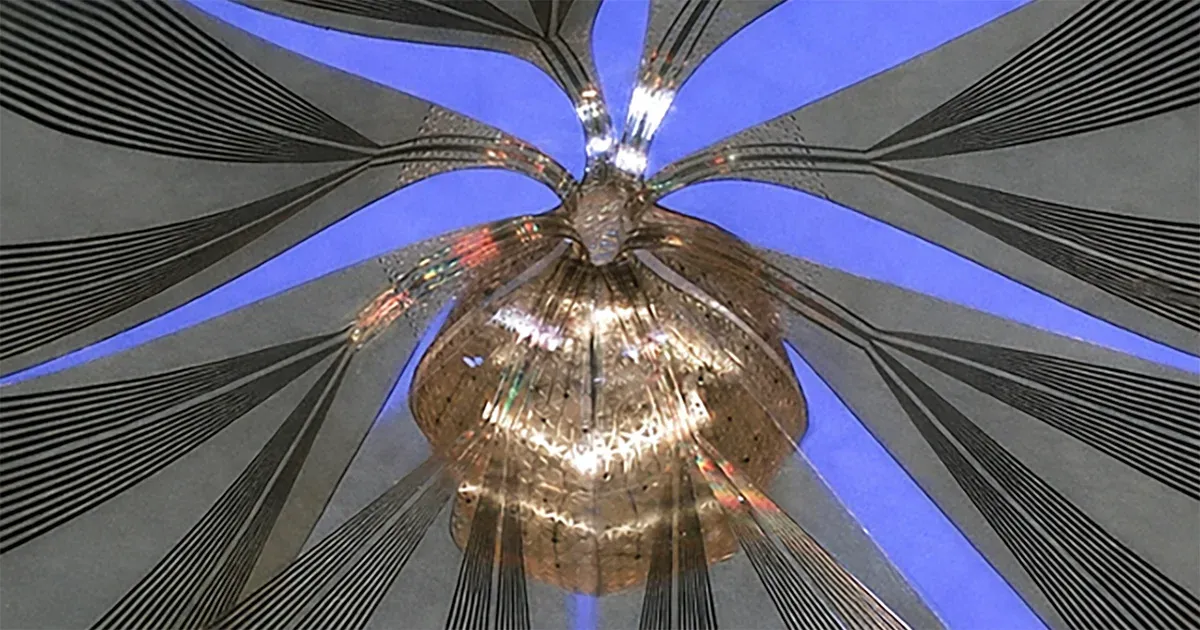
Scientists have built something that sounds like science fiction but works like a pop-up book: a flexible electrode mesh that wraps around pea-sized brain organoids and listens to their electrical chatter across nearly their entire surface.
These miniature brains—grown from human cells in the lab—are already changing how researchers study neurological disease. Some are built to model how the brain wires itself during early development; others are grown from patients' skin cells and carry the genetic mutations linked to schizophrenia or autism. The hope is to spot disease patterns and test whether drugs can fix them. But there's been a fundamental problem: the tools for recording brain activity were either too clunky (designed for full human brains) or too limited (capturing only fragments of organoid activity at a time).
A team at Northwestern University, led by Colin Franz and John Rogers, solved this by designing a device that starts flat—smaller than a US quarter, shaped like a flower—then gradually transforms into a breathable 3D net. The mesh contains 240 microelectrodes, each about the width of a single cell, distributed across the organoid's surface. Once deployed, the device covers roughly 91 percent of an average mini brain.
We're a new kind of news feed.
Regular news is designed to drain you. We're a non-profit built to restore you. Every story we publish is scored for impact, progress, and hope.
Start Your News DetoxWhat the electrodes reveal
When the team switched on their device, they detected something striking: synchronized waves of electrical activity rippling across the organoid, mimicking the brain-wave patterns seen in developing human brains. This wasn't just noise—it was evidence of coordinated neural communication. When they added botulinum toxin (which dampens brain activity), the waves collapsed, confirming that the organoid's wiring behaves like an actual developing brain.
Because the mesh is porous, nutrients and drugs can flow through it, which opens a practical door: the device works as a drug-testing platform. The team tested compounds known to increase or decrease neural activity and reliably detected the changes across the whole mini brain.
What makes this advance quietly significant is the shift in perspective it enables. Previous electrode systems could record from isolated cells or small regions, giving researchers a scattered view of activity. This device captures whole-network dynamics—how neurons coordinate with each other. That's closer to how brains actually work. As Franz noted, "We can now record from and stimulate hundreds of locations across an organoid's surface at once. This allows us to study neural activity at the level of whole networks rather than isolated signals."
The technical challenge was real. Mini brains are spheres; standard electronics are flat. Researchers have recently turned to flexible mesh designs inspired by origami and Japanese paper folding, but most struggled with coverage. The Northwestern team engineered a shape-shifting mechanism where each "petal" of the flower bends predictably as the device cinches into a purse, keeping electrodes evenly spaced and preventing gaps that would miss activity.
Why this matters beyond the lab
Organoids are already being used to study Parkinson's, multiple sclerosis, and ALS. With better tools for reading their electrical activity, researchers can watch how disease-related changes ripple through neural networks—information that's impossible to get from traditional cell cultures or even animal models. The device also pairs well with other techniques: the team confirmed it works alongside optogenetics (using light to activate neurons) and chemical tracking methods, creating a more complete picture of what's happening inside these tiny brains.
This is fundamentally about matching the tool to the problem. For decades, neuroscientists had to choose between crude whole-brain methods and precise single-cell recordings. Mini brains demand something in between—something that respects their spherical shape, keeps them alive, and listens to the whole conversation at once. The next step is likely refining the device for organoids modeling specific diseases and scaling up the approach to test therapeutic compounds more systematically.