For decades, scientists suspected trees were doing something strange during thunderstorms—producing brief electrical discharges that no one had ever actually seen. Last summer, a team from Penn State finally caught it on camera, and the footage reveals a hidden light show happening in forests across North America every time a storm rolls through.
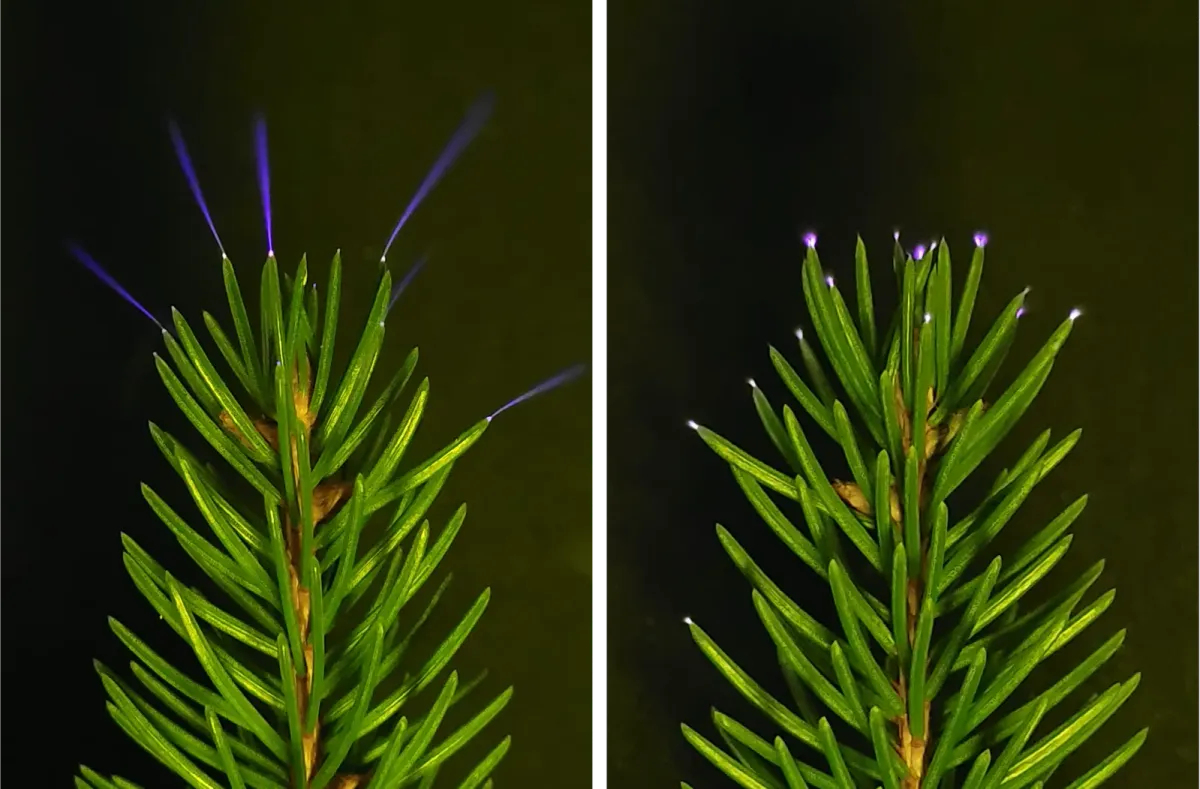
Here's what's happening at the molecular level: when thunderclouds build up negative charge, the ground below gets positively charged in response. That positive charge gets pulled upward toward the tallest points—usually treetops. At the leaf tips, the electric field becomes so intense it excites the air molecules around them. As those molecules settle back down, they release ultraviolet radiation in brief, flickering bursts called coronae. The whole thing happens in fractions of a second.
"These things actually happen," says Patrick McFarland, the meteorologist who led the research. "We've seen them; we know they exist now. To finally have concrete evidence of that is what I think is the most fun."
We're a new kind of news feed.
Regular news is designed to drain you. We're a non-profit built to restore you. Every story we publish is scored for impact, progress, and hope.
Start Your News DetoxChasing Storms in a Minivan
McFarland and his team converted a 2013 Toyota Sienna into a mobile laboratory. They cut a hole in the roof, mounted a specialized ultraviolet camera, added an electric field detector and a laser rangefinder, and pointed everything skyward. Throughout the summer of 2024, they drove from Florida to Pennsylvania chasing thunderstorms, finally capturing footage during a storm in Pembroke, North Carolina.
Pointing the camera at three branches of a sweetgum tree, they recorded roughly 90 minutes of footage. What they found: 859 individual UV signals grouped into 41 distinct coronae events. Some lasted only a fraction of a second; others persisted for more than three seconds. The discharges hopped unpredictably from leaf to leaf, sometimes repeating on the same spot. They captured additional coronae on a nearby loblolly pine and other trees across four more storms.
The UV camera was calibrated to detect only a narrow wavelength range, which means the researchers suspect coronae happen far more frequently than their footage shows. They're planning to refine their equipment for future observations.
The Hidden Light Show
Coronae do emit visible light, but it's so faint that the ambient glow of a thunderstorm drowns it out—like trying to see stars in light-polluted skies. Only in completely dark laboratory conditions can researchers detect a subtle blue shimmer at the leaf tips.
If human eyes could actually see what's happening in forests during storms, McFarland suggests it would look "like thousands of fireflies dancing on the treetops." Imagine swaths of scintillating light flickering across the canopy as the storm passes overhead. It's a phenomenon that's been occurring in forests for millions of years, completely invisible to us until now.
What This Means for Forests
Beyond confirming something scientists long suspected, these electrical discharges have practical consequences. The coronae produce large amounts of molecules that react with other compounds to form haze and smog—this could help scientists better understand how thunderstorms influence forest air quality.
There's also a question about tree health. Laboratory experiments show that coronae can burn leaf tips within seconds, potentially causing sun damage and dehydration. Yet thunderstorms happen regularly in many forested regions. If coronae can damage leaves, the logical question follows: have trees evolved protective mechanisms?
"Trees are incredibly resilient," notes Evan Gora, a forest ecologist at the Cary Institute of Ecosystem Studies. "I would assume, if coronae can damage trees, then trees also likely have some adaptations to them."
This discovery opens a new window into how atmospheric electricity, forest ecosystems, and tree physiology interact—a relationship that's been shaping forests for eons but only now becomes visible to science. As McFarland refines his equipment, the next phase of storms will reveal just how much of this hidden light show we've been missing.