Space doesn't reveal itself easily. What looks like a single star might be two locked in orbit. A flicker might be a distant planet drowning in its star's light. For centuries, astronomers had one answer: build bigger mirrors. A wider lens collects more light, sees finer detail. But physics and budgets eventually say no—there's a limit to how large a single telescope can grow.
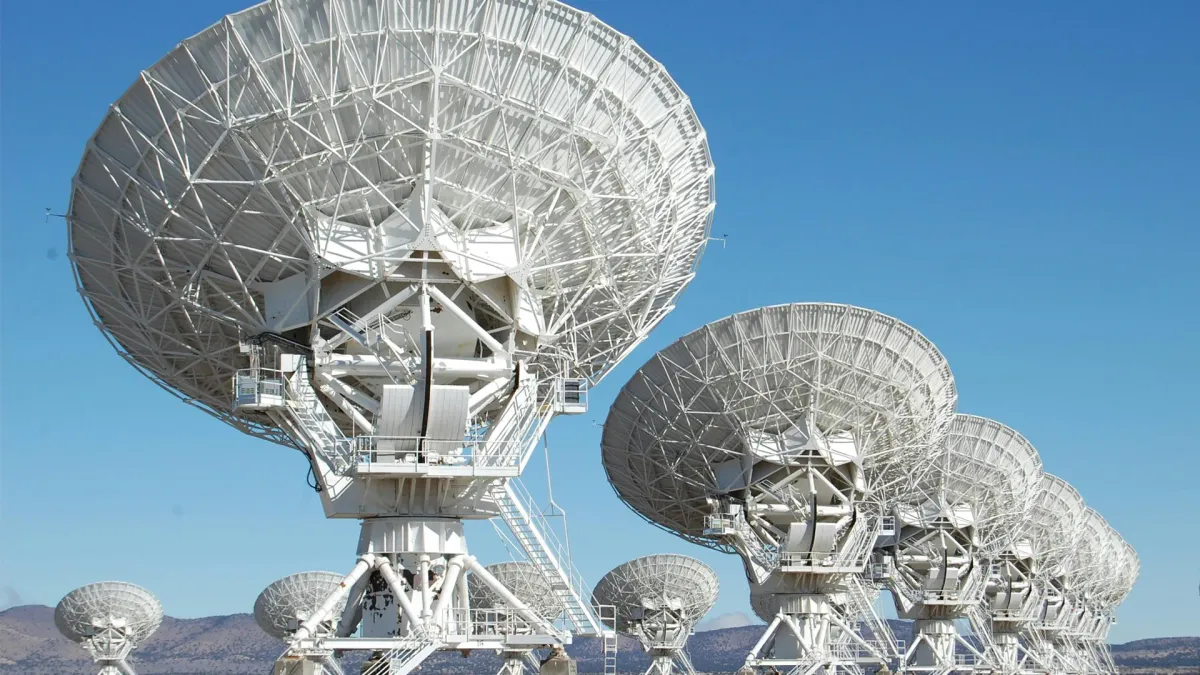
Researchers found a workaround decades ago: scatter smaller telescopes across vast distances and combine their light. Done right, the system behaves like one enormous mirror stretching between them. It's called long-baseline interferometry, and it works. Except for one problem: bringing that light together.
Light is fragile. The information it carries lives in subtle ripples across the wave. Travel far enough, and small disturbances—tiny losses, environmental noise—weaken or distort those ripples. By the time beams from distant telescopes meet, crucial details are already gone.
We're a new kind of news feed.
Regular news is designed to drain you. We're a non-profit built to restore you. Every story we publish is scored for impact, progress, and hope.
Start Your News DetoxA team from NASA Goddard, the University of Maryland, and the University of Arizona asked a different question: What if telescopes didn't need to bring their light together at all?
The Quantum Shortcut
Instead of thinking of light as simple waves forming an image, the researchers treated it as a quantum carrier of information. That shift changes everything. The question becomes not "What picture do we see?" but "What's the maximum information quantum physics allows us to extract?"
Over the past decade, quantum information theory revealed that smarter measurement strategies can pull more detail from the same light. One approach is spatial mode sorting: when starlight enters a telescope, it isn't a blob—it's a pattern of electric fields distributed across space. A sorter splits that incoming light into different patterns, sending each to its own detector. Analyzing these patterns helps telescopes extract more from faint or tiny objects.
Earlier work showed that combining spatial mode sorting with long-baseline interferometry could reach the true quantum limit for resolving two nearby stars. But the different light patterns still had to be physically combined using beam splitters—bringing researchers back to the original problem of transporting fragile light across long distances.
The new approach uses quantum entanglement to bypass this entirely. Entanglement creates correlations between distant systems stronger than any classical connection. If each telescope shares entangled quantum memories—atomic systems storing quantum bits—then joint measurements can happen across distance. Using entanglement plus ordinary classical communication, the researchers showed they could mathematically reproduce the same joint measurement that physical beam splitters would perform.
The telescopes interfere with each other's data without their light ever meeting. "We came up with a way to perform the pairwise combining of the locally sorted starlight at each telescope in an array of beamsplitters, but without any physical beamsplitter, and without ever physically bringing the light from the two telescopes to one location," said Saikat Guha, a quantum networking expert at the University of Arizona.
The framework goes further than simply copying traditional interferometry in a quantum way. It allows arbitrary joint quantum measurements across a network of telescopes—meaning the system isn't locked into old methods. In principle, it can perform the most information-efficient measurement quantum mechanics allows.
From Theory Toward Reality
The team tested the idea with detailed calculations for real astronomical scenarios, like resolving two closely spaced stars. Results suggest an entanglement-assisted telescope network could outperform both single telescopes and classical long-baseline systems using only classical communication.
One crucial piece—entanglement-assisted phase measurements of weak light—has already been demonstrated in the lab. Researchers at Harvard created remote entanglement between atomic quantum memories using silicon-vacancy centers in diamond, proving the fundamental physics works.
If this approach becomes practical, it reshapes how we observe the universe. The next leap in astronomical resolution may not come from building larger mirrors, but from building quantum communication networks.