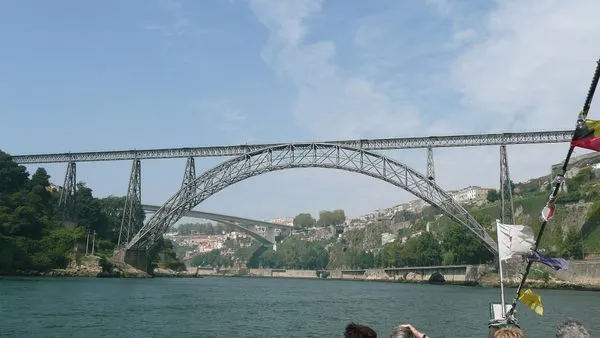
Porto, Portugal. A city of impossibly steep streets, riverfront views, and enough port wine to make you forget about those steep streets. It’s also a place where history and heavy industry decided to become best friends. Case in point: the Maria Pia Bridge.
Turns out, before Gustave Eiffel was busy making Paris iconic with his very tall tower, he was in Portugal, casually building what would become the longest iron arch span in the world. In 1877, no less. This wasn't just a warm-up act; it was a full-blown engineering mic drop.
The Iron Architect's Early Triumph
Eiffel, alongside engineer Théophile Seyrig, conjured a wrought-iron arch that looked like it could float across the deep Douro Valley. It had a lightness that was, frankly, unheard of at the time. Imagine the structural audacity required to pull that off. It was a clear preview of the kind of ambitious, gravity-defying work that would later define his Parisian landmark.
We're a new kind of news feed.
Regular news is designed to drain you. We're a non-profit built to restore you. Every story we publish is scored for impact, progress, and hope.
Start Your News DetoxNamed after Queen Maria Pia of Savoy, the bridge quite literally connected Porto with Vila Nova de Gaia, changing the game for railway travel in northern Portugal. Its central arch stretched a mind-boggling 160 meters (that’s about 525 feet, for those keeping score), a record that held for quite some time.
What's truly striking is how this delicate-looking iron lacework managed to carry heavy trains for over a century. From a distance, it appears almost fragile, like a spiderweb spun across the river. Up close, it's a testament to the fact that sometimes, the most elegant solutions are also the strongest.
In 1991, the trains moved to the newer São João Bridge, giving Maria Pia a well-deserved retirement. But it didn't fade into obscurity. Instead, it became one of Porto's most beloved industrial landmarks. Whether you’re sipping wine on the riverbanks or cruising by on a boat, its airy silhouette still demands attention.
The bridge isn't just an old piece of infrastructure; it’s a monument to a time when iron, steam, and sheer human ambition converged to create something both incredibly useful and undeniably beautiful. It reminds us that engineering, at its best, is an art form.