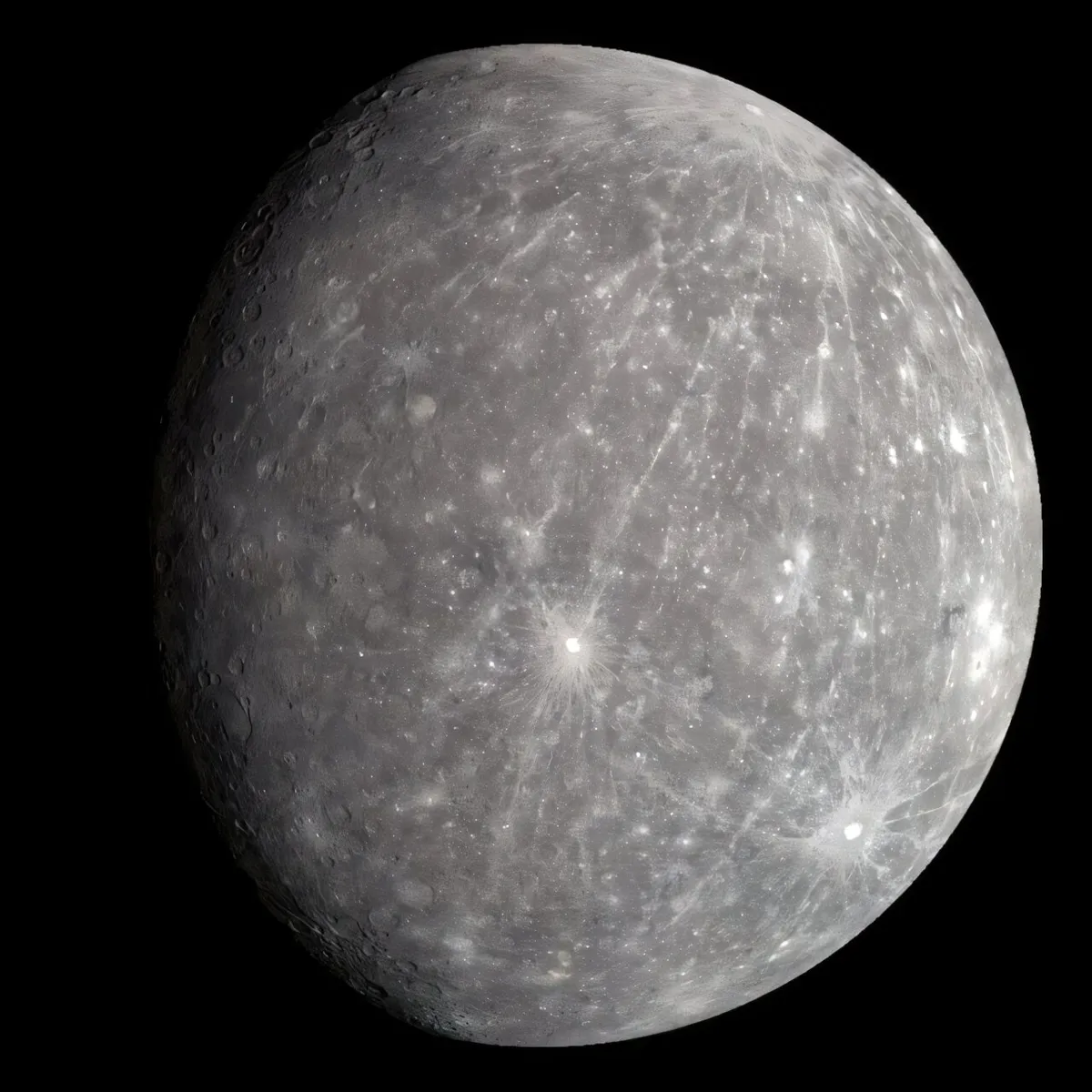
Mercury: the closest planet to the sun, a scorching hot rock that's notoriously difficult to visit. Spacecraft attempting to get there often find themselves in a cosmic tug-of-war, pulled in by the sun's immense gravity, requiring vast amounts of fuel just to slow down enough to orbit. Imagine the gas mileage on that trip.
But what if you could ditch the fuel entirely? What if your spaceship could just… sail? That's the rather brilliant idea behind a new mission concept called Mercury Scout, dreamed up by researchers at Brown University.
Catching a Ride on Sunlight
The core of Mercury Scout's plan is a solar sail. Think of it as a giant, incredibly thin mirror that harnesses the pressure of sunlight particles to push a spacecraft through the void. No rocket fuel, no heavy tanks, just pure photon power. This isn't science fiction anymore; it's a technology that's been successfully tested by Japan's IKAROS mission in 2010 and The Planetary Society's LightSail-2 in 2019. NASA even recently deployed its Advanced Composite Solar Sail System (ACS3) in low Earth orbit, which is currently doing its thing, tumbling around like a microwave oven with a very important job.
We're a new kind of news feed.
Regular news is designed to drain you. We're a non-profit built to restore you. Every story we publish is scored for impact, progress, and hope.
Start Your News DetoxThis fuel-free approach promises cheaper missions and longer lifespans for the spacecraft itself. Fewer moving parts and less mass mean less to break, which translates to more time collecting data about Mercury's mysterious surface. It's a win-win, provided the sails actually, you know, sail.
Peering at Mercury's Thin Skin
Mercury Scout aims to be a NASA Discovery-class mission, meaning it needs to clock in under a billion dollars – a bargain in space exploration terms. Its primary goal: high-resolution geological imaging. It would carry a single instrument, a narrow-angle camera (NAC), capable of snapping pictures so detailed you could spot features as small as 1 meter (3.2 feet) across. To put that in perspective, NASA's previous Mercury orbiter, MESSENGER, had a NAC that could only resolve details down to about 20 meters.
Why such detail? Mercury's crust is surprisingly thin, only about 26 kilometers (16 miles) deep. With its super-sharp camera, Mercury Scout could help scientists understand the planet's crustal history and search for any signs of recent geological rumblings. It's like giving Mercury a really thorough dermatological exam, from orbit.
To survive the sun's brutal heat, the spacecraft would fly in a highly elliptical orbit, swooping as close as 200 kilometers (124 miles) and then retreating to a safer distance of 10,000 kilometers (6,214 miles). For communication, it would use a flat antenna, similar to the ones that kept MESSENGER talking to Earth.
The takeaway? A simple, camera-only mission powered by sunlight could vastly improve our understanding of Mercury. While some engineering challenges remain (like keeping the sail pointed correctly and not melting), the basic physics checks out. Soon, we might just be sailing to the sun's closest neighbor, no gas station required.