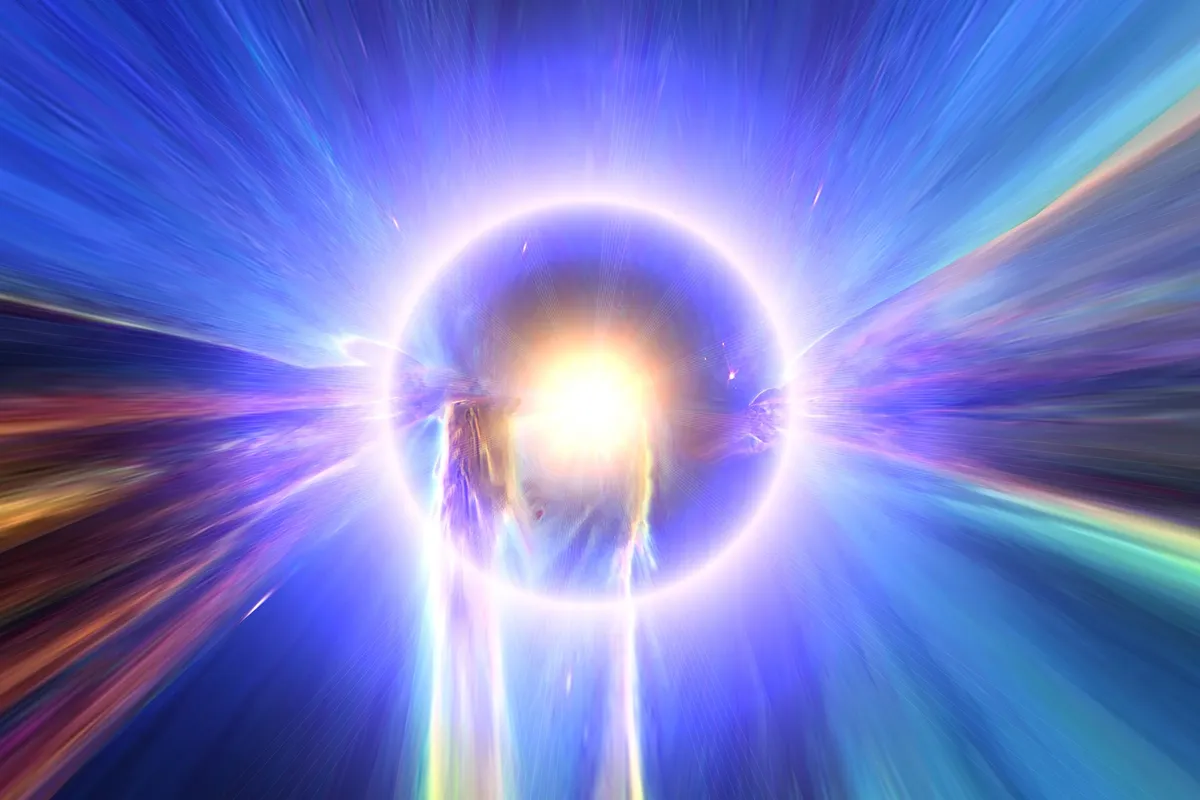
What if the universe’s dramatic origin story — the Big Bang, all explosive and mysterious — wasn’t some cosmic fluke but simply, well, natural? Scientists at the University of Waterloo have cooked up a quantum gravity theory that suggests exactly that, and it might just rewrite the universe's baby pictures.
For decades, cosmologists have grappled with the Big Bang's earliest moments, trying to figure out how everything went from an infinitely dense point to, well, everything. Einstein's general relativity does a bang-up job explaining gravity for, say, planets and black holes, but it throws its hands up when you get to the universe's absolute infancy. Think of it as trying to describe a toddler's tantrum with Shakespearean sonnets; it just doesn't quite fit.
Gravity Gets a Quantum Upgrade
Enter Dr. Niayesh Afshordi and his team. They’ve been playing around with something called "Quadratic Quantum Gravity." The name sounds like a final exam you definitely wouldn't want to take, but the idea is elegant: it combines quantum physics (the weird rules of the very small) with gravity in a way that remains mathematically sound even at the mind-boggling energies present at the universe's birth. No more hand-waving or adding extra bits to Einstein’s equations like cosmic duct tape.
We're a new kind of news feed.
Regular news is designed to drain you. We're a non-profit built to restore you. Every story we publish is scored for impact, progress, and hope.
Start Your News DetoxWhat they found is pretty wild: the universe's incredibly rapid expansion right after the Big Bang – the part cosmologists call "inflation" – doesn't need any special pleading. It emerges naturally from this new, deeper theory of gravity. It's like finding out the secret ingredient to your grandma's famous cookies was just… flour, but treated a little differently.
Ripples in the Fabric of Spacetime
Even better, this isn't just a theoretical parlor trick. The model makes a concrete prediction: a minimum level of primordial gravitational waves. These are tiny ripples in spacetime, echoes of the universe's very first moments. And here’s the kicker: future experiments might actually be able to detect them. We could soon be listening to the universe’s earliest whispers.
“This work shows that the universe’s explosive early growth can come directly from a deeper theory of gravity itself,” Afshordi explained. “Instead of adding new pieces to Einstein’s theory, we found that the rapid expansion emerges naturally once gravity is treated in a way that remains consistent at extremely high energies.”
This direct link between the theoretical fireworks of quantum gravity and actual, measurable data is, as Afshordi puts it, “rare and exciting.” It means we’re not just theorizing in a vacuum; we might actually get to see the proof. With new, hyper-sensitive instruments coming online – galaxy surveys, cosmic microwave background studies, and gravitational wave detectors – we’re entering an era of unprecedented precision. Ideas once confined to whiteboards and late-night debates are now becoming testable hypotheses. The universe, it seems, is finally ready to tell us its whole story.