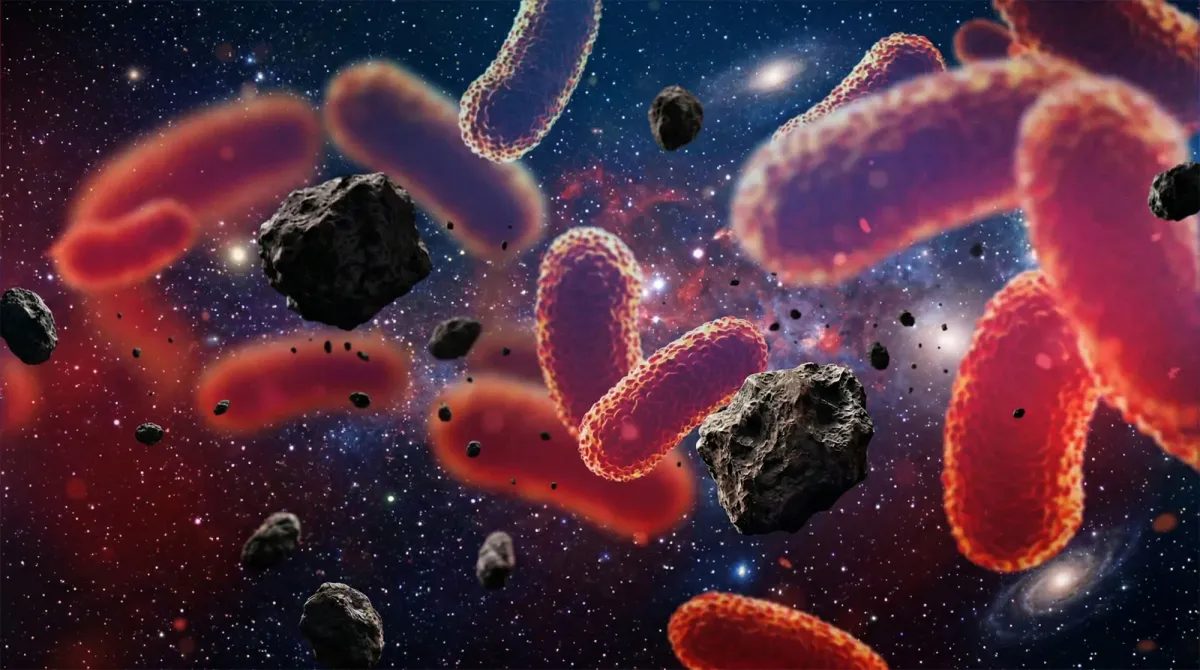
Fungi living in a petri dish aboard the International Space Station just extracted palladium from meteorite rock. It's a small moment in a cramped lab module 250 miles above Earth—but it hints at something larger: the microbes we'll inevitably carry into deep space might actually help us survive there.
When humans eventually travel to Mars or beyond, they won't travel alone. Bacteria live on our skin, fungi colonize our food, microbes cling to every surface. Rather than fighting this reality, scientists are asking a different question: what if we put these microscopic hitchhikers to work.
The Experiment
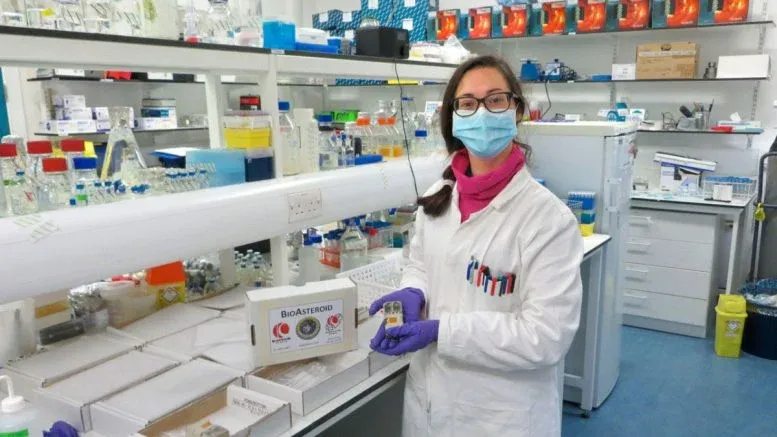
Researchers from Cornell University and the University of Edinburgh sent two organisms to the ISS as part of the BioAsteroid project: a bacterium called Sphingomonas desiccabilis and a fungus, Penicillium simplicissimum. Their job was to extract valuable elements from L-chondrite meteorite material—the kind of rock that makes up asteroids. On Earth, certain microbes already do this in mines and waste processing sites. The question was whether microgravity would change how well they worked.
We're a new kind of news feed.
Regular news is designed to drain you. We're a non-profit built to restore you. Every story we publish is scored for impact, progress, and hope.
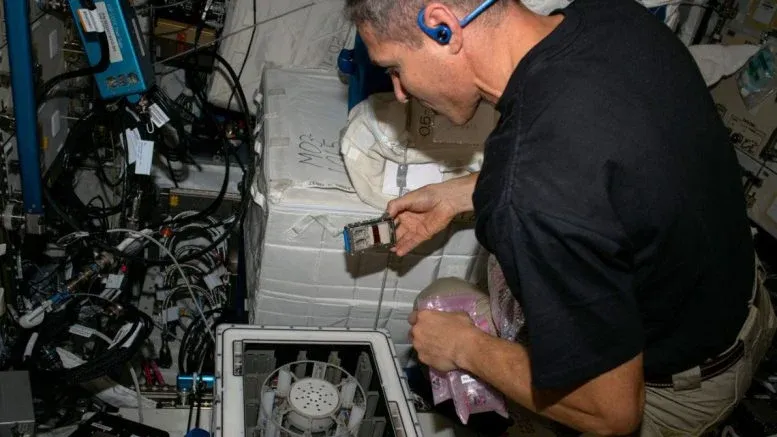
Start Your News DetoxNASA astronaut Michael Scott Hopkins ran the space-based experiments while researchers on Earth performed identical tests under normal gravity. The team then analyzed 44 elements across both sets of samples, looking for which ones the microbes had successfully extracted.
The results, published in npj Microgravity, showed something unexpected. The fungus didn't just survive in microgravity—it thrived. It ramped up production of carboxylic acids, carbon-based molecules that bind to minerals and help release them. Palladium extraction improved. Platinum and other precious metals came loose more readily.
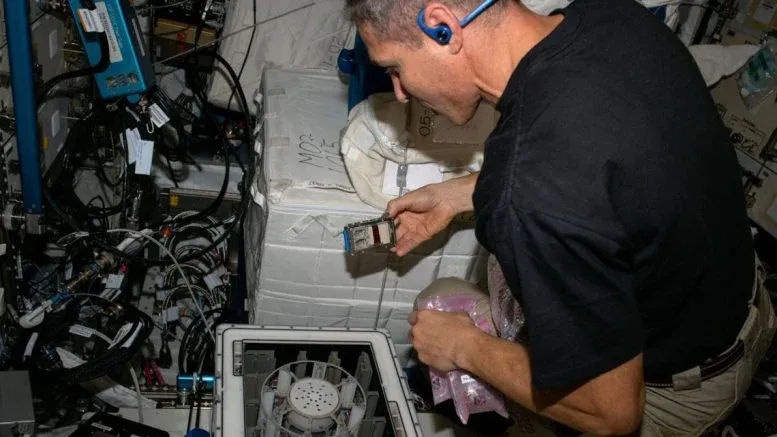
But here's where it gets interesting: nonbiological leaching—using a chemical solution without any microbes—performed worse in space. The microbes kept extraction rates steady across both gravity conditions. As Rosa Santomartino, the lead author and Cornell assistant professor, put it: "The microbe doesn't improve the extraction itself, but it's kind of keeping the extraction at a steady level, regardless of the gravity condition."
Why This Matters
The practical implication is significant. Future space stations or lunar bases won't need to haul massive quantities of raw materials from Earth. If microbes can reliably extract what we need from local rocks—whether on the Moon, Mars, or an asteroid—we've just solved a major logistics problem. Every kilogram we don't have to launch from Earth saves millions in fuel and resources.
But the deeper insight is about resilience. Space is hostile. Radiation, vacuum, microgravity, temperature swings—conditions that would kill most life. Yet these microbes didn't just survive; they adapted. Their metabolism shifted. They produced more of the molecules they needed to get the job done. It's a reminder that life, even microbial life, is remarkably flexible.
The findings also have terrestrial applications. Mining on Earth could become more efficient and less environmentally damaging if we harness microbial extraction. Processing mine waste, recovering metals from e-waste, supporting a circular economy—all become more feasible with organisms that can do the heavy lifting at molecular scales.
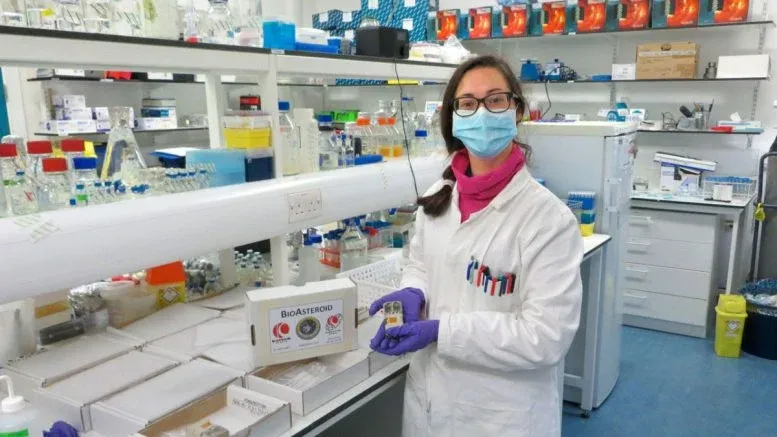
Santomartino acknowledged that the system is more complex than a simple answer. Different microbes behave differently. Different metals respond differently. Gravity conditions matter, but not always in predictable ways. "Depending on the microbial species, depending on the space conditions, depending on the method that researchers are using, everything changes," she said. "At present, you cannot give a single answer."
That complexity is exactly what makes this work valuable. Science that confirms a simple hypothesis is useful. Science that reveals a system is more intricate than expected—that opens doors. It means there's more to discover, more to optimize, more potential waiting.
As humans plan missions deeper into space, we're learning that our microscopic companions aren't just along for the ride. They might be essential crew members, quietly extracting the resources we'll need to stay.