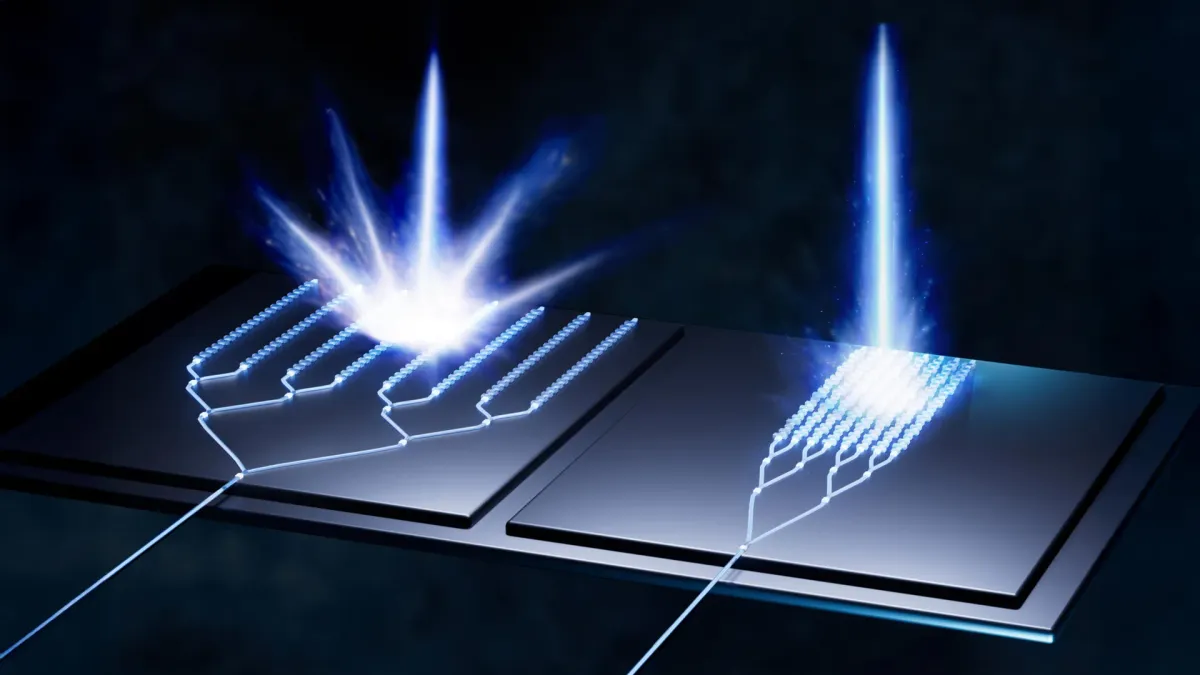
Self-driving cars are already pretty clever, but their eyes — specifically, their lidar sensors — have always been a bit of a hulking problem. Think big, expensive spinning contraptions on the roof that are prone to wear and tear, and often have a rather limited view of the world. Not ideal when you’re trying to avoid a squirrel, or, you know, a bus.
Enter MIT engineers, who’ve just cooked up a new lidar chip that promises to give autonomous vehicles a much wider, clearer perspective. The kind of breakthrough that could shrink those rooftop behemoths down to something far more discreet and durable. Because apparently, the future of seeing everything is to see it with less junk.
The Light Fantastic, Without the Wobble
Lidar works by zapping out infrared light pulses and timing how long they take to bounce back, creating a detailed 3D map. Crucial for a car that needs to know exactly what’s around it, and how far away it is. The problem with current silicon-photonics lidar (the chip-based kind) is that widening its view usually means a noisy, less accurate picture. It’s like trying to get a panorama shot with a shaky camera.
We're a new kind of news feed.
Regular news is designed to drain you. We're a non-profit built to restore you. Every story we publish is scored for impact, progress, and hope.
Start Your News DetoxThe MIT team’s solution? An array of integrated antennas, each with a subtly different shape. Instead of a single, uniform antenna design that tends to get all chatty with its neighbors (engineers call it “crosstalk”), they created a repeating pattern of three distinct shapes. This clever trick means the antennas don’t “see” each other, even when packed close. Which, if you think about it, is both impressive and slightly terrifying if applied to human social gatherings.
This design dramatically cuts down on interference, allowing the chip to scan a much broader area with far less noise. It’s the difference between a clear, wide-angle shot and a fuzzy, narrow peep-hole view. According to Jelena Notaros, an MIT professor and senior author, this solves a fundamental issue for integrated optical-phased-array tech, paving the way for significantly better lidar sensors.
No More Grating Lobes, Just Good Vibes
Traditional lidar often uses a physical spinning unit, but chip-based systems use an optical phased array (OPA) to electronically steer a light beam. Imagine a tiny grid of antennas, each with microscopic bumps that scatter light. By tweaking the phase of the light sent to each antenna, you can control the beam’s direction without any moving parts. No more spinning! Just pure, unadulterated light wizardry.
One major headache has always been how close you can pack these antennas. Too close, and they interfere, scrambling the light. Too far apart, and you get “grating lobes” — unwanted copies of the main beam that pop up at different angles. These phantom beams confuse the sensor, waste energy, and are generally just bad news for a self-driving car trying to distinguish a curb from a mirage.
The MIT team’s varied antenna shapes solved this. By making each antenna unique, they reduced the interference (or “coupling”) from a whopping 100% down to a mere 1%. The result? A single, precise beam that can be steered across a wide view without any confusing grating lobes. It’s like having a laser pointer that only points exactly where you want it, every single time. This combination of wide scanning, minimal interference, and high beam quality is a serious leap for integrated lidar. It means future self-driving cars, drones, and even construction site monitors could get the kind of vision that makes them truly reliable. Because knowing what’s coming from the side, without any optical guesswork, is always a good thing.