A granite block carved with ancient Greek text, discovered beneath the floor of the Great Mosque in Homs, Syria, may finally settle a decades-old historical puzzle: whether this Islamic landmark stands on the remains of a pagan temple dedicated to the sun god Elagabalus.
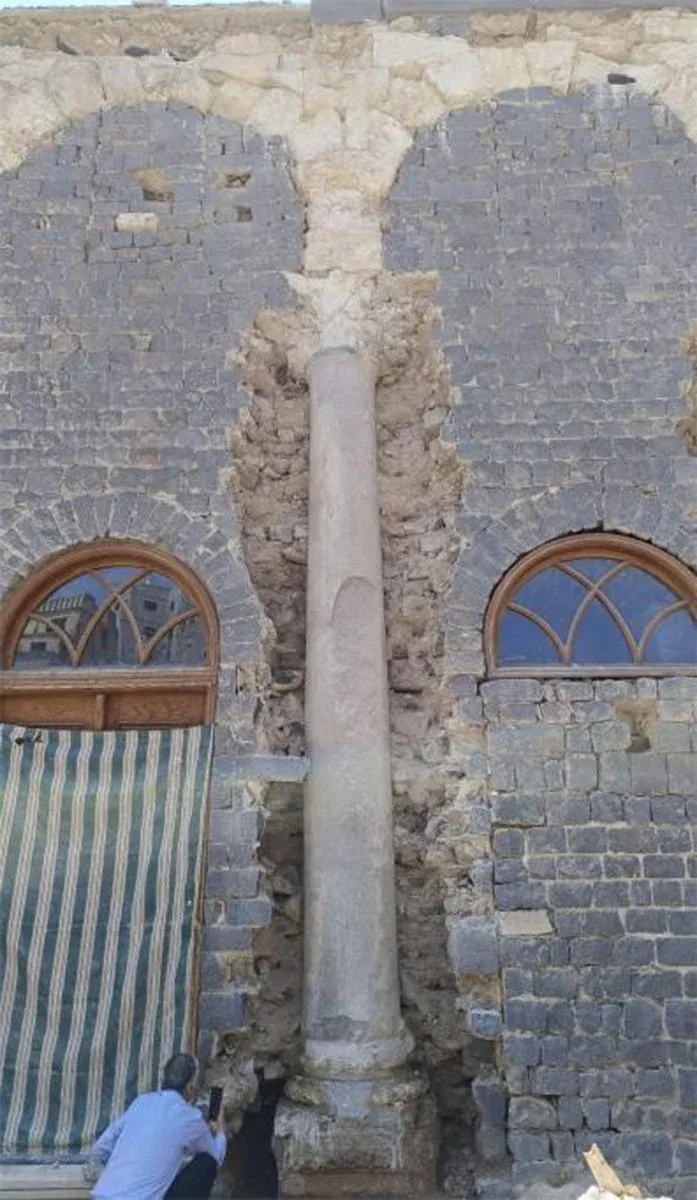
The inscription was unearthed during restoration work at the mosque, which is known for its distinctive oval design and sits at the heart of what was once Emesa, a vital trading hub in Roman-era Syria. For years, scholars have debated whether the mosque's foundation rested on the Temple of the Sun, then a Christian church dedicated to St. John the Baptist, before becoming Islamic. Now, research published in the archaeology journal Shedet suggests the answer is yes.
A Stone That Bridges Faiths
Dr. Maamoun Saleh Abdulkarim, professor of archaeology at the University of Sharjah, spent months analyzing the one-meter square column base that holds the inscription. The text is formal and symmetrical, carved in the style of a dedication or commemorative plaque—the kind of stone that would have announced something important to the people passing by.
We're a new kind of news feed.
Regular news is designed to drain you. We're a non-profit built to restore you. Every story we publish is scored for impact, progress, and hope.
Start Your News DetoxWhat makes this discovery significant isn't just what the inscription says, but what it reveals about how cities change. The text describes a warrior king likened to wind, storm, and leopard—language typical of Roman-era propaganda. Yet the Greek itself contains grammatical oddities, hints that Aramaic, not Greek, was the lingua franca in this part of Syria. These small details suggest the stone is genuinely from the Roman period, not a later imitation.
"This inscription provides new evidence in a long-standing debate," Abdulkarim explains. "Every artifact from the Roman era uncovered in this mosque adds to our understanding of how religious transformation actually happened."
That last phrase matters. Religious transformation in Emesa wasn't a sudden switch—pagan and Christian practices coexisted for generations, perhaps centuries. The temple didn't vanish when Christianity arrived in the fourth century AD. Instead, the sacred space was reinterpreted. The building that had hosted festivals honoring Elagabalus became a church. Later, it became a mosque. The site remained the spiritual and political heart of the city through all three eras.
Why This Matters Beyond Archaeology
Emesa's history is a window into how religious change actually unfolds in cities. The popular narrative treats religious conversion as rupture—old gods out, new god in. But Emesa suggests something more nuanced: religious transformation as negotiation. Sacred buildings persist because they're embedded in the urban landscape, in memory, in power structures. You don't demolish the temple; you rededicate it. You don't erase the past; you layer new meaning onto it.
This pattern appears across the Mediterranean and Middle East. What Abdulkarim's work does is ground that pattern in a specific place, with a specific stone, at a specific moment when a warrior king's name was carved into granite and left for future generations to puzzle over.
The inscription was first discovered in 2016 during excavations, but Syria's instability delayed detailed study. It wasn't until historian Abdulhadi Al-Najjar shared the Greek translation on Facebook in May 2016 that scholars outside the region could begin examining it. Even now, with the research published, the full story of what that stone originally commemorated remains partially obscured by time and translation.
What comes next is methodical: more inscriptions may emerge as restoration continues. Each one will add detail to the layered history of Emesa—a city that survived by adapting, by allowing new faiths to inhabit the same sacred spaces their predecessors had sanctified. The Great Mosque stands today not as a replacement for what came before, but as a continuation of a conversation that began nearly two thousand years ago.