A rugged Martian landscape looks like a giant spiderweb from space. This area may hold important clues about water on ancient Mars.
NASA's Curiosity rover has been studying this region for about six months. It's covered with geological features called boxwork. These are narrow ridges, about three to six feet tall, separated by sandy dips.
Martian Spiderwebs and Ancient Water
These crisscrossing ridges stretch for miles. They suggest that groundwater flowed through this part of Mars later than scientists thought. If true, this raises new questions about how long microscopic life might have survived on the planet. This was billions of years ago, before Mars became the cold desert it is today.
We're a new kind of news feed.
Regular news is designed to drain you. We're a non-profit built to restore you. Every story we publish is scored for impact, progress, and hope.
Start Your News DetoxFrom orbit, the boxwork ridges form patterns that look like huge spiderwebs. Researchers believe these shapes formed when groundwater moved through cracks in the bedrock. This water deposited minerals along the cracks. Over time, these mineral deposits hardened the fractured zones into ridges. The surrounding rock, which wasn't reinforced, slowly eroded away. This left behind the web-like network we see today.
Before Curiosity arrived, scientists could only study these formations from orbital images. Many questions remained about their true structure and origin.
Exploring Martian Boxwork Up Close
Boxwork formations also exist on Earth. But they are usually only a few centimeters tall and often found in caves or dry, sandy places. The Martian versions are much larger. The Curiosity team wanted to investigate these ridges directly and collect detailed measurements.
Navigating this terrain has been challenging. Engineers must carefully guide Curiosity, which is about the size of an SUV and weighs nearly a ton. The rover drives along ridge tops that are sometimes only slightly wider than the rover itself.
Ashley Stroupe, an operations systems engineer at NASA's Jet Propulsion Laboratory, noted it feels like a highway. But then the rover has to go down into the hollows. There, the wheels can slip or have trouble turning in the sand. She said there is always a solution, it just takes trying different paths.
Scientists are also trying to understand how such a large network of ridges formed on Mount Sharp. This mountain is three miles tall and Curiosity has been climbing it. Each layer of the mountain tells a different part of Mars' ancient climate story. As the rover climbs, the landscape shows more signs that water slowly disappeared. However, there were occasional wetter periods when rivers and lakes returned.
Tina Seeger of Rice University, a mission scientist, said seeing boxwork this far up the mountain suggests the groundwater table was quite high. This means water needed for life could have lasted much longer than previously thought.
Evidence of Ancient Groundwater
Earlier satellite images showed another interesting feature: dark lines running through the spiderweb-like ridges. In 2014, researchers thought these streaks might be central fractures. They believed groundwater once seeped through these cracks and concentrated minerals there.
Curiosity's close look has confirmed these dark lines are indeed fractures. This supports the idea that groundwater helped form the ridges.
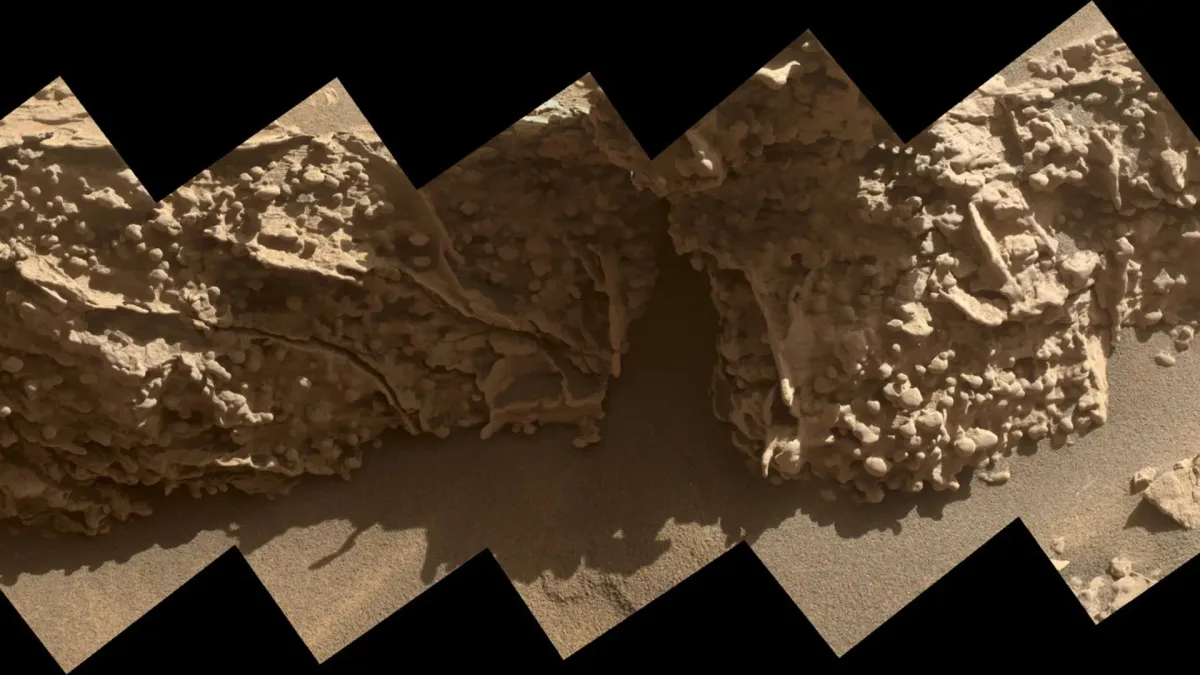
The rover also found small, bumpy structures called nodules. These textures are often linked to ancient groundwater activity. Curiosity and other Mars missions have seen them before. Surprisingly, these nodules were not near the central fractures. Instead, they appeared along the sides of the ridges and in the sandy hollows between them.
Seeger said they can't quite explain why the nodules appear where they do. She suggested the ridges might have been cemented by minerals first. Then, later groundwater episodes left nodules around them.
Curiosity: A Mobile Chemistry Lab
A key part of Curiosity's mission is collecting rock samples. It uses a drill on its robotic arm to grind rock into powder. This powder is then analyzed by instruments inside the rover.
Last year, scientists analyzed three samples from the boxwork region. One was from a ridge top, another from bedrock in a hollow, and a third from an area Curiosity passed through earlier. Using X-ray analysis and a high-temperature oven, the rover found clay minerals in the ridge and carbonate minerals in the hollow. These findings offer more clues about how this unusual terrain formed.
More recently, the rover collected a fourth sample for a special analysis. After heating the powdered rock, chemical reagents were added for "wet chemistry." This method helps reveal certain organic compounds, which are carbon-based molecules important for life's chemistry.
Continuing the Search for Mars' Climate History
Curiosity is expected to leave the boxwork region in March. This area is within a layer of Mount Sharp rich in salty minerals called sulfates. These minerals formed as water on Mars slowly disappeared.
Over the next year, the rover will continue through this sulfate-rich layer. It will gather new clues about how the climate of ancient Mars changed billions of years ago.
Deep Dive & References: NASA’s Curiosity rover investigates strange spiderweb ridges on Mars - ScienceDaily, 2026